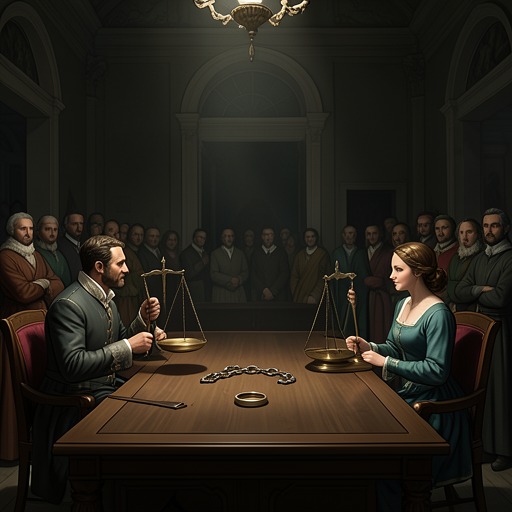
The marriage of Palamon and Emily
The Canterbury TalesThe marriage of Palamon and Emily is the decisive act of reconciliation at the end of their rivalry. After love, imprisonment, combat, and the death of Arcite have made Emily the center of a struggle between two knights, Theseus arranges for Palamon to receive her hand. The wedding transforms a conflict that had been governed by force and chance into a legitimate social and sacred bond, witnessed by the council and the baronage and presented as an answer granted by God.
Causes and Background
The marriage emerges from a prolonged struggle over Emily rather than from an isolated declaration of affection. Palamon and Arcite, both associated with Thebes, had become rivals for her love, and their contest placed personal desire inside a larger structure of chivalric violence. Arcite’s death removes the immediate obstacle, but it does not by itself establish Palamon’s right to marry Emily. The concluding union therefore requires a public decision that can convert victory and survival into lawful recognition.
That decision belongs to Theseus. In addressing Emily, he explains that he has considered how best to relieve the greatest sorrow present among them and has acted with the advice of his parliament. His intervention gives the marriage a political as well as personal foundation: Emily’s future is not left to private passion or the arbitrary aftermath of combat, but is settled by the ruler and his advisers. Theseus also presents mercy as superior to social rank, declaring that he would continue to regard Palamon favorably because mercy should transcend one’s social station.
The Ceremony and Public Legitimization
Theseus then addresses Palamon directly and treats further persuasion as unnecessary. He tells him to come forward and take Emily by the hand. The gesture is simple, but it marks the passage from disputed desire to recognized commitment. Palamon’s taking of Emily’s hand is immediately followed by their joining in the grand and holy union known as marriage.
The ceremony occurs before the council and the baronage. Its witnesses matter because the union is not merely emotional or domestic; it is publicly authorized within the political order that has governed the preceding conflict. The wedding gathers together the institutions that can make the relationship durable: Theseus’s authority, the council’s presence, the baronage’s recognition, and the sacred status of marriage itself. The violence of rivalry is thus answered by a ritual of lawful incorporation.
Resolution and Prosperity
The narrator describes the wedding as taking place amid bliss and melody, and states that Palamon has been wed to Emily. The atmosphere reverses the grief and danger that have surrounded the lovers’ story. The marriage does not simply reward Palamon with possession of the woman for whom he fought; it gives the entire narrative a settled form in which love can exist without further contest.
The consequences are material as well as emotional. Palamon possesses wealth and is able to live in bliss, richness, and health. Prosperity here functions as evidence that the reversal has been completed: the knight who had been exposed to confinement, rivalry, and the uncertainty of combat now occupies a secure life. The ending links marital fulfillment with social and economic stability rather than treating love as an experience detached from worldly conditions.
Emily’s response confirms that the union is reciprocal. She loves Palamon tenderly, and the narrator emphasizes that no word passes between husband and wife in jealousy or strife. The absence of quarrel is not a minor domestic detail; it is the final negation of the rivalry that once made their relationship impossible. The marriage settles not only who will be with Emily, but also what kind of emotional order will govern the household.
Narrative Significance
The event completes a pattern in which crisis is resolved through public ritual. Elsewhere in the book, departure begins with pilgrimage, prayer gives form to fear, and marriage can be solemnized as a sacred act. In this case, the wedding performs the final transition from violence to community: the combatants’ world is reorganized through a ceremony that binds personal desire to political witness and religious legitimacy.
The marriage also clarifies the narrative’s treatment of fortune and providence. Palamon’s success is not represented as the simple mechanical result of superior strength. Theseus’s judgment, the public ceremony, and the narrator’s appeal to God together frame the union as an outcome that has been brought into moral and social order. The closing prayer that God save the company gives the conclusion the character of a communal benediction.
The story therefore ends with reconciliation rather than with the triumph of one rival over another. Arcite’s death remains the cost at the edge of the marriage, but the final emphasis falls on the peaceful life that follows. Palamon and Emily’s union turns the unstable energy of courtly love and chivalric competition into marriage, wealth, tenderness, and freedom from strife. In that sense, the wedding is both the plot’s resolution and its governing image of social restoration.