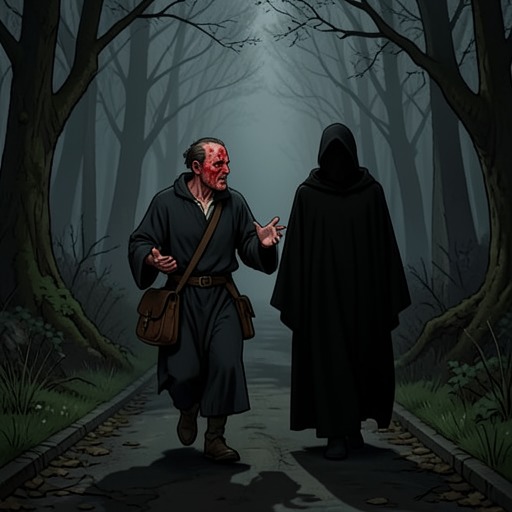
The pact between the Summoner and the Devil
The Canterbury TalesThe pact between the Summoner and the Devil is the decisive transaction in which the Summoner’s worldly extortion is answered by supernatural retribution. A ride made for profit brings the corrupt officer into partnership with a disguised fiend, and their apparently practical agreement ends with the Summoner being carried bodily and spiritually to hell. The episode converts an ordinary abuse of authority into a moral exemplum: the man who treats other people’s property as his own discovers that he, too, can be claimed as property.
Occasion and Participants
The pact arises when the Summoner rides out to summon an old widowed hag. The journey is not presented as an act of public service detached from personal interest; the narrator emphasizes the Summoner’s appetite for gain and the way his intentions are turned toward what he may extract. The encounter therefore begins in an atmosphere of economic predation. The widow is poor and vulnerable, while the Summoner possesses the institutional power to threaten her with legal or ecclesiastical trouble.
The second rider appears as a yeoman, but his manner contains a warning. While the Summoner speaks with satisfaction at having met a companion, the yeoman carries a small smile. When asked to reveal his name, he answers that he is a fiend whose dwelling is in hell and that he rides about soliciting. The revelation identifies him not as an ordinary traveling partner but as the supernatural counterpart of the Summoner: both solicit, both seek advantage, and both operate by turning other people’s fear into income.
Terms of the Bargain
The two men agree to divide whatever either obtains, with each expected to be truthful and to share with his brother if one has more than the other. The Devil grants the arrangement in faith, and they continue toward the town. The language resembles a commercial partnership, but its apparent fairness conceals a profound asymmetry. The Summoner imagines that he has acquired a profitable associate; the Devil has acquired a participant whose own methods will supply the conditions of his punishment.
The agreement also gives the episode its central irony. The Summoner’s profession depends on compelled payment, intimidation, and the conversion of authority into private wealth. Yet he accepts a reciprocal rule of division when it is offered by a stranger. His willingness to enter the pact reveals that greed has made him careless about the nature of the partner and the meaning of the terms. The bargain is not merely an exchange of money; it is a verbal commitment that prepares the transfer of the Summoner himself.
The Widow’s Curse
The pact is activated by the confrontation with the widow. The available scene presents her kneeling and cursing the Summoner, calling upon the Devil to take both his body and the pan from her. Her words join an immediate object of dispute to the larger moral demand. The pan represents the tangible property the Summoner seeks, while the curse names the ultimate consequence of his attempt to seize it. Her speech is therefore both protest and judgment.
The Devil does not treat the curse as empty anger. He addresses the Summoner as a brother and explains that the Summoner’s body and the pan are his by right. The word “brother” is the bitter completion of the earlier agreement: the Summoner entered a partnership in which the Devil was to share what was obtained, and the Devil now interprets the bargain according to its most terrible possible meaning. The contract’s commercial vocabulary becomes the language of damnation.
Damnation and Aftermath
The Devil tells the Summoner that he will go to hell that very night, where he will be more deeply admitted to their fellowship than any master of divinity. The comparison is sharply satirical. The Summoner has abused religious and legal mechanisms while lacking the spiritual authority associated with learned theology; the Devil’s promise offers him a final, grotesque membership in a community whose intimacy is not salvation but punishment.
The conclusion is swift and physical. The fiend grabs the Summoner, spends no further words, and carries away both body and soul. The ending denies the Summoner the possibility of bargaining, appeal, or escape. His earlier confidence in solicitation and collection collapses into helpless possession: the officer who came to take another person’s goods is himself taken.
Moral and Narrative Significance
The event functions as a compact satire of clerical corruption, avarice, and predatory authority. It exposes a reversal between the Summoner and the Devil: the human agent is already devilish in conduct, while the supernatural Devil merely makes the hidden logic of that conduct visible. Their pact thus does not introduce corruption into an innocent world; it gives corruption a literal partner and an exact consequence.
The scene also relies on the force of speech. The Devil’s disclosure, the agreement to share, the widow’s curse, and the final claim of ownership all alter the practical situation. Words first create a partnership, then invoke judgment, and finally authorize seizure. The episode’s moral structure depends on the fact that promises and curses are not ornamental language: spoken commitments produce material consequences.
Placed within the wider pilgrimage framework, the pact is one of the tales’ clearest moral exempla. The pilgrims begin by setting out on pilgrimage toward distant shrines, a movement associated with spiritual purpose and travel beyond ordinary life. Against that frame, the Summoner’s ride is a corrupt parody of a journey: he travels not toward devotion but toward private profit, and his companion is not a fellow pilgrim but a fiend. The result is a dark counterimage of pilgrimage, in which the road leads not to a shrine or renewed community but to hell.