The philosopher’s stone
The Canterbury TalesThe philosopher’s stone is the object at the center of the alchemists’ hope: an elusive substance, also called the elixir, imagined as a means of securing safety and relief. Its decisive significance lies in the contradiction it creates between promise and result. The search keeps desire alive even as the work consumes money, labor, and peace of mind, while the narrative finally turns that failed pursuit into a moral warning against challenging God’s will.
Definition and Promise
The alchemists identify The philosopher’s stone with the “Elixir,” presenting it as the goal for which their art and equipment are employed. Possession of it would leave them “safe and sound,” so the object is valued not merely as a material discovery but as a guarantee against insecurity and suffering. The promise therefore gives the search an almost salvific force: the stone appears capable of transforming uncertain human existence into lasting relief.
That promise remains powerful precisely because it is never fulfilled. The alchemists continue to imagine that the substance will eventually be found, even while their efforts bring pain and financial loss. Their hope is not extinguished by failure; instead, it repeatedly creeps back into their hearts. The stone thus operates as an object of deferred fulfillment, kept alive by expectation rather than confirmed by possession.
The Cost of the Search
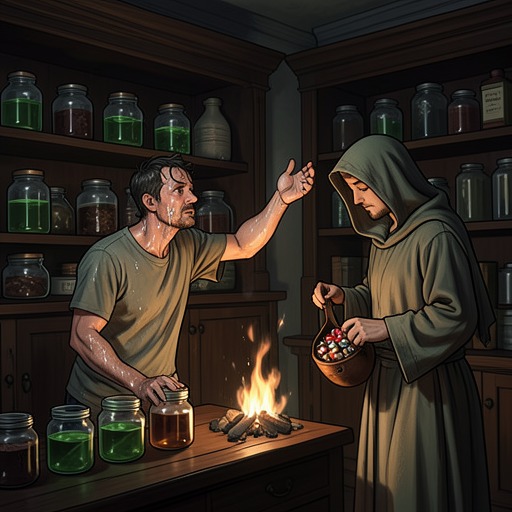
The pursuit requires “all our craft and all our tricky gear,” but when the work is finished, The philosopher’s stone still does not appear. The contrast between elaborate means and absent result makes the object’s material status unstable: the alchemists treat it as though it were obtainable, yet their instruments produce no decisive evidence of its presence. What should be the culmination of practical knowledge becomes a repeated confrontation with failure.
The financial consequences are explicit. The search has made the alchemists spend much money, and their disappointment is described as a source of sorrow that has driven them nearly mad. The stone therefore exerts a practical power even without appearing. It directs expenditure, sustains exhausting labor, and shapes the emotional condition of those who seek it. Its absence is not passive; it organizes the whole cycle of effort, loss, and renewed expectation.
Authority and Secrecy
The narrator frames the discussion through the testimony of philosophers and books. He announces that he will report what philosophers have said about the art, then invokes Arnold of New Town and his Rosarium. The cited maxim states, “No man can mercury transmogrify / Without its brother knowing.” The saying presents the work as governed by hidden correspondences and guarded technical knowledge, with Hermes named as the father of philosophers. The stone consequently belongs to a tradition that claims authority through obscure learning, inherited names, and difficult doctrine.
The question of its name intensifies that atmosphere of secrecy. A philosophical inquiry asks, “What is the name of that most secret stone?” and Plato answers, “As Titan it is known.” The exchange suggests that the object is surrounded by aliases rather than clarified by a single transparent designation. Naming becomes part of the mystery: each additional title appears to promise access while preserving concealment.
Divine Limit and Final Warning
The narrator ultimately refuses to treat the stone as knowledge that human beings may legitimately force into view. God, he says, does not will that philosophers declare how The philosopher’s stone may be found. The failure of alchemy is therefore interpreted within a theological boundary: the secret remains withheld not simply because the searchers have not worked hard enough, but because divine providence has not granted the knowledge.
The concluding advice is direct: it is best to leave the stone alone. Anyone who would make God an adversary by doing work contrary to divine will risks turning intellectual ambition into spiritual rebellion. The object’s narrative function consequently changes. At first it is the promised source of safety; by the end it is a test of human restraint. The alchemists’ hope, spending, sorrow, and near-madness demonstrate the danger of allowing an invisible promise to govern visible life, while the stone’s continued absence confirms the limits imposed on human craft.