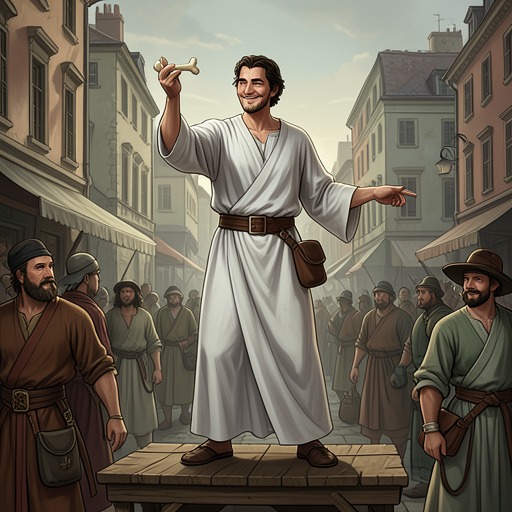
The three rioters seek Death
The Canterbury TalesThe three rioters seek Death in a tavern-born quest that exposes the fatal gap between violent words and moral understanding. After hearing that a former comrade has been slain by Death while drunk, they swear to find and kill the invisible adversary before nightfall. Their pledge sounds like brotherhood, but it is driven by drunkenness, bravado, and a desire to master the very power they fear. The quest therefore becomes the opening act of their own destruction and prepares the tale’s condemnation of avarice.
The Tavern and the News of Death
The episode begins before nine o’clock, with the three young revelers seated together in a tavern and drinking. Their setting matters because the quest does not arise from sober reflection or a defensible obligation. It grows out of communal revelry, intoxication, and the loose confidence produced by drink. The tavern gives them a temporary world in which loud declarations appear to carry the force of action.
A report interrupts that atmosphere. The men are told that, two hours earlier, their old comrade had been found slain at night. He had been sitting drunk and upright when a stealthy thief known as Death came upon him. Death is presented through the language of robbery and ambush: a hidden taker who steals a human life suddenly, without granting the victim time to prepare. The news changes the value at stake from pleasure to mortality, but the rioters do not respond with grief, repentance, or caution. They convert fear into aggression.
The Oath to Find and Kill Death
One rioter asks whether Death is so perilous to meet and declares that he will seek him in the by-ways and the street. The question is less an inquiry than a provocation. By speaking as though Death were an ordinary enemy who could be tracked down, confronted, and defeated, he reduces an ultimate condition of life to the scale of a tavern quarrel.
The three then raise their hands to one another and agree to become brothers. They announce that they will do away with the false traitor Death, whom they call the slayer of so many, and that they will slay him before nightfall. Their language performs a pledge: the words create an immediate bond and assign the group a shared purpose. Yet the oath is also internally unstable. Death is called a traitor, although he has not broken a personal agreement with them, and the men claim the authority to kill the universal slayer without knowing where or how such an encounter could occur.
Together they seal the pledge to live and die for one another as though they had been naturally born brothers. The formula presents solidarity as an absolute safeguard, but the surrounding circumstances expose its weakness. Their brotherhood is made in a moment of drink and excitement, not tested through patience, sacrifice, or responsibility. The vow binds them rhetorically while their conduct soon reveals that their fellowship is subordinate to personal appetite.
Quest as Misrecognition
The quest has the outward shape of an adventure: three companions depart with a clear enemy and a fixed deadline. Its substance is the opposite. They do not discover a path toward mastery over death; they misrecognize the object of their search and mistake moral danger for an external opponent. The language of pursuit lets them avoid the harder recognition that the report of their companion’s death should impose limits on their own behavior.
The oath also creates dramatic irony. The rioters intend to hunt Death, yet their first decisive action is to swear an extravagant promise while drinking. Their stated aim is to end the power that kills men, but their actual path begins with the habits that make them vulnerable to ruin. The pledge to live and die together sounds noble only until it is measured against the motives and choices that surround it. The words promise mutual fidelity; the quest places that fidelity under the pressure of greed.
In this sense, the event joins a quest plot to a moral exemplum. The men are active rather than helpless: they choose a goal, make a public commitment, and set a time limit. Their freedom intensifies the warning. The catastrophe that follows is not presented as an arbitrary punishment falling on innocent travelers, but as the consequence of a self-chosen pursuit formed by drunken confidence and defective judgment.
A Prelude to Avarice and Self-Destruction
The quest’s most important consequence is structural. It moves the tale from the death of the unnamed comrade to the larger revelation of how the three rioters will destroy one another. Their search appears directed outward toward Death, but it guides them toward a material temptation that tests the oath they have just made. The promise of brotherhood thus becomes an instrument of irony: the closer they come to what they desire, the less reliable their sworn fellowship proves.
The tale’s moral voice later asks God to forgive the trespass of such men and to guard others from the sin of avarice. That warning gives the oath its final interpretive frame. The rioters’ failure is not merely that they confront an unbeatable enemy. They are corrupted by the desire to possess, and their grand declaration against Death cannot protect them from the inward force that turns companion against companion. Their language of brotherhood is therefore remembered alongside the sin it cannot restrain.
Narrative Significance
The three rioters seek Death is the initiating action of a tightly constructed moral narrative. It establishes the men’s social identity as young revelers, introduces the report of their comrade’s sudden killing, converts fear into a public oath, and sets the deadline that drives the action forward. The event’s decisive reversal lies in its premise: the men believe they are beginning a hunt, while the narrative has already begun arranging their downfall.
As a scene of speech becoming action, the episode shows both the force and the emptiness of performative language. Raising hands and calling one another brothers makes the pledge socially real, but it does not make the speakers virtuous or guarantee that the promise will survive temptation. The quest consequently stands as a compact demonstration of the tale’s moral logic: bravado can disguise fear, fellowship can conceal rivalry, and a vow aimed at defeating Death can become the first step toward death through avarice.