The three rioters' deaths
The Canterbury TalesThe three rioters’ deaths are the decisive outcome of a quest corrupted by avarice. Three young men begin in a tavern, drinking before the day is far advanced, and respond to news of a companion’s death by swearing to seek Death and destroy him. Their search appears to promise fellowship and vengeance, but the discovery of gold beneath a tree turns the quest inward. The men who set out together become conspirators against one another, and all three die through the very greed, false oaths, and violence that they intended to direct against an external enemy.
Causes and Background
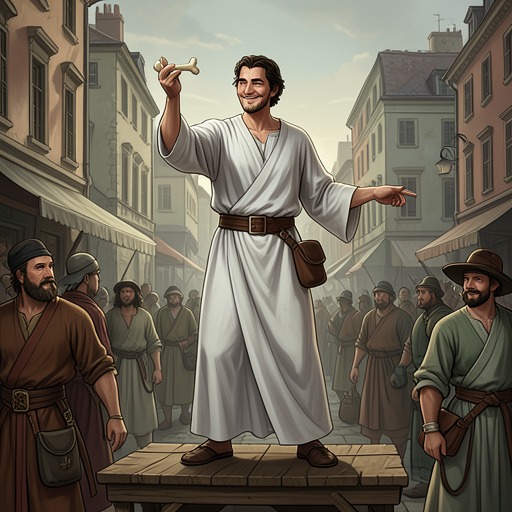
The episode begins with the rioters in a tavern, already defined by revelry, drunkenness, and reckless speech. They hear of a fellow reveler who has died, and the news is treated not as a summons to mourning but as a challenge. One rioter declares that Death is a perilous enemy and announces that he will seek him in the by-ways and streets. The vow gives the group a shared objective: they will find Death and kill him, as though mortality were a person who could be hunted down and overcome.
Their language creates an appearance of solidarity, but it also exposes the instability of their fellowship. They appeal to oaths and masculine bravado, yet the enterprise rests on anger, intoxication, and a refusal to accept death as a universal condition. The quest therefore carries a built-in reversal. The men imagine themselves as avengers pursuing a named foe; in practice, the danger will arise from their own conduct and from the desires released by sudden wealth.
The Discovery Beneath the Tree
The rioters encounter an aged man, who directs them toward a tree. When each reaches it, the men find florins beneath its branches, coined gold that is described as fine, round, and newly bright. The object of their search changes immediately. Instead of finding Death, they find treasure; instead of confronting a single enemy, they face the temptation of dividing wealth among themselves.
The treasure first seems to offer a shared escape from their ordinary condition. They agree to carry it away at night, when the movement of the gold can be made safer and less visible. A drawing of lots is arranged to decide who will go into town for provisions. The youngest is selected, and the apparently fair procedure divides their tasks while leaving their common possession intact. Yet the formal act of drawing lots also marks the moment when cooperation becomes calculation: each man’s share, risk, and opportunity can now be measured against the others.
Treachery and Poison
Once the youngest has gone to town, the remaining two decide to betray and kill him. Their reasoning is brutally simple: two men are stronger than one, and the treasure will be divided between fewer owners. Their agreement transforms the discovery into a murder plot. The oath they had used to establish fellowship is now replaced by a private conspiracy, showing how quickly their public language of loyalty gives way to self-interest.
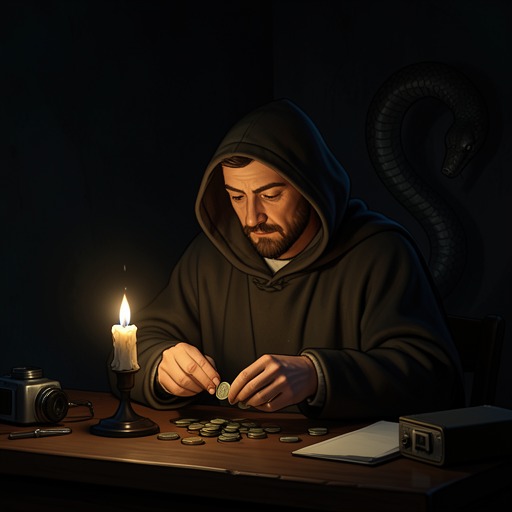
The youngest, meanwhile, is also changed by the gold. As he travels, he imagines the beauty of the new florins and devises a plan to possess them alone. He buys poison and fills three bottles with wine, intending to kill both companions when he returns. The plot thus becomes triangular rather than merely oppositional: the two older rioters prepare to murder the youngest, while the youngest independently prepares to poison them. Each participant believes that deception will secure his private gain.
The convergence of the plots is almost mechanical. The youngest returns with the wine, and the two conspirators carry out the murder they had already planned, killing him on the spot. They then propose to sit and drink and afterward bury his body. Their attempt to convert homicide into a moment of celebration reveals the moral emptiness of the group: even at the point of triumph, their fellowship is only a cover for possession.
The Final Reversal
The surviving two drink from the bottles prepared by the man they have just killed. One takes the poisoned bottle and drinks, then gives some of the wine to his companion. The poison therefore completes the youngest rioter’s revenge after his death, though the result is not justice in any humane sense. The two killers suffer the symptoms of poisoning and die as well. The episode closes by making the causal symmetry explicit: the two men who committed homicide meet homicide, and the false poisoner also perishes.
The treasure never becomes a means of prosperity. It functions instead as a test that exposes the men’s character and converts potential companionship into mutual destruction. The promised reward remains at the center of the scene, but none of the rioters can possess it. Their deaths leave the gold as a silent measure of the distance between desire and fulfillment: they kill for wealth, yet their greed prevents any of them from enjoying what they sought.
Moral and Narrative Significance
The event is a compact moral exemplum built on a sequence of value reversals. A shared quest becomes rivalry; the expectation of vengeance becomes the discovery of treasure; the expectation of enrichment becomes murder; and the expectation that murder will secure the future becomes death for all three. The episode’s power comes from the fact that no outside executioner is required. The rioters’ own vows, plans, and appetites produce the ending.
Its structure also turns speech into action. A boast about seeking Death initiates the quest, an oath binds the conspirators, an agreement to drink disguises the completed murder, and the poisoned wine fulfills a plan that its author never lives to witness. Words promise fellowship or conceal violence, but their consequences reveal the speakers’ real commitments. The repeated reliance on oaths is especially ironic because the men treat sworn language as a guarantee while continually preparing to violate it.
The deaths therefore embody the proverb-like logic of moral consequence associated with the tale. The rioters do not merely encounter death; they manufacture the conditions of their own destruction while pursuing it. Their drunken beginning, their fixation on gold, their betrayal of the youngest, and the poison hidden in the wine form one unbroken chain. The episode’s ending is not an accidental catastrophe but the completed shape of its central lesson: greed turns companions into enemies, and violence returns upon those who believe they can use it without becoming its victims.