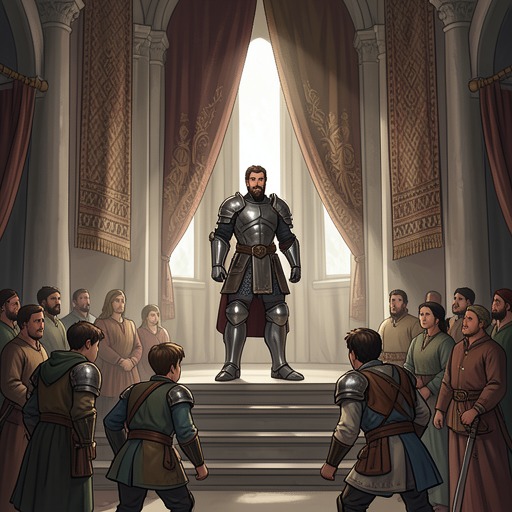
The tournament for Emily
The Canterbury TalesThe tournament for Emily is Theseus’s elaborate answer to the dangerous rivalry between Palamon and Arcite. Rather than allow the two Theban knights to continue fighting outside law, he authorizes a public contest in which each must return with one hundred armed knights and contend for Emily under recognized rules. The event transforms a private struggle over love into a civic ritual, but its apparent fairness does not produce a simple human victory: Arcite wins the field, then dies, leaving the tournament’s meaning suspended between martial glory, tragic loss, and the eventual reordering of love and marriage.
Causes and Background
The tournament arises from the conflict between Palamon and Arcite, whose desire for Emily has made them rivals despite their earlier bond. Theseus’s solution is both practical and ceremonial. He permits each knight to leave and return with one hundred knights, giving the contest a fixed scale, a public audience, and a definite deadline: after fifty weeks, each side must appear armed for the lists. The arrangement replaces uncontrolled vengeance with an authorized test of strength, while preserving the central prize of Emily as the object around which the rivalry turns.
The returning day therefore carries the pressure of an appointment already proclaimed. Palamon and Arcite are not merely arriving for an ordinary battle; they are fulfilling the terms imposed by Theseus, whose authority determines when private passion may become public combat. The event belongs to the wider world of pilgrimage and formal departure as well: people set out toward distant shrines, while these knights depart and return according to a political and martial promise. In both cases, movement is given meaning by an organized destination, but the knights’ destination is a field where love will be measured through violence.
Before the fighting, Palamon and Arcite turn to the gods, making the contest a religious as well as military undertaking. Palamon prays to Mars, the god of strength honored in Thrace and across many lands. His prayer places the coming struggle under divine scrutiny and aligns his cause with the power of war. The tournament thus begins before the first charge: its competing claims have already been translated into vows, petitions, banners, and ritual expectation.
Rules and Public Order
Theseus’s intervention is explicitly motivated by the danger of wasting noble blood. Through his spokesman, the duke declares that it would be a desolation of gentle blood to let the enterprise proceed as unrestricted slaughter. The tournament is therefore a controlled form of conflict, not an invitation to annihilation. Its rules seek to preserve the dignity of the participants while still allowing the rivalry to reach a decisive conclusion.
The structure makes Theseus both judge and stage-manager. He determines the conditions, receives the assembled forces, and remains responsible for stopping the combat when its limits have been reached. The contest gathers noble warriors, spectators, and women of rank into a single ceremonial space. What began as the emotional fixation of two men becomes a matter watched and interpreted by a whole social order.
That public framework also changes the meaning of victory. A knight’s success is no longer simply the result of a secret encounter or an unauthorized ambush. It is witnessed, measured, and confirmed by the authority that created the contest. Yet the rules do not remove suffering. They regulate violence without abolishing it, making the tournament an image of a society that can civilize conflict only by giving conflict a lawful form.
Course of the Combat
Arcite enters through the western gates under Mars the Red, leading his hundred men beneath a bright red banner in the sun. The color and the martial association announce the character of his challenge before the fighting begins. His entrance gives visible form to the force he has invoked in prayer: disciplined, public, and prepared for war.
The two forces clash repeatedly, and the contest becomes especially intense when Palamon and Arcite meet. Their rivalry is not settled by a single exchange. They repeatedly strike one another and inflict pain, and each has twice unhorsed the other. The repeated reversals make the combat a contest between matched opponents rather than an effortless triumph by one side. Every fall is a temporary assertion of superiority, and every recovery renews the uncertainty surrounding Emily’s fate.
Theseus periodically orders the combatants to rest, refresh themselves, and drink if they request it. This detail reveals the tournament’s unusual combination of ferocity and supervision. The fighters are allowed to exhaust themselves in rivalry, but they are not abandoned to chaos. Their bodies remain subject to the duke’s regulation, and the pauses preserve the contest as a bounded event rather than an uncontrolled massacre.
The decisive interruption comes when Theseus witnesses the condition of the fighting. He cries for the combatants to hear him and declares that no more fighting is to continue. His command closes the physical struggle at the moment when the spectacle has reached its limit. The value at stake has shifted: what began as a contest for love and honor has become so costly that continued combat would threaten the very noble order the rules were intended to protect.
Victory, Death, and Aftermath
Arcite is recognized as the victor of the tournament, but the victory does not deliver him into marriage with Emily. His martial success is immediately shadowed by death, producing the event’s central reversal. The knight who prevails in the field cannot possess the future that victory seemed to promise. His triumph is therefore real in public terms and disastrous in personal terms.
The aftermath turns from combat to commemoration. Theseus takes the greatest care to find a proper setting for Arcite’s sepulchre, seeking a place where the dead knight can be honored and where the living may find some comfort rather than remain wholly overcome by grief. The burial setting gives the tournament a second ritual phase. The field of competition, marked by banners and repeated falls, is followed by a place of remembrance in which Arcite’s identity is preserved through ceremony.
Arcite’s death also changes the relation between victory and inheritance. The tournament has resolved the question of immediate martial superiority, but it has not resolved the emotional and social consequences of the rivalry. The winner’s death leaves Palamon and Emily’s future to be determined after the contest, so the event functions as a hinge: it ends the rivalry as a physical struggle while opening the path toward the marriage that follows.
Narrative Significance
The tournament’s deepest irony lies in the gap between the result the participants seek and the result they receive. Palamon and Arcite enter to win Emily through arms; Arcite wins the arms but loses life, while the contest’s final human arrangement emerges only after his removal. The event therefore tests the limits of chivalric agency. Courage, endurance, prayer, and victory all matter, but none gives the combatant complete control over the outcome.
Its ceremonial pattern connects combat with other rites of passage in the larger narrative. Departure, return, prayer, public judgment, regulated ordeal, and burial form a sequence in which identity is repeatedly exposed and reordered. The tournament begins with competing claims and ends with a public command to stop, followed by a sepulchre intended to transform grief into remembrance. Violence is not erased; it is enclosed within ritual and then interpreted through mourning.
The tournament also makes Theseus’s authority visible in its fullest form. He permits the rivalry, defines its conditions, supervises its progress, and ends it by command. His rule does not prevent tragedy, but it prevents the tragedy from becoming endless. In that sense, the event’s decisive significance is not merely that one knight defeats another. It demonstrates how public order can contain private passion, even though the containment itself cannot shield the lovers from death, loss, or the unpredictable turn of fortune.