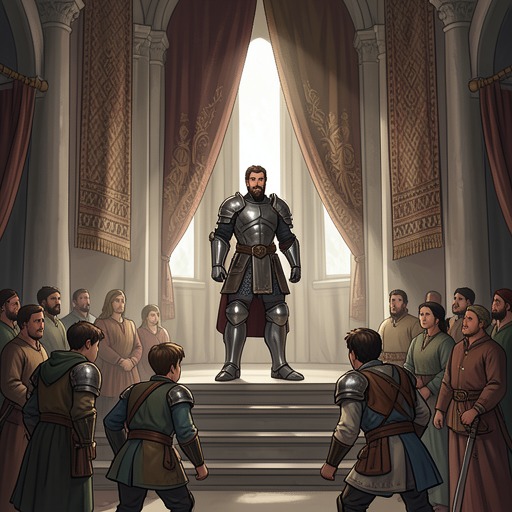
Theseus
The Canterbury TalesTheseus, duke and governor of Athens, is the governing presence of The Knight’s Tale: a ruler whose authority reaches from the battlefield and the road to the formal settlement of love, imprisonment, and rivalry. His decisive significance lies in the combination of pity and command. He can be moved almost to the breaking point by the grief of the defeated, yet he can also place himself physically between armed enemies and end their violence by an order that admits no further protest.
Identity and Introduction
The tale introduces Theseus as the lord and governor of Athens, placing him at the summit of both political and military authority. He is not presented first as a private lover or an isolated adventurer, but as a duke whose public role determines the shape of the surrounding action. His identity therefore supplies the tale with a center of judgment: the conflicts of other people become matters that his authority must hear, interpret, and finally regulate.
His power is established through movement as well as title. When he encounters two wretched men pleading for mercy, Theseus dismounts at once. The gesture matters because it temporarily lowers the distance between ruler and sufferers: rather than remaining elevated and remote, he comes down to meet their grief. The narrator emphasizes that he does so with a pitying heart and that their words affect him so deeply that he feels his heart is nearly broken. Theseus’s first defining quality is thus not hardness but responsiveness to distress.
Mercy and the Recognition of Suffering
Theseus’s pity is active rather than merely emotional. The men’s appeal reaches him as a human claim, and his immediate dismounting shows that he treats their misery as requiring personal attention. His compassion also gives his later authority a moral foundation. He is not simply a force capable of suppressing disorder; he is a ruler who has first allowed the suffering behind the disorder to become visible.
That response creates a contrast between social rank and human need. Theseus is a duke, while the men before him are described as wretched, yet their lower condition does not make their grief negligible. His pity crosses the boundary that separates governor from supplicant. The episode presents mercy as a form of judgment: before deciding what should happen, Theseus listens to the pain that has brought the petitioners before him.
Martial Intervention and Public Order
Theseus’s compassion does not make him passive. At another moment he sees two formidable figures engaged in combat, each strong enough to fell an oak, while he does not yet know who they are. He immediately spurs his horse toward them and places himself between the two. The action is both tactical and symbolic. He does not wait for the fighters to exhaust themselves, nor does he remain outside the danger while issuing an abstract command. He enters the space of conflict and physically interrupts it.
Having drawn his sword, Theseus orders them to halt. The brevity of the command gives it the force of sovereign speech: violence is stopped because the duke has made himself the visible boundary of what may continue. His sword and his voice work together. The sword demonstrates that he possesses the strength required to enforce order, while the command translates that strength into law rather than uncontrolled retaliation.
Decree and Conflict Resolution
Theseus later announces that he has devised a will intended to conclude the matter once and for all. His formulation presents the decision as final and deliberately closes the way to protest. He allows the parties to make the best of the settlement if they accept it, but the structure of the declaration makes clear that private preference cannot indefinitely prolong the dispute. The duke’s role is to transform an unresolved conflict into a rule that everyone must inhabit.
His settlement is therefore a political answer to a conflict that might otherwise remain personal and destructive. The language of conclusion, finality, and the exclusion of protest shows Theseus acting as a legislator of human relations. He does not erase disagreement by pretending that it never existed; he contains it by imposing a form in which competing claims can be judged and brought to an end.
Relationship to Palamon and the Tale’s Moral Order
Theseus addresses Palamon directly when presenting the final terms of the settlement. He tells him that no sermon is needed to make him assent, implying that Palamon has already been brought to a point where the duke’s decision can be accepted without elaborate persuasion. This moment joins authority to consent: Theseus commands, but he also frames the outcome as something Palamon can recognize as reasonable.
The duke’s interaction with Palamon reveals a broader principle of his characterization. Theseus does not merely defeat opponents; he seeks an arrangement that can replace continuing hostility. His intervention redirects the energy of rivalry away from endless private combat and toward an acknowledged public resolution. In that sense, he is the agent through whom the tale’s competing desires become compatible with social order.
Narrative Role and Evaluation
Theseus functions as both participant and arbiter. He acts with the speed of a warrior when danger is immediate, yet his most important power is interpretive and judicial: he hears grief, recognizes the need for mercy, interrupts violence, and declares terms designed to end dispute. The tale’s political imagination depends on this double image. A ruler must be strong enough to stop force, but legitimate enough to make that interruption appear as justice rather than another act of force.
His characterization also organizes the tale’s movement from disorder toward settlement. The pitying dismount, the ride between the combatants, the drawn sword, and the final pronouncement form a sequence in which compassion and coercive power are not opposites. Theseus’s authority becomes credible because it is shown responding to suffering; his mercy becomes effective because it is backed by the capacity to command. He stands, consequently, as the figure who turns the passions and violence of private life into a public order capable of enduring beyond the immediate scene.