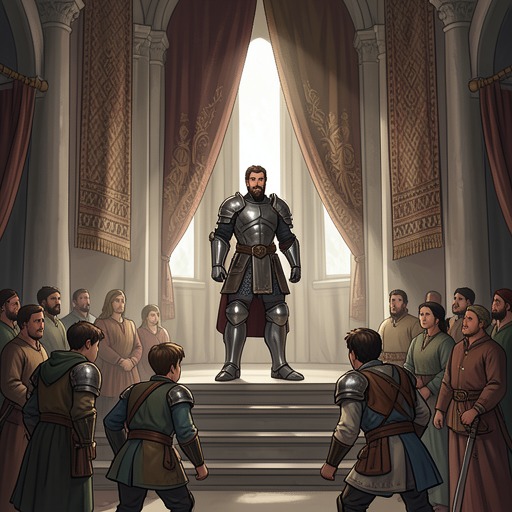
Theseus's tournament rules
The Canterbury TalesTheseus's tournament rules establish the legal and ceremonial framework for the great contest held for Emily. Their decisive purpose is to preserve the spectacle of mortal rivalry while preventing the aristocratic combatants from turning the event into uncontrolled slaughter: the contestants may fight fiercely, but the sovereign authority of Theseus places life, order, and final judgment above the immediate violence of the lists.
Public Proclamation and Authority
A herald announces the regulations from a scaffold, calling the assembled crowd to attention before Theseus's judgment is delivered. This public voice gives the rules a formal, collective force. The tournament is not a private feud between Palamon and Arcite, nor merely an eruption of personal jealousy; it is an authorized civic event whose conduct is explained before the spectators and contestants alike.
The rules also reveal Theseus's willingness to revise his earlier purpose. The participants are men of gentle blood who have entered the enterprise to fight a mortal battle for the prize, but Theseus changes the arrangement so that no one should die. The contest therefore retains the language of honor, courage, and combat while abandoning the most destructive consequence that its original form would have allowed. The modification is both practical and symbolic: noble status makes the fighters worthy of public recognition, but it also makes their needless death unacceptable within the ruler's ordered spectacle.
Weapons and Limits of Combat
The regulations distinguish between the appearance of full battle and the actual means permitted in the tournament. The combatants may use long swords and maces, preserving the weight and visibility of armed struggle, while the spear is restricted to a finely sharpened weapon used for no more than a single course. A rider may defend himself with the spear if he has been unhorsed, but the weapon is not authorized for repeated or unrestricted attack.
This limitation does not make the contest peaceful. The herald still commands the fighters to go forward and lay on, and the conclusion sends them into combat with swords and maces. The rules instead convert violence into a measured form. They leave room for courage, force, and reversal, yet impose boundaries that distinguish a tournament from an exterminating battle. The spectacle depends on this tension: the weapons must seem capable of real harm, while the regulations continually redirect that danger toward controlled competition.
Rescue, Capture, and the End of the Contest
The clearest safeguard concerns any combatant who falls into serious danger. Anyone in trouble is to be taken to a stake, one fighter from each side, and held there by force. The stake functions as a visible instrument of interruption: when a combatant can no longer safely continue, officials remove him from the immediate violence rather than allowing his opponent to complete a killing blow.
The rules also define a decisive condition for ending the tournament. If one of the chieftains is captured, or if one chieftain has slain his counterpart, the contest is over. The first condition makes capture a legitimate substitute for death; the second acknowledges the extreme outcome that the broader regulations seek to prevent. Victory therefore depends not only on striking an opponent but on the controlled status of the principal leaders. Once that status changes, continued combat loses its legal purpose.
Chivalric Order and Narrative Function
The regulations give Theseus's tournament a structure that contrasts with the passion driving the two rivals. Palamon and Arcite are bound to Emily by a conflict that began in imprisonment and rivalry, but the public contest places their private desire inside a system of witnesses, weapons, penalties, rescue, and sovereign command. Their emotions may be absolute; their fighting is not allowed to be.
The tournament also belongs to a wider ceremonial order in which departure, prayer, combat, and burial are carefully arranged. Before the contest, the warriors appeal to divine powers, including Mars, while Theseus remains responsible for arranging the setting and enforcing its earthly rules. After Arcite's death, Theseus takes the greatest care to provide a proper sepulchre, showing that the principle of ordered treatment extends beyond the fight itself. The rules thus connect the arena to the larger pattern of the tale: desire produces conflict, authority contains it as far as possible, and ritual seeks to give meaning to the losses that violence nevertheless causes.
The regulations do not abolish tragedy. They make the tournament safer than the mortal battle first proposed, but they cannot prevent Arcite's eventual death after his victory. Their importance lies precisely in that limitation. They demonstrate the power of human governance to restrain direct slaughter, while leaving larger forces—fortune, divine judgment, and the consequences of rivalry—to determine the final outcome. Theseus's tournament rules are therefore both instruments of fair play and evidence of the boundary between political order and the uncontrollable powers that shape the tale.