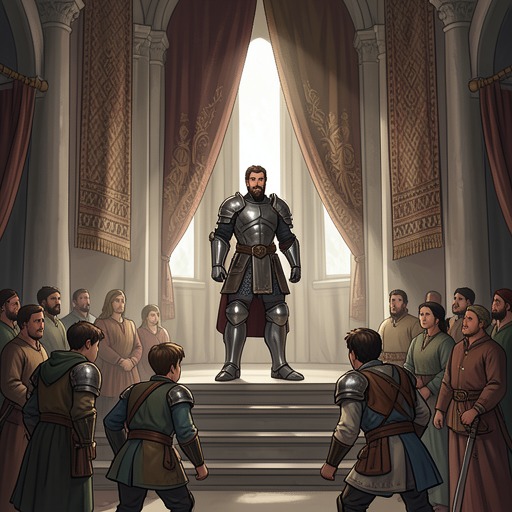
Theseus's vengeance against Creon
The Canterbury TalesTheseus's vengeance against Creon is the decisive military response to the suffering inflicted on the widows of Thebes. What begins as a public appeal by a group of bereaved women becomes a campaign of justice: Theseus converts their grief into an oath, carries that oath directly into war, and ends the episode by killing Creon, defeating his forces, destroying the city, and restoring the women whom Creon had wronged.
Causes and Moral Appeal
The campaign begins with a scene of mourning and supplication. One of the women identifies herself as the former wife of King Capaneus, who died at Thebes, and places the catastrophe under the sign of a cursed day. Her speech gives the military action a human and familial basis: the conflict is not introduced as an abstract rivalry between rulers, but through the visible grief of wives whose dead have been denied proper redress. The widows have already waited for a whole fortnight, and their prolonged waiting intensifies the urgency of their request for help.
Their appeal places Theseus before suffering that demands a response. He does not treat the women as incidental petitioners or postpone judgment while gathering political advantages. He takes them in his arms, consoles them, and promises, on his oath as a faithful knight, to do everything within his power against Creon's vengefulness. The oath binds his chivalric identity to action: compassion is immediately transformed into responsibility, and the honor of a knight is measured by whether a plea from the powerless produces concrete protection.
The March on Thebes
Theseus acts without delay. He displays his banner and rides toward Thebes with his entire host surrounding him, making the expedition a public and organized assertion of authority rather than a private act of retaliation. The speed of his departure shows that the widows' appeal has already settled the question of whether action is required; the narrative moves rapidly from mourning to mobilization, from the language of tears to the visible emblem of war.
The campaign's objective is equally direct. Theseus travels to Thebes to punish Creon for the treatment of the dead and their surviving women, and the approaching army gives physical form to the promise he has made. The banner, the host, and the destination together turn an ethical pledge into a political and military undertaking. Theseus is not merely avenging an insult to himself; he is presenting his intervention as the enforcement of justice against a tyrant.
Battle and Destruction
At Thebes, Theseus takes the field and fights Creon in open battle. The narrator emphasizes that he kills the Theban king in a manner befitting a knight and with conspicuous manliness. Creon's death therefore fulfills the central demand of the widows' petition: the ruler responsible for their suffering is defeated personally, not merely displaced by an unnamed military reversal.
Creon's army is put to flight immediately after his death. The victory then expands from the battlefield into the city itself, which Theseus wins by assault. He tears down its walls, beams, and rafters, presenting the destruction of Thebes as the material counterpart to the destruction of Creon's power. The campaign does not end with a change of ruler or a negotiated settlement. Its violence reaches the city's architecture, erasing the physical stronghold associated with the tyrant's rule.
Restoration and Narrative Significance
The episode closes by returning to the women whose grief began it. After conquering Thebes and demolishing the city, Theseus restores the ladies to the position from which Creon's violence had dispossessed them. Their restoration completes the movement from supplication to protection: the petitioners are no longer abandoned mourners waiting for aid, but survivors returned to safety through the fulfillment of Theseus's oath.
The campaign thus combines revenge, rescue, and the public testing of chivalric authority. Its value shift is stark: the widows move from prolonged helplessness toward restoration, while Creon moves from tyrannical command to death and his city from defended power to ruin. The narrative also establishes Theseus as a ruler whose legitimacy is demonstrated through responsiveness to the suffering of others. His vengeance is not presented as uncontrolled fury; it is framed by a witnessed appeal, a sworn promise, a swift campaign, and a final act of restitution.