Tragedy
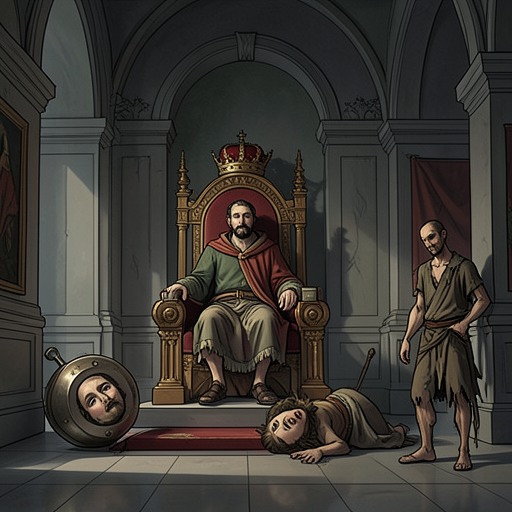
The Canterbury TalesTragedy is defined as the story of a person who once stood in great prosperity but then fell from a high degree into a wretched end. Its decisive subject is therefore not suffering alone, but reversal: the descent from eminence to misery, and the helplessness that follows when no remedy can restore the fallen. The form turns the instability of worldly success into a lesson preserved in narrative and verse.
Definition and Form
The narrator introduces tragedy as a specific kind of story recalled from old books. He distinguishes it from lighter or more pleasurable forms of tale by presenting it as an account of ruin, designed to make the audience hear and contemplate the harm suffered by those who occupied high positions. Tragedy is thus both a narrative category and a mode of emotional response: it tells of disaster and requires the teller to bewail it in a tragical manner.
The form depends on a sharp contrast between beginning and end. The central figure is first associated with prosperity, rank, power, or royal standing; the narrative then records a fall that converts public greatness into private woe. The movement is downward rather than restorative. The fallen person has no effective means of being brought out of adversity, so the story's completion lies not in recovery but in the full recognition of loss.
Fortune and Sudden Reversal
Tragedy is closely bound to the operation of Fortune. The narrator declares that Fortune may suddenly assail the kingdom of the proud, and that she is most likely to fail those who trust her. This makes the tragic fall appear both political and personal: a ruler may lose a kingdom, while an individual may lose security, status, or happiness through the same unstable power. Prosperity is therefore never presented as secure simply because it is great.
The image of Fortune is especially forceful because her blow is sudden. Tragedy does not merely describe a gradual decline produced by ordinary hardship; it dramatizes the shock of a reversal that exposes the weakness hidden beneath confidence. The proud kingdom is vulnerable precisely when its holders believe in Fortune's permanence. In this sense, tragedy teaches that worldly elevation contains the possibility of its opposite.
Examples of Fall and Lament
The narrator's tragic materials include the fate of Croesus, the proud king. His royal throne cannot save him, and he is hanged despite the dignity and authority that once surrounded him. The example condenses the tragic pattern into a single reversal: kingship promises extraordinary protection, yet the king's final condition demonstrates that rank offers no defence against Fortune's assault.
The broader collection of tragedies is described as containing many such cases, including a hundred tragedies held by the narrator for possible telling. He offers to recount these stories as they return to his remembrance, asking that any ignorance in his selection be excused. The remark presents tragedy as an inherited store of examples drawn from old books, while also emphasizing the act of recollection through which the narrator brings former catastrophes before a present audience.
Spiritual and Moral Perspective
Although tragedy records worldly collapse, the surrounding narrative places it beside religious suffering and providential deliverance. In the story of Constance, she crosses herself and prays to the cross of Christ when distress overwhelms her. Her ordeal includes separation, danger, and judgment, yet her suffering is framed through faith and prayer rather than as a final descent without remedy. The contrast clarifies the boundaries of the tragic mode: tragedy emphasizes irreversible worldly ruin, whereas saintly endurance can transform suffering into testimony and eventual salvation.
The same story also shows how the tragic pattern may be redirected. The constable and Hermengild begin as pagans, but Hermengild loves Constance deeply, and the household becomes a setting in which religious change and moral recognition can occur. At Constance's trial, a British book containing the Gospels is brought forward, and the accused woman is sworn guilty upon it; later events place this apparent judgment within a larger religious structure in which persecution does not have the final word. The movement from distress toward divine resolution differs sharply from the tragic fall of a proud ruler.
Narrative and Thematic Significance
Tragedy gives the work a language for thinking about the fragility of power. Its fallen figures are not merely unlucky individuals; their reversals reveal a general condition in which kingdoms, thrones, and human confidence remain exposed to forces they cannot command. The narrator's repeated attention to sudden loss turns isolated stories into a recurring demonstration of impermanence.
At the same time, tragedy is a form of moral witnessing. To tell the harm of those who rose high and fell without remedy is to preserve their downfall as warning and lament. The stories ask the audience to look beyond the surface splendour of prosperity and to measure greatness against its vulnerability. Their force lies in the unresolved contrast between exaltation and ruin: the higher the ascent, the more devastating the fall, and the more completely the narrative converts worldly glory into mournful knowledge.