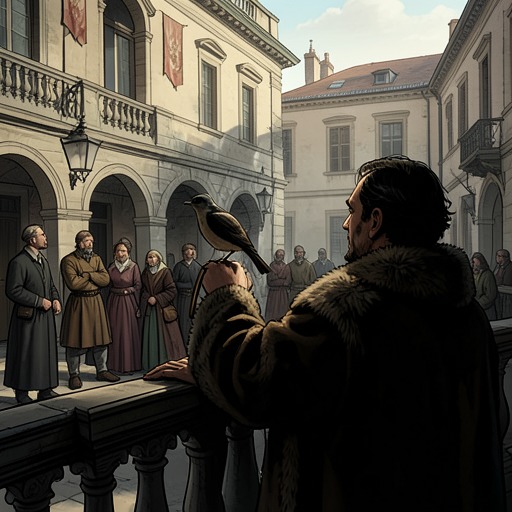
Walter's repudiation of Griselda
The Canterbury TalesWalter's repudiation of Griselda is the climactic public act in his campaign to test a wife's obedience: he disguises a private decision as a decree of the Church, announces a false divorce, and expels the woman who has given him her entire heart. The action turns marriage into a spectacle of authority, while Griselda's nearly wordless submission exposes the moral violence beneath Walter's claim to be testing virtue.
The Test Becomes a Public Sentence
Walter's purpose is not to reconcile with Griselda but to continue testing her. When their daughter reaches the age of twelve, he sends a legate to the court of Rome, whose will has already been communicated there, and prepares the political and religious appearance of legitimacy for what he intends to do. The timing makes the test more severe: the household has already endured earlier trials, yet Walter converts his wife's long obedience into a reason for imposing another ordeal.
The supposed divorce depends on counterfeit authority. Walter has people say that the pope, wishing the land to remain peaceful, has permitted him to marry another woman if he wishes. He then orders forged papal bulls declaring that he may leave his first wife by divorce. The action therefore works through a deliberate contradiction between appearance and reality: a document that should represent ecclesiastical judgment is fabricated to make Walter's personal will look like law.
The Marquis's Announcement
Walter finally makes the repudiation before an audience. On a certain day, with everyone listening, he declares that he has been pleased to have Griselda as his wife because of her worthiness, obedience, and honesty. The praise is not a reprieve. It is the rhetorical preface to dismissal, making the qualities that once justified her place beside him sound like the terms of a completed experiment.
His speech performs two actions at once. It acknowledges Griselda's virtues, appealing to the public judgment of her worth, while also asserting Walter's power to end the marriage despite those virtues. His language gives the appearance of gratitude and reason, but the forged bulls supply the coercive structure behind it. The marriage is treated as something Walter can validate or cancel at will, and the public setting turns his decision into a social fact that Griselda must physically enact.
Griselda's Dispossession
Walter tells Griselda that she may keep the smock she is wearing and take it home with her. The instruction reduces the consequences of the false divorce to a single retained garment: she is permitted no restored dignity, property, or visible sign of the rank she held as his wife. The smock becomes the material proof of her dispossession, while the command also recalls the poverty from which Walter originally took her.
Walter himself can scarcely speak after issuing the order. He turns away immediately, moved to pity and remorse, yet that reaction does not prevent the harm. His pity arrives after the sentence has been pronounced and after the public mechanism of repudiation has been set in motion. The scene thus separates feeling from responsibility: Walter may suffer at what he does, but Griselda bears the bodily and social consequences.
Griselda then strips herself in view of the people, down to the smock, and leaves barefoot with her head uncovered. Her movement toward her father's house reverses her earlier ascent from poverty into a marquis's household. The return is not merely a change of residence. It is a ceremonial removal of status, performed before witnesses and completed through the exposure of her body and the loss of courtly clothing.
Contrasts Within the Pilgrims' World
The repudiation gains force from the social variety of the pilgrimage framework. The narrator pauses to describe the pilgrims as they appeared to him, presenting clothing, professions, manners, and public identities as signs through which social rank is read. The Knight is identified through a rusty fustian tunic despite his good horses and chivalric reputation; the Prioress's coy simplicity is condensed into her mild oath; artisans appear together in professional livery; the Wife of Bath is marked by her cloth-making excellence; and the Miller, Reeve, Summoner, Pardoner, Manciple, and narrator occupy the same traveling company.
Against that backdrop, Griselda's change of clothing is especially legible. Walter's repudiation strips away the outward signs of her elevated marital position just as the pilgrimage portraits show other identities being announced through dress, occupation, and speech. Her smock and bare feet make her altered condition visible to the community, while the forged papal documents show how institutional signs can be manipulated by power.
Dramatic and Ethical Significance
As an action, the false divorce combines the plots of testing, dispossession, and reversal. Walter's stated admiration for Griselda's obedience culminates in the destruction of the social position that obedience has sustained. The event's reversal is therefore structural as well as emotional: the wife praised for worthiness is publicly treated as removable, and the marquis who claims to evaluate virtue becomes the agent of its most extreme trial.
The scene also exposes the instability of authority. Walter invokes the pope and counterfeit bulls to transform personal domination into apparent religious law, while Griselda's conduct supplies the moral contrast that the official documents lack. Her departure does not vindicate the procedure; it reveals the cost of confusing obedience with justice. The action ends with Griselda on the road to her father's house, barefoot and in her smock, carrying no visible remnant of the rank Walter had granted and then withdrawn.