Walter–Griselda relationship
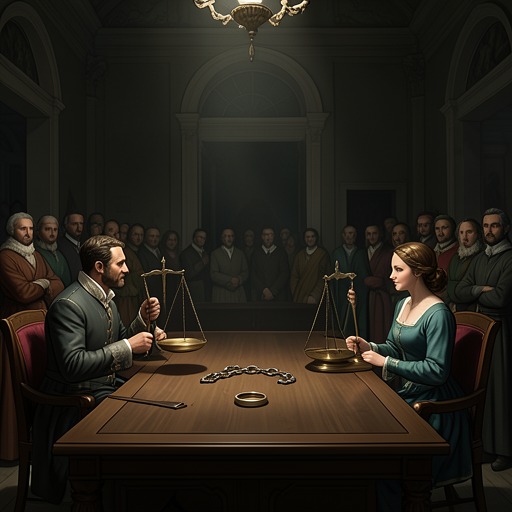
The Canterbury TalesThe Walter–Griselda relationship is one of the most severe and morally unsettling marriages in the work. Walter, a marquis, is impressed by Griselda’s virtue despite her low social position and chooses her as his wife; Griselda accepts the match with obedience and humility. Their marriage then becomes the setting for Walter’s prolonged tests of her loyalty, including the removal of their children and the false announcement that he will repudiate her. Griselda’s steadfastness survives every reversal, while Walter’s authority is eventually tempered by pity and by his recognition of what her patience has endured.
Identity and Unequal Beginnings
Walter and Griselda enter marriage from radically different positions. Walter is the ruling marquis, while Griselda is a poor young woman whose virtue is not easily recognized by ordinary people. The narrator nevertheless emphasizes that she is exceptionally good in both thought and conduct, and Walter is so deeply impressed by her that he decides to take her as his wife. The relationship therefore begins as a deliberate contrast between social rank and moral worth: Walter possesses lordship, whereas Griselda possesses the inward quality that the narrative treats as genuine nobility.
The marriage also links Griselda to her father, Janicula, whose poverty forms part of the match’s social meaning. Walter brings Janicula aside and speaks with him before arranging the marriage, making the father a necessary participant in the transfer of Griselda from household poverty into aristocratic marriage. The scene places Walter’s choice within a structure of authority and consent: Griselda’s future depends not only on her own virtue but on the marquis’s decision and on her father’s acceptance of it.
Marriage as Authority and Service
Walter’s proposal presents marriage as an arrangement requiring Griselda’s submission to his will. He tells her that her father shares his wish that they should wed, and the language of the proposal makes obedience part of the expected marital order. Griselda is described as kind, faithful, true, and meek, qualities that prepare her to accept a relationship in which Walter retains decisive power over the household and over her personal security.
Yet the relationship is not reduced to simple domination. Later, Walter freely promises, as a knight, that he will not assume mastery over her in the manner men commonly exercise lordship over wives. This promise introduces a striking tension into the marriage. The stated ideal is mutual peace rather than coercive sovereignty, but the subsequent action repeatedly contradicts the security that such a promise would seem to offer. The gap between Walter’s declared restraint and his later conduct makes the relationship a test not only of Griselda’s patience but also of the credibility of marital promises.
The Tests of Griselda
The decisive pattern of the relationship begins after the birth of their child. While the child is still nursing at the mother’s breast, Walter develops the intention to test his wife. His purpose does not arise from a demonstrated failure on Griselda’s part; it is an experiment imposed by the husband upon a wife who has already shown fidelity. The child’s infancy makes the act especially severe, because the test transforms the ordinary bond between mother and child into an instrument of Walter’s authority.
Walter’s testing continues as the family grows. When their daughter reaches the age of twelve, he sends a legate to the court of Rome, having already communicated his will. The episode shows that his actions are planned rather than impulsive: the testing is sustained over time and supported by official or political machinery. Griselda’s position remains precarious because Walter can convert a private marital decision into a public command, while her virtue offers no practical protection against his power.
The relationship’s central value shift is therefore from apparent marital safety to threatened loss. Griselda’s marriage promises status and belonging, but Walter repeatedly turns those goods into conditions of fear. The narrative does not present her patience as a single moment of endurance; it builds it through recurring trials, each of which asks whether loyalty can survive the husband’s withdrawal of affection, protection, and family security.
Pity, Recognition, and the Moral Contradiction
At last Walter feels pity for Griselda’s wifely steadfastness and tells her that the testing has gone far enough. His speech marks a change in his perception: what he had treated as an object of examination becomes suffering that he can no longer disregard. He asks her to be no more displeased and no more afraid, and he praises her faith and benignity. The language of recognition restores emotional value to qualities that his tests had exploited.
This recognition does not erase the asymmetry that made the trials possible. Walter remains the person who determines when the fear begins, how long it continues, and when it ends. Griselda’s virtue is thus both honored and demanded under pressure. The relationship embodies a conflict between duty-based obedience, the consequences of cruelty, and the ideal of virtuous character: Griselda follows an ethic of patience, while Walter’s conduct reveals how easily a language of marital order can become a means of control.
Narrative and Thematic Significance
The Walter–Griselda relationship gives the work its starkest exploration of marriage as sovereignty and service. Walter’s rank allows him to command, remove, threaten, and later restore; Griselda’s lack of worldly power leaves patience as her principal means of preserving moral identity. Their marriage consequently tests the difference between freely offered loyalty and obedience produced by dependence.
The relationship also belongs to the poem’s larger interest in exchanges that appear generous but carry unequal obligations. Walter offers Griselda elevation from poverty into aristocratic life, while she offers him fidelity and submission. Because he controls the terms of the exchange, however, the marriage reveals how a gift of status can coexist with a debt of obedience. Griselda’s endurance is celebrated as an extraordinary virtue, but the very extremity of Walter’s tests forces readers to measure the cost of that celebration. The marriage ends not by proving that authority is harmless, but by showing that recognition and pity arrive only after authority has already inflicted its deepest wounds.