Walter's marriage to Griselda
The Canterbury TalesWalter's marriage to Griselda is a decisive social and ceremonial transformation in the tale of Saluzzo: a marquis who has long refused marriage chooses the poorest man's daughter for her exceptional virtue, obtains her father's consent, demands her submission, and publicly installs her as his wife. The event joins private judgment to public spectacle. Griselda leaves the poverty of her household, but the terms of her elevation already reveal the unequal sovereignty that will govern the marriage.
The Marquis and the Unmarried Lord
Walter is the marquis who rules Saluzzo, a noble region inherited from worthy forebears. His people obey his command, yet he is absorbed in hawking and hunting and allows other matters to slide. His refusal to take a wife becomes the source of particular distress among his subjects: they fear that his unmarried state leaves the succession and the political future of the territory uncertain. The marriage therefore begins not simply as a romance but as a response to the responsibilities of rule.
Walter's resistance to marriage makes his eventual choice unexpected. Rather than selecting a bride from among the socially powerful, he turns his attention toward Griselda, whose position is the opposite of his own. The narrative presents this decision as a judgment that common social standards cannot easily make. Although virtue is not readily assessed by ordinary people, Walter is deeply impressed by what he sees in her, especially because her goodness appears in both thought and action.
Griselda's Poverty and Virtue
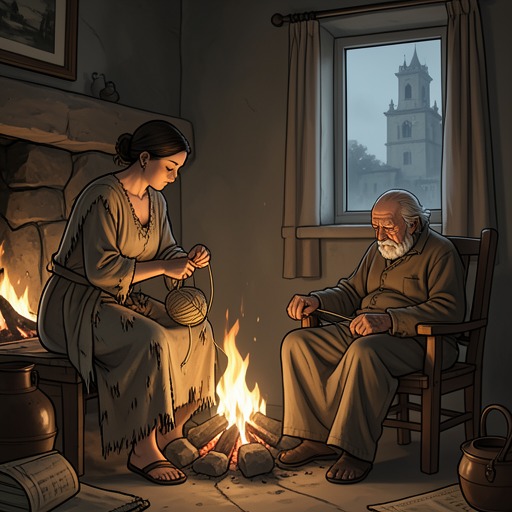
Griselda is the daughter of Janicula, a man described as the poorest among the poor people living by their own labor on the land. Her background places her outside the circles of wealth and inherited power that would normally furnish a marquis's bride. The contrast between the two households is therefore fundamental: Walter commands a noble region, while Griselda belongs to a family marked by extreme poverty.
Walter repeatedly sees Griselda while riding out to hunt. What first appears to be a passing observation becomes a sustained evaluation of her character. The tale emphasizes that she possesses an unusual virtue for one so young, a goodness visible in both inward thought and outward conduct. Her value, as Walter understands it, does not depend on rank, clothing, or property; it is precisely the quality that ordinary social judgment may fail to measure.
Her conduct toward Janicula also establishes the discipline that Walter will later demand from her. Griselda serves her father with diligent obedience and reverence, and this filial service becomes part of the evidence by which Walter judges her fit for marriage. The same virtue that makes her admirable also makes her vulnerable, because the narrative connects goodness with a readiness to submit herself to another's will.
Consent, Command, and the Marriage Bargain
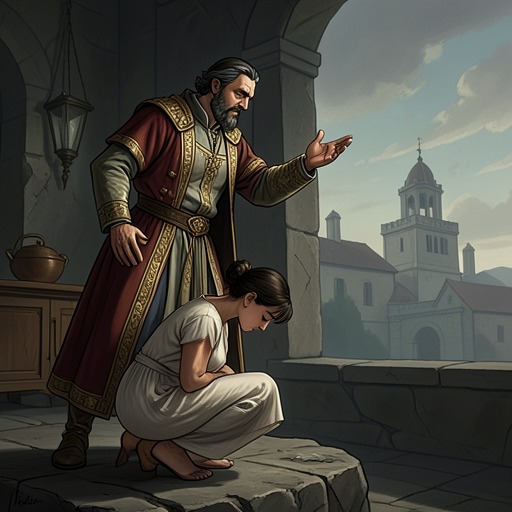
Walter approaches Janicula privately and states that he can no longer conceal his desire to make Griselda his wife. He asks the old man to consent before he proceeds, while also assuring him that the marriage will be lifelong. The request gives Janicula a formal place in the transition, but the social imbalance remains unmistakable: the ruling marquis asks a poor father to surrender his daughter to the highest authority in the region.
Walter then addresses Griselda directly. He tells her that her father shares his wish that they should marry and asks whether she will accept the arrangement. Her answer establishes the governing condition of the union. She promises that she will never oppose him in thought or action, even on pain of death, however unwilling she might be to die. Walter accepts this declaration as sufficient and immediately leaves the house, with Griselda following him.
This exchange makes the marriage a compact of sovereignty and service rather than a negotiation between equals. Griselda's consent is real within the scene, but it is expressed as an unconditional promise of obedience. Walter's approval is correspondingly brief: once she has accepted the terms, he treats the decision as settled. The event thus converts her virtue into a marital obligation and turns personal submission into the foundation of public legitimacy.
Public Elevation and Ceremony
The people scarcely recognize Griselda when she emerges in rich finery. Her change of appearance dramatizes the distance between the poor girl they knew and the noble bride she is about to become. Clothing functions here as a visible instrument of social transformation: the community must see the new status before it can fully recognize the person who has entered it.
Walter marries Griselda with a ring he has brought for the occasion. The ring gives the union a material sign and makes the private choice publicly binding. He then places her on an ambling, snow-white horse and brings her onward in the ceremonial movement associated with her elevation. The horse, the fine clothing, and the assembled public create a procession from poverty into marquisal dignity.
The ceremony also reorganizes the hierarchy of the whole community. Griselda does not merely become Walter's companion; she is presented as the woman who will occupy the position of marquise. Her elevation demonstrates that Walter can replace inherited rank with a ruler's personal judgment, while the manner of the wedding confirms that his authority controls both the selection of the bride and the terms under which she enters power.
Meaning and Future Pressure
The marriage produces an immediate value shift from poverty to prosperity and from obscurity to public honor, but it does not resolve the deeper tension between dignity and dependence. Griselda gains status, clothing, ceremonial recognition, and a place beside the ruler of Saluzzo. At the same time, she enters the union under a vow that requires her to obey Walter in thought and deed, even when obedience threatens her life.
The event therefore functions as both elevation and threshold. Griselda's social identity changes in a single public movement, yet the promise that makes the marriage possible also prepares the pattern of future trial. Her virtue is recognized, rewarded, and placed under authority all at once. The wedding is consequently not an uncomplicated happy ending: it is the formal beginning of Walter's marriage to Griselda and of the severe moral structure in which her patience will be measured against his power.