Americanization
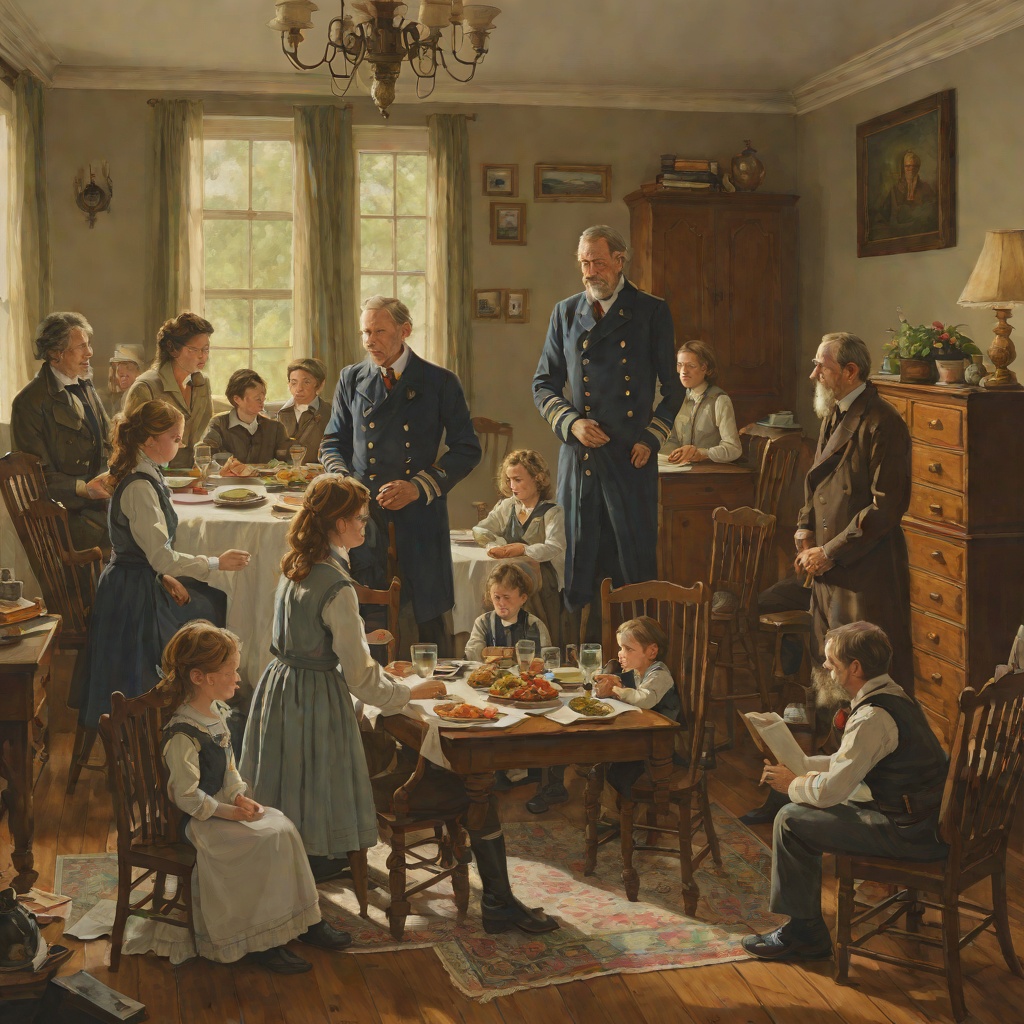
The Captain and Ann BarbaraAmericanization is the engine of Mary Antin's memoir The Promised Land, the process by which she and her family are remade from Russian Jews into Americans. It is at once a personal project, a family drama, and a social phenomenon, and the memoir traces its course from the first weeks after landing to the narrator's eventual entry into college and the drawing-rooms of the Back Bay. The concept is not presented as a smooth or simple conversion but as a strenuous, often contradictory ordeal: a shedding of old identities and an acquisition of new ones, marked by both triumphant discovery and painful dislocation. The family's experience of Americanization is the book's central subject, and its uneven progress shapes the narrative's arc from the crowded tenements of the South End to the satin drawing-rooms of Boston's elite.
The Father's Project and Its Methods
Americanization in the Antin household begins as the father's deliberate and headlong project. Mary's father, who had landed in America three years before the rest of the family, was hungry for his untasted manhood after a life held in leading-strings, and he saw in America the freedom to speak his thoughts and throw off the shackles of superstition. His ambition to make Americans of his children was, in Mary's words, rather headlong and strenuous in his methods. He wrote boldly to his wife on the eve of her departure for the New World that progressive Jews in America did not spend their days in praying, and urged her to leave her wig in Polotzk as a first step of progress. This instruction was a direct assault on the outward symbols of Orthodox Jewish womanhood, and it was carried out, though not without reluctance, as the mother set out on her journey in her own hair. The father's methods extended to the children's education and conduct: he conducted the children to school himself on their first day, a mission he would not have delegated to the President of the United States, and he had a neighborhood bully arrested and brought to court to teach the rascal a lesson. The father's project was thus a comprehensive remaking of the family's external and internal life, pursued with an urgency that left little room for the old ways.
Shedding the Old: Names, Clothes, and Customs
The early stages of Americanization were marked by a deliberate casting off of the markers of the old life. Within two weeks of landing, the family had been dressed from head to foot in American clothing, learning the mysteries of the iron stove, the washboard, and the speaking-tube, and trading with the fruit peddler through the window. With their despised immigrant clothing, they shed also their impossible Hebrew names. A committee of friends, several years ahead of them in American experience, concocted American names for them all, ruthlessly discarding those real names that had no pleasing American equivalents, content if they retained the initials. The mother, possessing a name not easily translatable, was punished with the undignified nickname of Annie. Fetchke, Joseph, and Deborah issued as Frieda, Joseph, and Dora, respectively. Mary herself was simply cheated, her Hebrew name Maryashe, shortened to Mashke and Russianized into Marya, holding good in English as Mary, which was disappointing to one who longed for a strange-sounding American name like the others. The family's progress was so diligent and adaptable that when they made the journey to Crescent Beach in the wake of their small wagon-load of household goods, the father had very little occasion to admonish them, and Mary was sure he was not ashamed of them. So much had they achieved toward their Americanization during the two weeks since their landing.
The process of shedding extended to religious observance, where it was most fraught. The father's purge of superstition from his house was a gradual and uneven affair. The mother's emancipation was not obvious to Mary at the time, but her outward conduct, interpreted by subsequent experience, revealed that she had dropped the husk and retained the kernel of Judaism. All the year round she kept the same day of rest as her Gentile neighbors, but when the ram's horn blew on the Day of Atonement, calling upon Israel to cleanse its heart from sin, her soul was stirred as of old, and she needed must join in the ancient service. Years were required for this process of instinctive selection. The mother's giving up of the wig was itself a sign of the times, part of a broader revolt against orthodox externals that was reaching Polotzk from the greater world, notably from America. Sons whose parents had impoverished themselves paying fines to save them from military service sent home portraits of themselves with their faces shaved, and the grieved old fathers and mothers exhibited the significant portraits on their parlor tables. Even within Polotzk, young women of education were beginning to reject the wig after marriage, and the beautiful daughter of Lozhe the Rav was not restrained by her father's conspicuous relation to Judaism from exhibiting her lovely black curls like a maiden, nor did the rav disown her.
The Inversion of Authority and the Pains of Adjustment
The most disruptive consequence of Americanization was the inversion of normal family relations. In Polotzk, the children had been trained and watched, their days regulated, their conduct prescribed. In America, suddenly, they were let loose on the street. Because the father had renounced his faith and the mother was uncertain of hers, they had no particular creed to hold the children to, and the conception of a system of ethics independent of religion could not at once enter as an active principle in their life. Chaos took the place of system; uncertainty and inconsistency undermined discipline. The parents knew only that they desired their children to be like American children, and seeing how their neighbors gave their children boundless liberty, they turned them loose as well, never doubting that the American way was the best way. In matters of etiquette and social intercourse, they had no standards to go by, seeing that America was not Polotzk. In their bewilderment, they must step down from their throne of parental authority and take the law from their children's mouths, for they had no other means of finding out what was good American form. The result was that laxity of domestic organization, that inversion of normal relations which makes for friction, and which sometimes ends in breaking up a family that was formerly united and happy. Mary describes this sad process of disintegration of home life as observable in almost any immigrant family of their class and traditions, part of the process of Americanization, an upheaval preceding the state of repose. It is the cross that the first and second generations must bear, an involuntary sacrifice for the sake of the future generations, the pains of adjustment as racking as the pains of birth. And as the mother forgets her agonies in the bliss of clasping her babe to her breast, so the bent and heart-sore immigrant forgets exile and homesickness and ridicule and loss and estrangement when he beholds his sons and daughters moving as Americans among Americans.
Americanization Tested Against American Reality
The memoir repeatedly tests the ideals of Americanization against the realities of American life, particularly in the slums of the South End. On Wheeler Street, in the lower South End of Boston, there were no real homes, only miserable flats of three or four rooms in which families cooked, washed, and ate, slept from two to four in a bed in windowless bedrooms, quarrelled in the gray morning, and made up in the smoky evening. The centre table in the parlor held invariably a photograph album and an ornamental lamp with a paper shade, usually out of order. The narrow sidewalk was crowded, and the people selected their resorts among the saloons, the missions, the libraries, the cheap amusement places, and the neighborhood houses. The children, let it be thankfully recorded, flocked mostly to the clubs, the little girls to sew, cook, dance, and play games, the little boys to hammer and paste, mend chairs, debate, and govern a toy republic, all forms of baptism by soap and water. The family's move to Dover Street, intersected near its eastern end by Harrison Avenue, placed them at the heart of the South End ghetto, where the multifarious business burst through the narrow shop doors and overran the basements, the sidewalk, and the street itself in pushcarts and open-air stands. The City Fathers provided soap and water for the slums in the form of excellent schools, kindergartens, and branch libraries, but there they stopped, at the curbstone of the people's life. They cleansed and disciplined the children's minds, but their bodies they pitched into the gutter, for there were no parks and almost no playgrounds in the Harrison Avenue district. The Americanization of the mind was thus offered without the Americanization of the body, a discrepancy that the memoir registers with sharp irony.
The Double Life and the Completion of the Process
The culmination of Americanization is the narrator's own double life, moving between the slums and the drawing-rooms of the Back Bay. From her bare room overlooking the lumber-yard, Mary traced her steps to the satin drawing-rooms of the Back Bay, where she drank afternoon tea with gentle ladies whose hands were as delicate as their porcelain cups. Coming straight from the cushioned refinement of Beacon Street, where the maid who brought her hostess her slippers spoke in softer accents than the finest people on Dover Street, she sometimes stumbled over poor Mr. Casey lying asleep in the corridor, and the shock of the contrast was like a searchlight turned suddenly on her life. She pondered over the revelation and wrote touching poems in which she figured as a heroine of two worlds. The process of Americanization, begun with the shedding of immigrant clothing and Hebrew names, completed itself in this double consciousness, the ability to move between the reeking slums and the gilded drawing-rooms, to think in English without an accent, and to take possession of Beacon Street while still remembering the bare room overlooking the lumber-yard. The memoir ends with the narrator's favorite abode being a tent in the wilderness, where she would be happy to serve a cup of tea out of a tin kettle, a final image of the Americanized self as one who has absorbed the new world while retaining the capacity for a simpler, more elemental life.