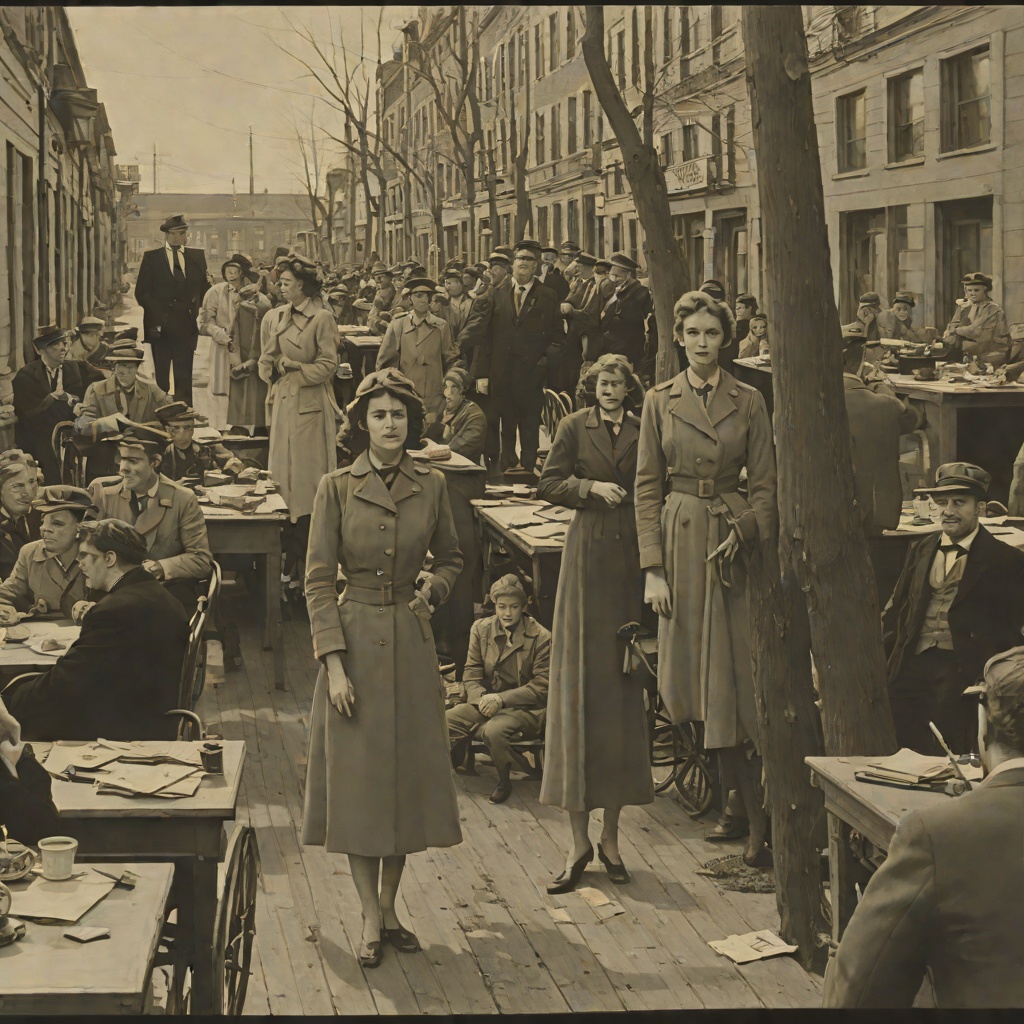
Consulting Mr. Tetlow about the Latin School
The Captain and Ann BarbaraConsulting Mr. Tetlow about the Latin School is a decisive moment in Mary Antin's account of her American education, the hinge on which her passage from the immigrant slums of Boston's South End to the city's most demanding academic institution turns. When the question arose whether she would be best fitted for college at the High School or the Latin School, Mary did not wait for her parents or teachers to decide for her. Instead, she went in person to Mr. Tetlow, who was principal of both schools, to obtain the most expert opinion on the subject. The visit crystallizes a habit she had already announced as a principle of her character: she never sends a messenger where she can go herself. It is an act of self-assertion all the more striking because it comes from a girl whose family had only recently arrived in America, and whose material circumstances were still those of poverty.
The Journey to Roxbury and the Contrast of Worlds
The errand took Mary far from the cramped tenement on Dover Street, where her family occupied five small rooms up two flights of stairs, with the right of way through dark corridors, dingy paper hanging in rags in the parlor, plaster falling in chunks, and one bedroom absolutely dark and air-tight. It was vacation time, and she had to find Mr. Tetlow at his home, away out to the wilds of Roxbury, perhaps half an hour's ride on the electric car from Dover Street. The journey itself became a kind of transformation. Between the corner of Cedar Street and Mr. Tetlow's house, she later wrote, she grew an inch taller and broader, such was the charm of the clean, green suburb on a cramped waif from the slums. The contrast between her origin and her destination could hardly have been sharper. Her faded calico dress, her rusty straw sailor hat, and the color of her skin all bespoke the waif. Yet she was never a bit daunted. She went up the steps to the porch, rang the bell, and asked for the great man with as much assurance as if she were a daily visitor on Cedar Street.
The physical details of her poverty are precise and unsparing: the faded calico dress recalls the gray pattern of the calico she had worn on her first day at the Chelsea public school, a garment that had marked her as a greenhorn among her classmates. The rusty straw sailor hat and the color of her skin complete the picture of a girl who had not yet been smoothed by American prosperity. But the same passage that records these signs of want also records her refusal to be defined by them. She calmly awaited the appearance of Mr. Tetlow in the reception room and stated her errand without trepidation. The assurance was not bravado but conviction: she was a solemn little person for the moment, earnestly seeking advice on a matter of great importance.
The Interview and Mr. Tetlow's Response
Mr. Tetlow received her with a gravity that matched her own. To judge by the seriousness with which he discussed her business with her, and the courtesy with which he showed her to the door, he saw exactly what she was: a solemn child earnestly seeking advice on a matter of great importance. He saw too, she fancied, that she was not the least bit conscious of her shabby dress, and she was sure he did not smile at her appearance, even when her back was turned. The interview was conducted with perfect mutual respect, a small drama of democratic courtesy in which the principal of Boston's leading schools treated a poor immigrant girl as a serious interlocutor. The outcome of the consultation is implied rather than stated directly: a new life began for her when she entered the Latin School in September.
The visit to Mr. Tetlow belongs to a larger pattern in Mary's narrative of her own making. From her earliest days in Polotzk, she had been a child who sought her own meanings rather than accepting conventional ones, a tendency she traced back to her first recollection of studying her grandfather's remains by the lighted candles. In Russia, her education had been confined to the heder, where Reb' Lebe, a tall, lean rebbe with a thin, pointed beard and large hands, taught her to chant the Psalms in Hebrew, rocking to the rhythm of the chant, though she understood about one word in ten. That early hunger for knowledge, which made the lesson always too short and sent her reading by the hour after the rebbe was gone, had carried her through the rapid promotions of the Chelsea public school, where Miss Nixon advanced her to the second grade within a week of taking her in hand. The visit to Mr. Tetlow is the same hunger translated into adult action: the girl who had once chanted Hebrew verses she barely understood now sought out the highest authority she could find to guide her toward college.
The Significance of the Consultation
The consultation matters not only for what it achieved but for what it reveals about Mary's character and her place in American society. It is an act of self-advocacy that anticipates the entire course of her later career as a writer and public figure. The girl who walked up the steps of Mr. Tetlow's house in Roxbury, in her faded calico dress and rusty straw sailor hat, was already practicing the art of personal presence that she would later celebrate as one of America's gifts to her. She had learned, in the years since her arrival, that in America even plain people wore their surnames on weekdays, that ability would be promptly recognized in the public schools, and that a child of the slums could claim the Boston Public Library as her own palace, built by the people and free to all. The visit to Mr. Tetlow was the logical extension of these lessons: she had a right to be there, and she acted on that right.
The episode also marks a turning point in her social experience. Until she entered the Latin School, she had gone to school with her equals, and as a matter of course. Now it was distinctly a feat for her to keep in school, and her schoolmates were socially so far superior to her that her poverty became conspicuous. The pupils of the Latin School, from the nature of the institution, were an aristocratic set, coming from refined homes, dressing well, and spending the recess hour talking about parties, beaux, and the matinée. The course of study was considered stiff, and the weeding process at the end of the year reduced the once numerous tribe of academic candidates to a cozy little family. Mary's decision to consult Mr. Tetlow was thus not merely a practical step toward college but a deliberate entry into a world where she would be tested not only academically but socially. The assurance she showed on the porch of his house was the same assurance she would need to survive among schoolmates who could afford to take their education for granted.
In the larger arc of her memoir, the consultation stands as a proof of the American promise she had come to believe in. The girl who had been born in a small, one-story wooden building in Polotzk, whose yard was screened from the street by a board fence and whose gate swung so high from the ground that pigs found their way in under it, had become a young woman who could ring the bell of a great man's house and state her errand without trepidation. The visit to Mr. Tetlow is the moment when the immigrant child's dream of America as a land of opportunity becomes a concrete, personal reality: she asked, and she was answered with respect. It is a small scene, but it carries the weight of her whole transformation.