Eating Ham at Miss Dillingham's Tea
The Captain and Ann BarbaraEating Ham at Miss Dillingham's Tea is a pivotal episode in Mary Antin's memoir, a moment when the young immigrant's proudly proclaimed freethought collides with the deep, unexamined habits of her Jewish upbringing. The event occurs during Mary's first visit to a genuine American household, a meal at the home of Miss Dillingham, the teacher who had helped her in so many ways. It is Mary's first meal at a Gentile, Christian board, and it becomes an early and shocking test of the enlightenment she had so recently and so confidently embraced. The episode reveals the chasm between intellectual conviction and bodily instinct, showing that the mind's new beliefs cannot instantly erase the body's old training. It is a scene of profound self-discovery, where the young rationalist discovers that she is not as free as she had believed, and that the traditions of her ancestors live on in her very flesh.
The Context of Mary's Newfound Freethought
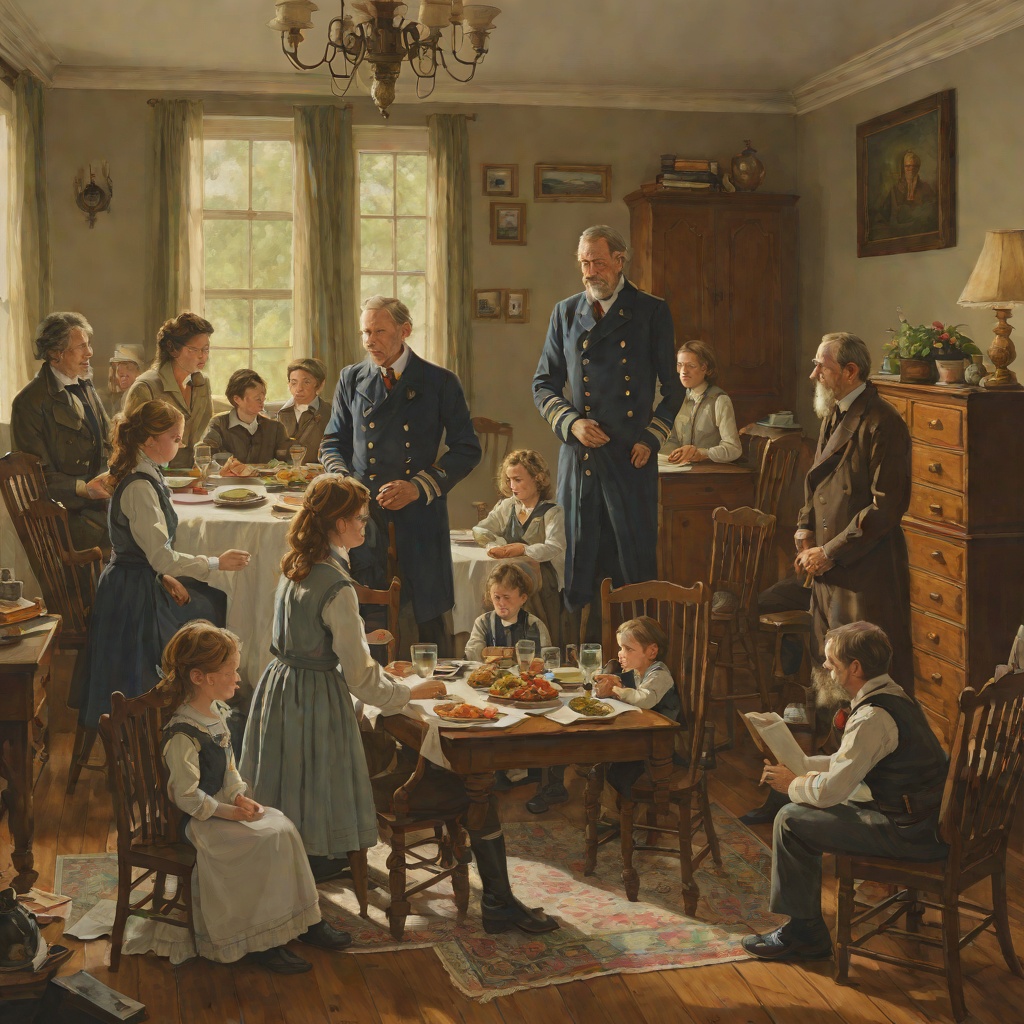
Mary arrives at Miss Dillingham's tea table in a state of high anxiety, acutely aware that this is her first entrance into a genuine American household. She is determined to behave properly, having been accustomed to consider her table manners irreproachable, but she is also mindful of her father's constant refrain that "America is not Polotzk." She proceeds cautiously with her spoons and forks, cunningly trying to conceal her uncertainty by being just a little bit slow, waiting until the others at the table have shown her which utensil to use. This careful observation is a normal state for her, as she is all eyes and ears, determined that nothing should escape her which might serve to guide her. The scene is set for a test not just of manners, but of something far deeper. Mary's anxiety is compounded by her recent declaration of atheism in the schoolyard, where she had horrified her peers by denying the existence of God on the authority of her father, and defended her right to her atheism on the authority of the Constitution. She considered herself absolutely, eternally, delightfully emancipated from the yoke of indefensible superstitions, and was wild with indignation and pity when she remembered how her poor brother had been cruelly tormented because he did not want to sit in heder and learn what was after all false or useless. She knew now why poor Reb' Lebe had been unable to answer her questions; it was because the truth was not whispered outside America. She was very much in love with her enlightenment, and eager for opportunities to give proof of it.
The Moment of the Forbidden Meat
All goes well at the tea until a platter is passed with a kind of meat that is strange to Mary. Some mischievous instinct tells her that it is ham, forbidden food, and she, the liberal, the free, is afraid to touch it. This is a terrible moment of surprise, mortification, and self-contempt. Despite her terror, she helps herself to a slice of ham, nevertheless, and hangs her head over her plate to hide her confusion. She is furious with herself for her weakness, asking how she, who had defied at least two religions in defence of free thought, could be afraid of a pink piece of pig's flesh. In a defiant gesture, she begins to reduce her ham to indivisible atoms, determined to eat more of it than anybody at the table. The act is a performance of her principles, an attempt to prove to herself and to the world that she is truly emancipated from the dietary laws of her ancestors. Yet the performance fails. Mary learns that to eat in defence of principles is not so easy as to talk. She eats, but only a newly abnegated Jew can understand with what squirming, what protesting of the inner man, what exquisite abhorrence of herself. She compares herself to the Spartan boy who allowed the stolen fox hidden in his bosom to consume his vitals rather than be detected in the theft, and concludes that he showed no such miracle of self-control as did she, sitting there at her friend's tea-table, eating unjewish meat.
The Body's Rebellion and the Symbolism of Food
The ham episode exposes a fundamental truth about Mary's identity: her body has been shaped by years of Jewish practice in ways that her conscious mind cannot simply override. The food of her childhood, the Sabbath suppers, the thick cheese cakes of Polotzk, the cherries eaten with their stones in a contest with a cousin's boy, are not just memories but are woven into the very fabric of her senses. She recalls the immortal flavor of those thick cheese cakes, a flavor that cannot be replicated by any American cook, because it takes history to make such a cake. The flavor contains the daisies and clover picked on the Vall, the sweetness of Dvina water, the richness of newly turned earth, the ripeness of red cherries bought by the dipperful in the market place, the fragrance of all her childhood's summers. This deep, sensory connection to the food of her past makes the ham a particularly potent symbol. It is not just a piece of meat; it is the embodiment of everything she has renounced. The episode forces Mary to recognize that she is a wonderful thing, being human, the image of the universe, the repository of all the wisdom in the world. She is the heir of the ages, and all that has been is in her. The struggles and triumphs of ages are reflected in the mental life of a half-grown child, and a ridiculous scrap of meat becomes the symbol and test of things so august.
The Deeper Significance: Assimilation and Its Limits
The ham incident is not an isolated moment of personal embarrassment but a profound commentary on the nature of assimilation. Mary's experience shows that Americanization is not a simple process of adopting new customs and beliefs; it is a struggle against the deeply ingrained habits of the Old World. The episode echoes the broader theme of the memoir, which traces the path of an immigrant child from the ship through the public schools, free libraries, and lecture halls, striving against the odds of foreign birth and poverty. Mary's body, trained in the laws of kashrut, rebels against the new freedom her mind has embraced. This is a testament to the persistence of tradition, a theme that runs throughout the book. The memoir also notes the different fates of Mary and her sister Frieda, who came to America too late to avail herself of the gifts of an American girlhood and was engaged to be married before they had been two years in the country. Frieda's path, shaped by the old dispensation, stands in contrast to Mary's, who was sent to school. The ham episode, however, shows that even Mary, the one chosen for glory, carries the Old World within her. The event also resonates with the story of the family's first meal in America, where her father produced several kinds of food from little tin cans and attempted to introduce them to a queer, slippery kind of fruit called a banana. That first meal was an object lesson of much variety, a joyful introduction to American abundance. The ham at Miss Dillingham's tea is a darker, more complex lesson, revealing that the freedom of the New World comes with its own costs and conflicts. The episode ultimately suggests that the conversion of the Jew to any alien belief or disbelief is never thoroughly accomplished, and that the persistence of Judaism in the blood is a force that even the most enthusiastic freethinker cannot fully escape.