Fellow Citizen
The Captain and Ann BarbaraIn Mary Antin's memoir The Promised Land, the phrase "Fellow Citizen" names the civic identity that Americanization confers on the immigrant. It is not merely a legal status but an emotional and moral awakening: through it, Mary discovers that she is "more nobly related" than she had ever supposed, joined in fellowship with George Washington himself. The concept transforms her self-estimate, replacing childish insignificance with a sense of sudden greatness and responsibility, and it becomes the lens through which she understands her country, her rights, and her place among Americans.
The Discovery of Fellow Citizenship
The revelation comes through the patriotic literature Mary reads at school, especially the story of George Washington. She had previously admired relatives like her Uncle Solomon and Cousin Rachel, who "preached the least and laughed the most," but Washington was different: "a human being strictly good, perfectly wise, and unfailingly valiant, all at the same time," someone she had "never heard or dreamed of." Reading about the noble boy who would not tell a lie, Mary felt "for the first time truly repentant of my sins," realizing she could never compare herself to such a paragon. Yet this new humility had a paradoxical twin: a sense of dignity she had never known. She learned from her father how he had become a citizen through naturalization, and how she too was a citizen "by virtue of my relation to him." The realization thrilled her: "Undoubtedly I was a Fellow Citizen, and George Washington was another." The concept sobered her as well, filling her with responsibility; she "strove to conduct myself as befitted a Fellow Citizen."
The Concept in Action: Public Performance and Defense
Fellow Citizen was not an abstract ideal but a role Mary performed publicly. When she stood before her class to recite her Washington's Birthday poem, she faced "twoscore Fellow Citizens, in clean blouses and extra frills," and felt compelled to tell them "what George Washington had done for their country—for our country—for me." Though thin, pale, and hollow-cheeked, with faulty pronunciation and flat declamation, she had "the courage of my convictions." The concept also armed her in the schoolyard when her classmates mocked her father's atheistic doctrines. Surrounded by Rachel, Kitty, Maggie, Sadie, Annie, and Beckie, who threatened her "with hell flames and utter extinction," Mary held her ground, perceiving that "a crowd of Free Americans were disputing the right of a Fellow Citizen to have any kind of God she chose." She reminded them, "This is a free country," and defended her position as "the defender of a cause," knowing from her father's teaching that such persecution was contrary to the Constitution of the United States.
The Family Dimension: Frieda and the Evening School
Fellow Citizen extended beyond Mary herself into her family's collective Americanization. After her sister Frieda went to work, the two sisters and the two younger children formed an evening school around the kitchen table, studying English and arithmetic with books borrowed from school and pencils supplied by their father. Mary was the teacher, and the earnestness of their labor was "worthy of the great things we meant to achieve." When Mary explained to Frieda "how she and I and George Washington were Fellow Citizens together," Frieda's "eyes shone like stars on a moonless night." The concept gave meaning to Frieda's daily toil at the sewing machine, glorifying her lot as she heard everyone talk about Mary Antin, whose poems were printed in an American newspaper. The whole Jewish community claimed kinship with Mary simply because she was a Jew, pointing to her small triumphs with pride, and Frieda, returning home from work at sunset, found her spirit revived when the books were opened after supper.
The Concept and the Immigrant Condition
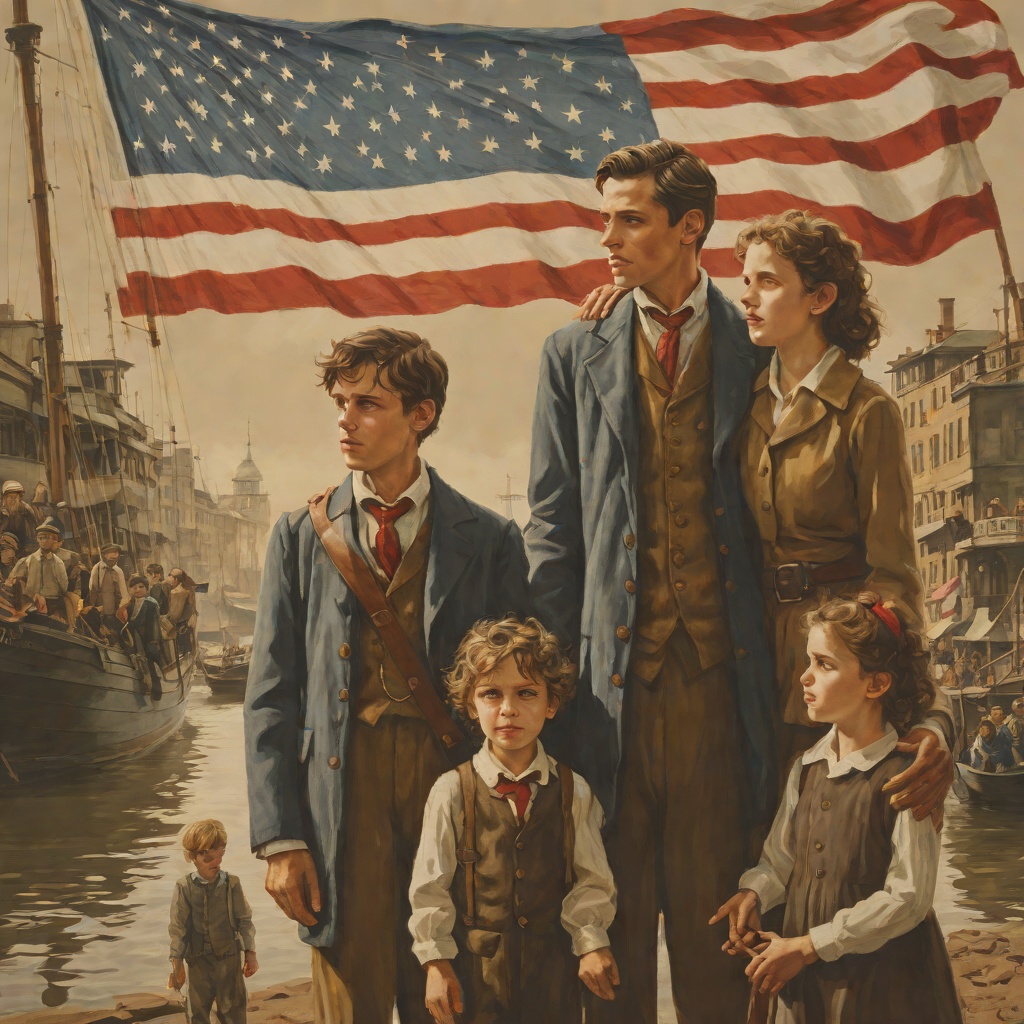
Fellow Citizen also illuminates the broader immigrant experience that Mary's father embodied. He had applied for naturalization almost as his first act on landing on American soil, three years before the family's arrival, and completed the process "at the earliest moment allowed by the law." For him, American freedom meant far more than the right to reside and work; it meant "the freedom to speak his thoughts, to throw off the shackles of superstition, to test his own fate, unhindered by political or religious tyranny." Yet the path was hard: his three years of probation were marked by "false starts in business," the history of thousands who came to America "with pockets empty, hands untrained to the use of tools, minds cramped by centuries of repression." The memoir insists that such men, dismissed as "The Jew peddler!" by native Americans, might carry citizenship papers in their bosoms, support a boy in college who would one day mend the state constitution, or send daughters to teach in the public schools. The concept of Fellow Citizen thus carries a moral challenge to the reader: to see beyond the "greasy alien on the street" and recognize a person "born thousands of years before the oldest native American."
The Concept and the Pains of Adjustment
The achievement of Fellow Citizenship came at a cost, part of what Mary calls "the sad process of disintegration of home life" observable in immigrant families. Because her father had renounced his faith and her mother was uncertain of hers, the children were "let loose on the street" without a creed to hold them, and chaos took the place of system in domestic education. The parents, knowing only that they desired their children to be like American children, turned them loose, "never doubting but that the American way was the best way," and had to "take the law from their children's mouths" to learn what was good American form. This inversion of normal relations, Mary writes, "makes for friction, and which sometimes ends in breaking up a family that was formerly united and happy." Yet she frames this upheaval as "part of the process of Americanization; an upheaval preceding the state of repose," the cross that the first and second generations must bear, "an involuntary sacrifice for the sake of the future generations." The pains of adjustment are as racking as the pains of birth, but the immigrant forgets exile and homesickness and ridicule "when he beholds his sons and daughters moving as Americans among Americans." Fellow Citizen, then, is both the prize of this sacrifice and the promise that redeems it.
The Concept and the Separation of Church and State
Fellow Citizenship also entailed a distinctively American doctrine: the separation of church and state. When Miss Bland, the teacher, heard of the schoolyard dispute, she asked Mary for her version of the story and then made her understand, as Miss Dillingham had done on an earlier occasion, "that it was proper American conduct to avoid religious arguments on school territory." Mary felt honored by this "private initiation into the doctrine of the separation of Church and State," her alarm about the safety of the Constitution allayed by the teacher's calmness. The concept thus taught her that her right to hold any belief was protected precisely because religion was kept out of public institutions. This lesson connected to her father's atheism, which he had embraced as part of his American freedom, and to her mother's gradual emancipation, which left her keeping the same day of rest as her Gentile neighbors all year round, yet still stirred "as of old" when the ram's horn blew on the Day of Atonement. The mother had "dropped the husk and retained the kernel of Judaism," a process of instinctive selection that mirrored the larger Americanization of the family.
The Concept and the Graduation Day
Fellow Citizen reached its fullest expression on Graduation Day, when Mary's triumph and humiliation were intertwined. The assembly hall was crowded to bursting, and her friends—her parents, Frieda, Miss Dillingham, and other Chelsea teachers—were ushered up to the platform reserved for guests of honor. Mary was proud to see them treated with such distinction. But when she stepped on stage to read her composition about her beloved little cousin who died in Russia, she was seized with stage fright, paralyzed by the conviction that her dress was too short and that ten thousand people were looking up at her. She read mechanically, then gradually forgot herself, and "made a thousand strangers feel" her love for the dead boy; before the applause there was a moment of stillness in the great hall. Yet afterward, when the principal Mr. Swan called for thanks, Mary rose unbidden and began, "I want to thank you—" before he waved his hand to silence her. She realized the enormity of her blunder: she had been "brazenly forward, deliberately calling attention to myself when there was no need." She hated herself and the girls who had prompted her, wished the ground would yawn and snap her up, and felt she had disgraced herself, her friends, and the Winthrop School. The crowd mobbed and lionized her, everyone wanting to shake hands with "the prodigy of the day," but she smirked back without knowing what she said, wild to be clear of the building, her roses turned to ashes. The episode reveals the double edge of Fellow Citizen: the same public visibility that conferred greatness also exposed her to the agony of self-consciousness and the fear of failing the very community that honored her.