Free public education
The Captain and Ann BarbaraIn Mary Antin's memoir, free public education is more than a policy; it is the beating heart of the American promise, the tangible proof that the New World is the opposite of the Old. It is the institution that transforms the abstract ideals of liberty and equality into a lived reality for the immigrant child, and its presence in the narrative serves as the central, defining contrast to the oppressive and exclusionary world of the Russian Pale of Settlement. The promise of free schooling is the thread that binds the family's emigration together, the treasure that a father promises his children, and the force that reshapes a 'greenhorn' into a 'Fellow Citizen.'
The Promise and the Contrast
The significance of free public education is established through the starkest possible contrast with the world Mary Antin leaves behind. In Russia, the Czar commanded the Jews to stay within the Pale of Settlement, a fence around Polotzk that divided the world into Jews and Gentiles. This knowledge of being a prisoner trickled into her consciousness drop by drop, and the shackles grew familiar to her flesh. The system was one of exclusion and persecution, where a Jewish recruit was likely to be treated with severity and forced to violate Jewish law, and where the Czar always got his dues, even if it ruined a family. The constant risk, the worry, and the dread of a police raid in the night left very little margin of profit or comfort. It was a world of taxes on houses, rents, business, and profits, where even a railroad bridge across the Dvina could be used by the people only by individual permission. Against this backdrop of legalized oppression, the American promise of free education shines as a beacon of liberation.
The Concrete Proof on Union Place
The abstract ideal of American freedom becomes a concrete, almost miraculous reality on the family's second day in Boston. A little girl from across the alley, who had never seen them before and could not pronounce their names, came and offered to conduct them to school. This child, no better dressed than they were, was able to offer them the freedom of the schools of Boston. The incident impressed Mary more than anything she had heard in advance, for it was a concrete proof—almost the thing itself. There was no application made, no questions asked, no examinations, rulings, exclusions, no machinations, no fees. The doors stood open for every one of them, and the smallest child could show them the way. This was the essence of American opportunity, the treasure that no thief could touch, not even misfortune or poverty, which her father had written about repeatedly as his chief hope for his children.
The Father's Sacred Mission
The day Mary first entered the public school was the apex of her civic pride and personal contentment, a day she must always remember. Its importance was a hundred times magnified on account of the years she had waited, the road she had come, and the conscious ambitions she entertained. Her father himself conducted her to school, a mission he would not have delegated to the President of the United States. He had awaited the day with impatience equal to hers, and the visions he saw as he hurried them over the sun-flecked pavements transcended all her dreams. Almost his first act on landing on American soil, three years before, had been his application for naturalization, and he became a citizen at the earliest moment allowed by the law. The boasted freedom of the New World meant to him the freedom to speak his thoughts, to throw off the shackles of superstition, and to test his own fate, unhindered by political or religious tyranny. The school was the fulfillment of his best promises, the living proof that his sacrifice had been worthwhile.
The Schoolyard as a Crucible of Citizenship
The public school was not just a place of academic learning; it was the arena where the principles of the Constitution were tested and defended. When Mary was surrounded by a circle of classmates who mocked her and threatened her with hell flames for her father's atheistic doctrines, she held her ground as the defender of a cause. She perceived that a crowd of Free Americans were disputing the right of a Fellow Citizen to have any kind of God she chose, and she knew from her father's teaching that this persecution was contrary to the Constitution of the United States. "This is a free country," she reminded them in the middle of the argument, and she felt honored by her teacher's private initiation into the doctrine of the separation of Church and State. The schoolyard was also where she witnessed the way justice was actually administered in the United States, when her father had a bullying boy arrested and brought to court. In the little courtroom, nobody cringed, nobody was bullied, and all were treated equally, just as it said in the Constitution. The evil-doer was actually punished, and not the victim, as might very easily happen in a similar case in Russia.
The Expanding Circle of Opportunity
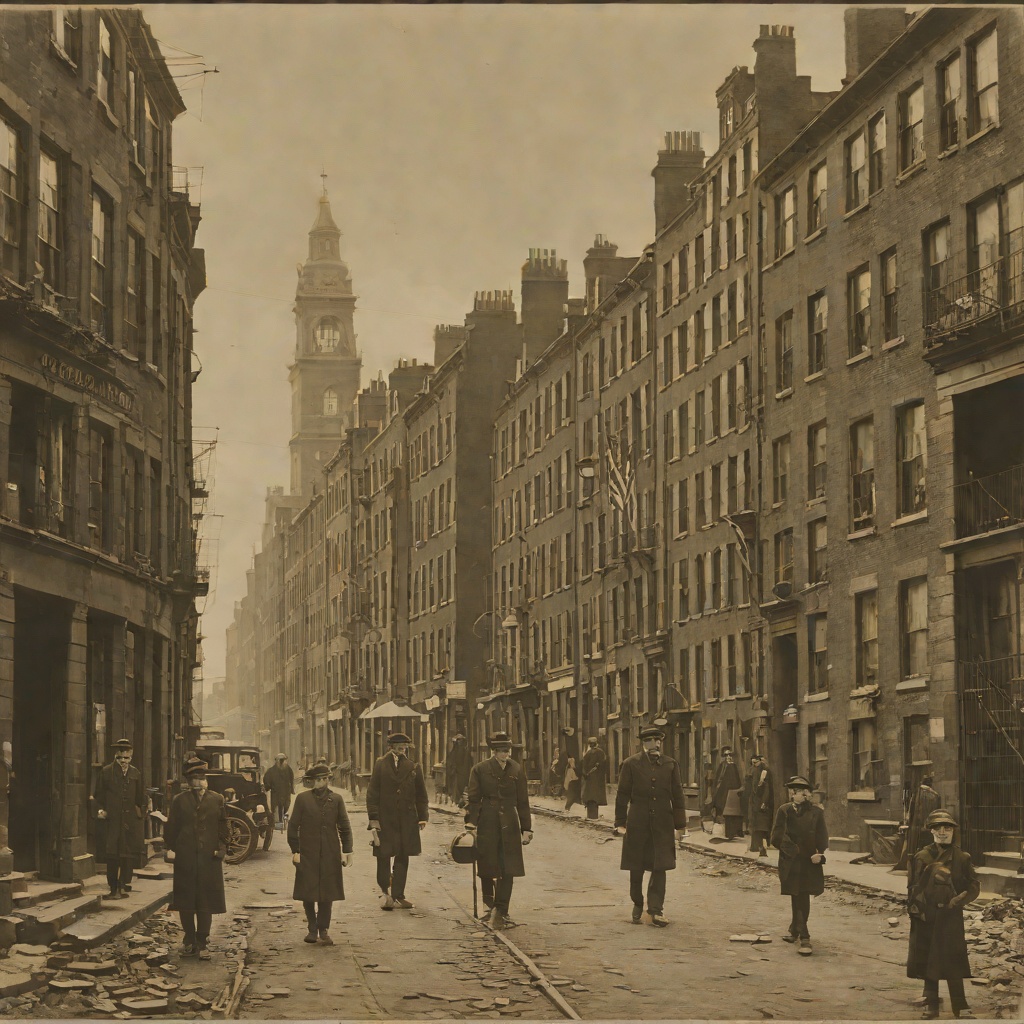
The promise of free education extended beyond the classroom, shaping the family's entire American experience. When the family moved to Wheeler Street in the lower South End of Boston, there was the school three blocks away, where "America" was sung to the same tune as in Chelsea. Even in the slums of Dover Street, intersected by Harrison Avenue, the heart of the South End ghetto, the City Fathers provided soap and water for the slums in the form of excellent schools, kindergartens, and branch libraries. The education was free, and it was the one thing that was able to be promised, surer and safer than bread or shelter. This freedom of education was the thread that connected the family's various homes, from Union Place to Chelsea to the South End, and it was the force that would eventually lead Mary from her bare room overlooking the lumber-yard to the satin drawing-rooms of the Back Bay, where she drank afternoon tea with gentle ladies. The public school was the first step on a journey that would take her to Barnard College, where she learned to think in English without an accent, and to a life where she could dream her dreams in English phrases, a miracle for Mashke, the granddaughter of Raphael the Russian.