Harrison Avenue
The Captain and Ann BarbaraHarrison Avenue is the heart of the South End ghetto in Boston, the teeming, filthy commercial and residential artery of the immigrant Jewish quarter where Mary Antin's family settled after leaving Chelsea. It is the physical and symbolic center of the book's later chapters, embodying both the crowded vitality and the squalid neglect of immigrant life in America, and it serves as the stark backdrop against which Mary measures her own ascent into American society.
The Heart of the South End Ghetto
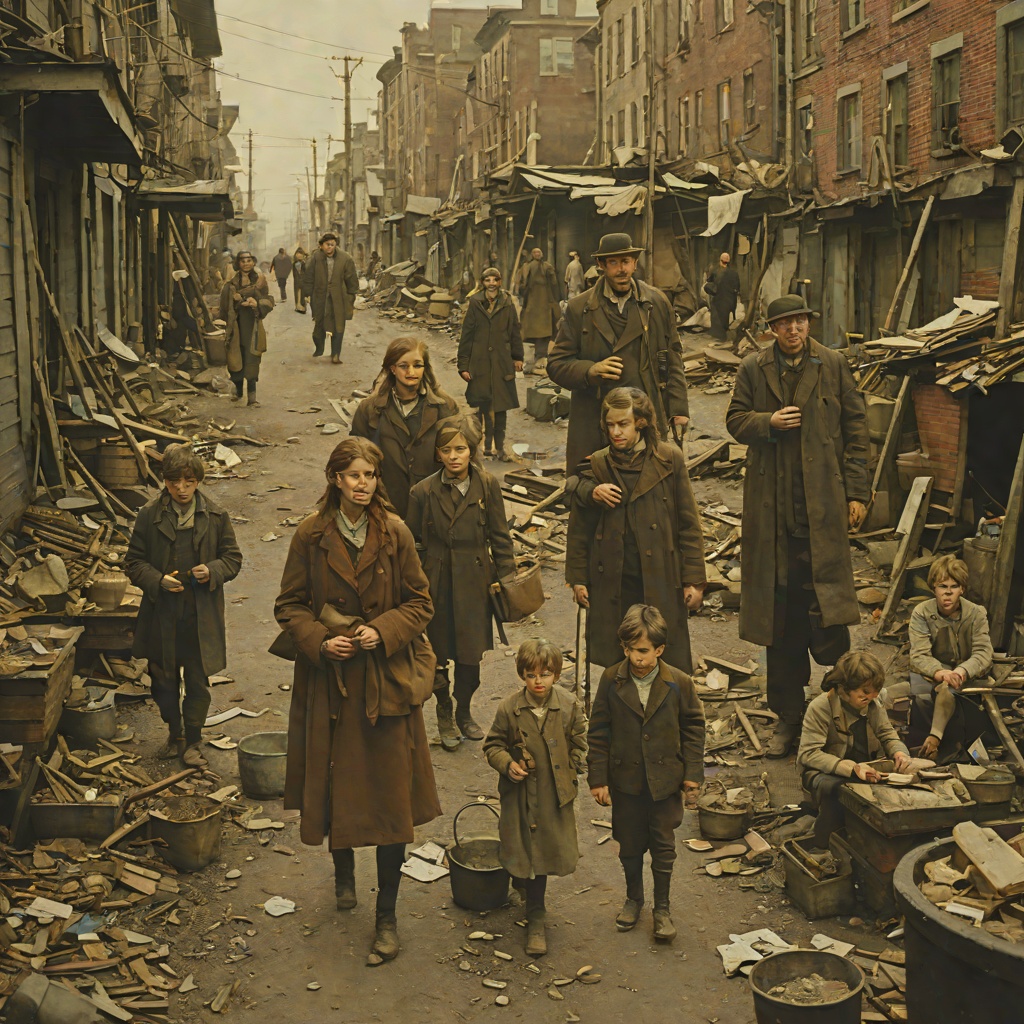
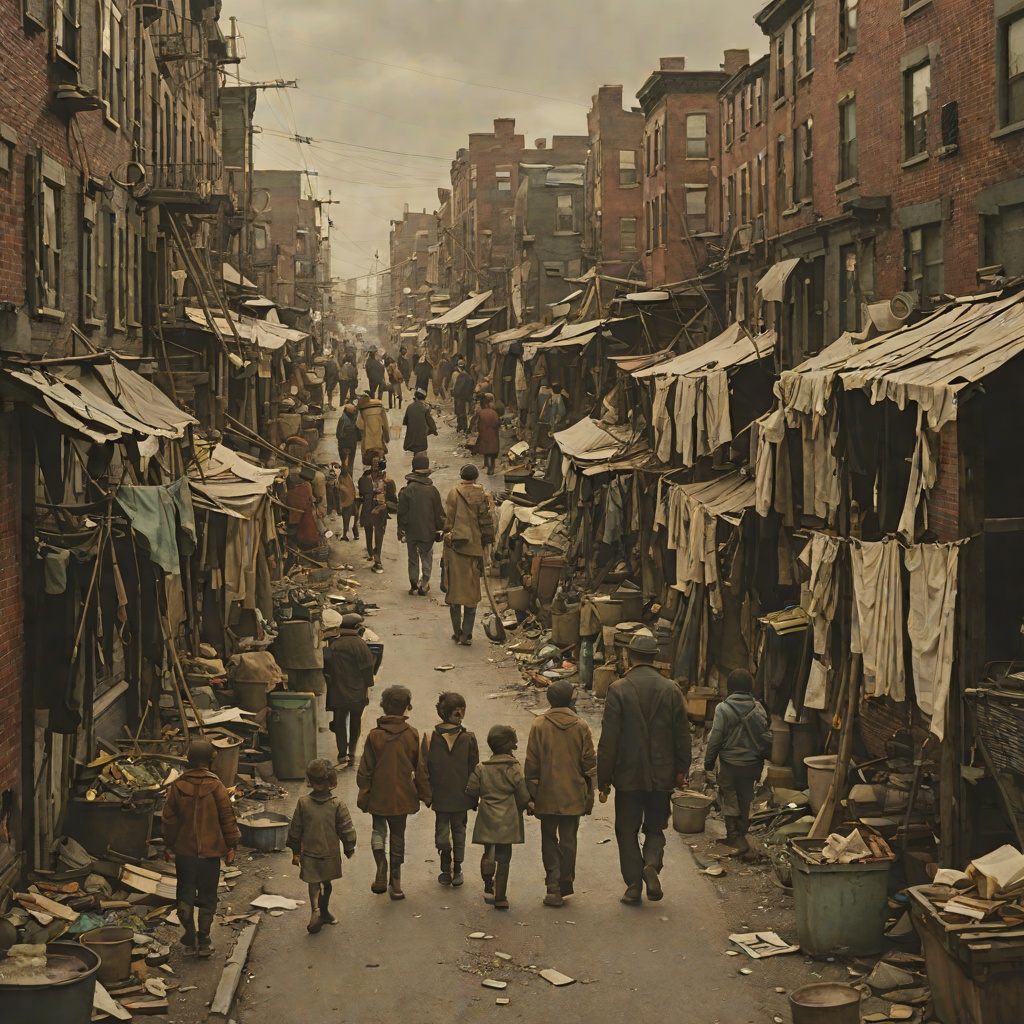
Harrison Avenue is to the South End what Salem Street is to the North End: the defining thoroughfare of the Jewish immigrant district. For the greater part of its length it forms the heart of the South End ghetto, though its northern end belongs to the realm of Chinatown. The street's multifarious business bursts through the narrow shop doors and overruns the basements, the sidewalk, and the street itself in pushcarts and open-air stands. Its multitudinous population bursts through the greasy tenement doors and floods the corridors, the doorsteps, the gutters, and the side streets, pushing in and out among the pushcarts all day long and half the night besides. Rarely is Harrison Avenue caught asleep, and even more rarely is it found clean; nothing less than a fire or flood would cleanse this street.
The filth of Harrison Avenue is not merely incidental but structural. Even Passover cannot quite accomplish the feat of cleansing it. Although the tenements may be scrubbed to their remotest corners on this one occasion, the cleansing stops at the curbstone. A great deal of the filthy rubbish accumulated in a year is pitched into the street, often through the windows; and what the ashman on his daily round does not remove is left to be trampled to powder, in which form it steals back into the houses from which it was so lately removed. The City Fathers provide soap and water for the slums in the form of excellent schools, kindergartens, and branch libraries, but there they stop: at the curbstone of the people's life. They cleanse and discipline the children's minds, but their bodies they pitch into the gutter, for there are no parks and almost no playgrounds in the Harrison Avenue district—in Mary's day there were none—and such as there are have been wrenched from the city by public-spirited citizens who have no offices in City Hall.
The Family's Arrival and Domestic Life
Mary's family came to the South End after a year or so in Chelsea, when her father, finding a discrepancy between his assets and liabilities on the wrong side of the ledger, once more struck tent, collected his flock, and set out in search of richer pastures. There was a charming simplicity about these proceedings: here to-day, apparently rooted; there to-morrow, and just as much at home. Another basement grocery, with a freshly painted sign over the door; the broom in the corner, the loaf on the table—these things made home for them. There were rather more Negroes on Wheeler Street, in the lower South End of Boston, than there had been on Arlington Street, which promised more numerous outstanding accounts; but they were a neighborly folk, and they took the strangers in—sometimes very badly. Then there was the school three blocks away, where "America" was sung to the same tune as in Chelsea, and geography was made as dark a mystery. It was impossible not to feel at home. Presently, lest anything be lacking to their domestic bliss, there was a new baby in a borrowed crib; and little Dora had only a few more turns to take with her battered doll carriage before a life-size vehicle with a more animated dolly was turned over to her constant care.
The Wheeler Street neighborhood is not a place where a refined young lady would care to find herself alone, even in the cheery daylight. If she came at all, she would be attended by a trusty escort. She would not get too close to people on the doorsteps, and she would shrink away in disgust and fear from a blear-eyed creature careering down the sidewalk on many-jointed legs. The delicate damsel would hasten home to wash and purify and perfume herself till the foul contact of Wheeler Street was utterly eradicated, and her wonted purity restored. Mary does not blame her, but wishes that she would bring a little soap and water and perfumery into Wheeler Street next time she comes; for some people there may be smothering in the filth which they abhor as much as she, but from which they cannot, like her, run away.
Justice and Contrast on the Avenue
The moral lessons of Harrison Avenue extend beyond its squalor. In a striking incident, a great, hulky colored boy, who was the torment of the neighborhood, treated Mary roughly while she was playing on the street. Her father, determined to teach the rascal a lesson for once, had him arrested and brought to court. The boy was locked up overnight, and he emerged from his brief imprisonment with a respect for the rights and persons of his neighbors. But the moral of this incident lies not in the revenge on a bully but in what Mary saw of the way in which justice was actually administered in the United States. There they were gathered in the little courtroom, bearded Arlington Street against wool-headed Arlington Street; accused and accuser, witnesses, sympathizers, sight-seers, and all. Nobody cringed, nobody was bullied, nobody lied who didn't want to. They were all free, and all treated equally, just as it said in the Constitution. The evil-doer was actually punished, and not the victim, as might very easily happen in a similar case in Russia. "Liberty and justice for all."
The Double Life and the Measure of Ascent
Harrison Avenue and its surrounding slums become the baseline against which Mary measures her extraordinary ascent. She could fill another book with anecdotes of how she took possession of Beacon Street, and learned to distinguish the lord of the manor from the butler in full dress. She traces her steps from her bare room overlooking the lumber-yard to the satin drawing-rooms of the Back Bay, where she drank afternoon tea with gentle ladies whose hands were as delicate as their porcelain cups. Coming straight from the cushioned refinement of Beacon Street, where the maid who brought her hostess her slippers spoke in softer accents than the finest people on Dover Street, she sometimes stumbled over poor Mr. Casey lying asleep in the corridor; and the shock of the contrast was like a searchlight turned suddenly on her life. She pondered over the revelation, and wrote touching poems, in which she figured as a heroine of two worlds. The reeking slums of Harrison Avenue and the gilded drawing-rooms of the Back Bay thus define the poles of her double life, and the avenue itself stands as the enduring emblem of the world she left behind—the world whose filth and vitality alike shaped the immigrant consciousness she carried into American society.