Heritage
The Captain and Ann BarbaraHeritage is a central concept in Mary Antin's memoir The Promised Land, representing the dual inheritance of Jewish tradition and American opportunity. The term appears as a chapter title and recurs throughout the narrative to explore how the author reconciles her ancestral past with her new identity as an American citizen. Heritage encompasses both the sacred Torah passed down through generations and the democratic ideals of her adopted country, ultimately becoming a symbol of personal transformation and cultural synthesis.
The Sacred Inheritance of the Torah
The concept of heritage first emerges in the context of Jewish religious education in Polotzk. When a boy entered heder, he was presented with a bun on which were traced in honey the words: "The Torah left by Moses is the heritage of the children of Jacob." This ritual marked the beginning of a boy's formal religious training, typically starting around age five, and established the Torah as the foundational inheritance of the Jewish people. The honey-sweetened words symbolized the sweetness of sacred learning, a tradition so central that no Jewish boy was allowed to grow up without at least a rudimentary knowledge of Hebrew. The scantiest income had to be divided to provide for the boys' tuition, and to leave a boy without a teacher was considered a disgrace upon the whole family, to the remotest relative. This sacred heritage was so valued that a heder boy became the hero of the family, served before other children at table, and was given shoes and hot soup even if the family was very poor and all the girls went barefoot.
The Burden of a Persecuted Past
Heritage also carried the weight of persecution and suffering. The memoir recounts the dreadful conditions of the old régime under which Jewish boys could be taken from their mothers to be made into soldiers and Christians. Even under the "New Régime" of Alexander III, who was no friend of the Jews, military service forced Jewish recruits to break the Jewish laws of daily life, eating trefah, working on Sabbath, shaving their beards, and doing reverence to Christian things. The stigma of these enforced sins could not be shaken off even after returning home. Beyond religious violation, conscription at age twenty-one often meant leaving behind wives and children, with families suffering and businesses ruined during the soldier's absence. At the end of their term, they were sent home as beggars, stripped of their good uniforms and given shabby ones, with only a free ticket and a few kopecks a day for expenses, hurried back into the Pale like escaped prisoners. This heritage of persecution was compounded by periodic anti-Semitic movements, such as the wholesale expulsion of Jews from Moscow and its surrounding district at cruelly short notice, which drove hundreds of fugitives into the open districts, spreading hardship and ruin ring beyond ring.
The American Inheritance of Freedom
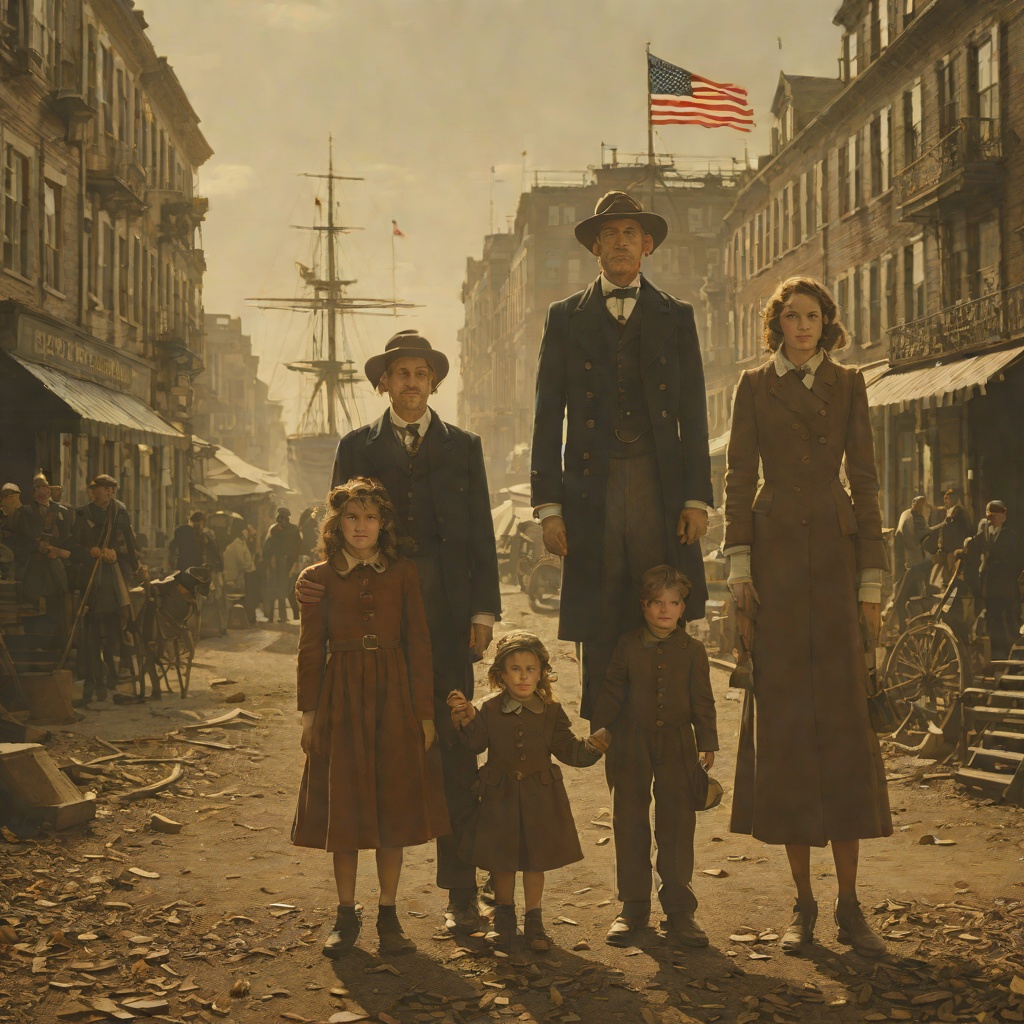
In America, heritage took on a new meaning. Mary's father, who had emigrated three years before the family, made his application for naturalization almost his first act on landing on American soil. He took the remaining steps with eager promptness and became a citizen of the United States at the earliest moment allowed by law. For him, the boasted freedom of the New World meant far more than the right to reside, travel, and work wherever he pleased; it meant the freedom to speak his thoughts, to throw off the shackles of superstition, and to test his own fate, unhindered by political or religious tyranny. This American heritage was demonstrated in a small courtroom in Chelsea, where a great, hulky colored boy who had treated Mary roughly was arrested and brought to court. In the little courtroom, bearded Arlington Street faced wool-headed Arlington Street, and nobody cringed, nobody was bullied, nobody lied who didn't want to. "Liberty and justice for all" was not just a phrase but a lived reality, a stark contrast to what might easily have happened in a similar case in Russia. The evil-doer was actually punished, and not the victim, and Mary saw that justice was administered as it said in the Constitution.
The Pains of Adjustment and the New Heritage
The process of Americanization, however, came at a cost. The disintegration of home life, observed in almost any immigrant family of their class and traditions, was part of the process of Americanization, an upheaval preceding the state of repose. It was the cross that the first and second generations must bear, an involuntary sacrifice for the sake of the future generations. These were the pains of adjustment, as racking as the pains of birth. Yet, as the mother forgets her agonies in the bliss of clasping her babe to her breast, so the bent and heart-sore immigrant forgets exile and homesickness and ridicule and loss and estrangement when he beholds his sons and daughters moving as Americans among Americans. The heritage of the past was not discarded but transformed. Mary's father, who had been endowed at birth with a poor constitution, a nervous, restless temperament, and an abundance of hindering prejudices, had been held in leading-strings most of his life, but in America he was hungry for his untasted manhood. The heritage of sacred learning, once sold for bread and salt, was now being reinvested in the education of his children in American public schools.
The Past as Cradle, Not Prison
Mary's final meditation on heritage comes at the Boston Public Library, where she reflects on her place in history. She declares that the past was only her cradle, and now it cannot hold her because she is grown too big, just as the little house in Polotzk, once her home, has now become a toy of memory. She asserts, "No! it is not I that belong to the past, but the past that belongs to me." America, the youngest of the nations, inherits all that went before in history, and Mary, as the youngest of America's children, is given all her priceless heritage, to the last white star espied through the telescope, to the last great thought of the philosopher. This is the culmination of the concept of heritage in the memoir: the Jewish heritage of Torah and persecution, and the American heritage of freedom and opportunity, are not in conflict but are synthesized into a new, personal inheritance. The heritage of the past becomes a foundation upon which the future is built, and Mary's own journey from the slums of Dover Street to the intellectual summit of the latest century embodies this transformation. The heritage is not a static possession but a dynamic force, one that moves the world through personal presence and allows the individual to claim the whole majestic past and the shining future as their own.