Pogrom
The Captain and Ann BarbaraIn Mary Antin's memoir The Promised Land, the pogrom stands as the most extreme expression of the persecution that defined Jewish existence in the Russian Empire's Pale of Settlement. The term names the organized attacks in which Gentile mobs, often inflamed by vodka and the ancient blood libel—the lie that Jews murdered Christian children—set out to kill Jews with knives, clubs, scythes, and axes, torturing or murdering them and burning their houses. For Antin, the pogrom is not an abstract historical category but the central terror of her childhood, the force that made the world feel divided into Jews and Gentiles and that drove her family, and ultimately herself, toward the promise of America. Its shadow falls across the entire memoir, from her earliest lessons in Polotzk to her father's emigration and her own transformation into an American schoolgirl, making it the indispensable background against which her celebrated freedom is understood.
The Pogrom as a Defining Threat in the Pale
The pogrom was the violent culmination of the system that confined Jews to the Pale of Settlement, the designated area that included Polotzk, Vitebsk, and Vilna, where the Czar commanded Jews to stay. Within this fence, as Antin came to understand it, the threat of violence was ever-present, even if an actual pogrom never broke out in her own street. The horror was communicated to her from the earliest age through the stories of survivors who escaped to Polotzk bearing wounds and terrible tales—of little babies torn limb from limb before their mothers' eyes. Merely hearing such accounts made one sob and choke with pain, and Antin records that people who witnessed such atrocities never smiled again, that some had their hair turn white in a single day, and that others became insane on the spot. The pogrom was thus not only a physical danger but a psychological wound that permeated the consciousness of every Jewish child in the Pale.
The Priest, the Cross, and the Fear of Baptism
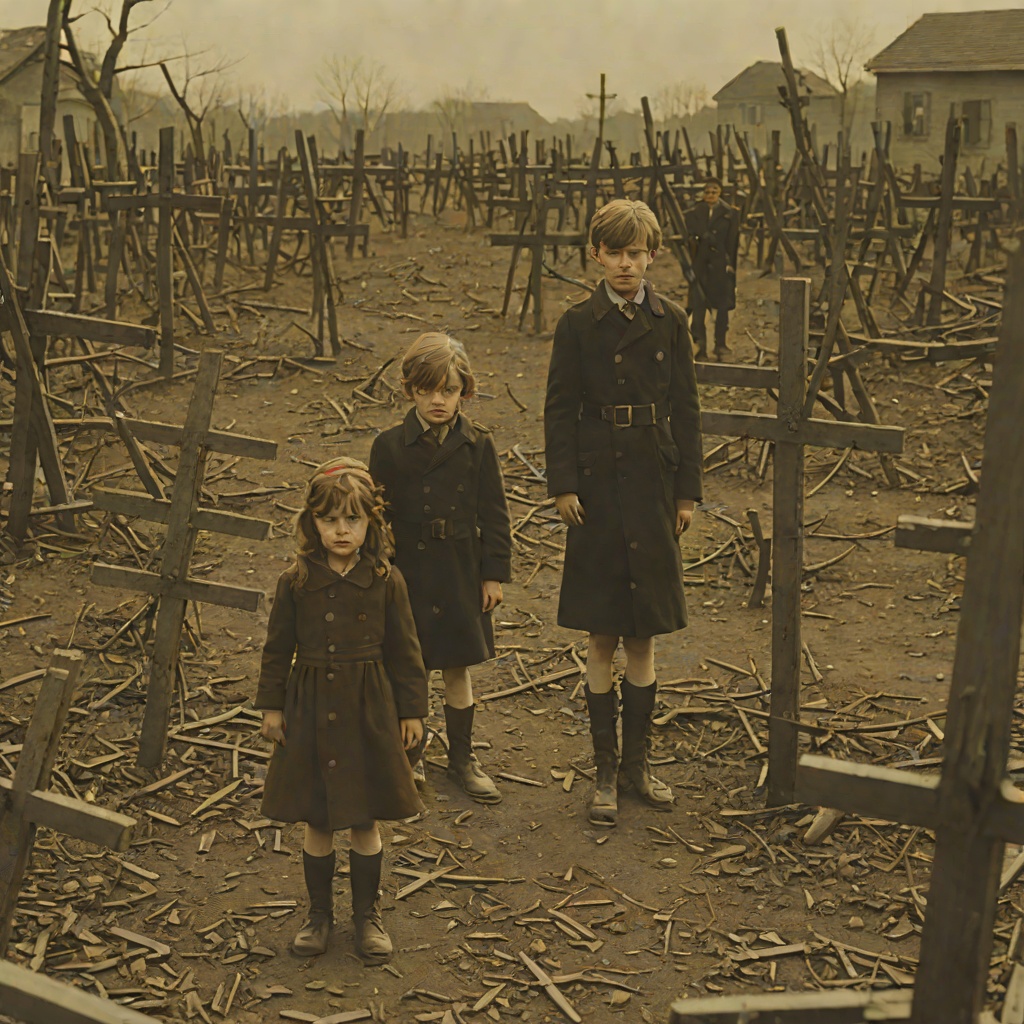
A distinctive feature of the pogrom as Antin describes it was its religious dimension: the mob was often led by a priest carrying a cross, and the cross was held up as the excuse for cruelty. In her fearful imaginings, as she hid in dark corners thinking of what the Gentiles might do to her, she always saw the cross—the cruel cross. This religious framing intensified the terror, for it meant that the violence was not merely random hatred but a sanctioned, ritualized persecution. The worst fate Antin could imagine was not death by burning or rending but baptism: to be forced to kneel before hideous images, to kiss the cross, to forswear the One God and bow before idols. She declared that she would rather drown in the Dvina than have a drop of baptismal water touch her forehead, and that she would rather be seized with the plague and eaten by vermin than submit. This hierarchy of horrors—in which forced conversion was worse than death—reveals how deeply the pogrom's religious symbolism penetrated her childhood psyche.
The Procession Through the Shutter Crack
Antin's most vivid memory of the pogrom threat came on a Christian holiday when the police had warned Jews to keep indoors. Gates were locked, shutters barred, and if a child cried, the nurse threatened to give it to the priest who would soon be passing by. Fearful yet curious, Antin looked through the cracks in the shutters and saw a procession of peasants and townspeople led by priests carrying crosses, banners, and images, with a casket containing a relic from the monastery on the outskirts of Polotzk held in the place of honor. Once a year the Gentiles paraded with this relic, and on that occasion the streets were considered too holy for Jews to be about. When Antin asked the nurse why the soldiers and police were in the street, the nurse thoughtlessly answered, "In case of a pogrom." In that moment, everything seemed ready: the crosses, the priests, the mob, the pealing church bells. Antin was convinced the Gentiles were going to tear her to pieces with axes and knives and ropes, or burn her alive, and she wondered that she did not die of fear. The scene crystallizes the pogrom as a suspended, imminent catastrophe—a threat that defined daily life even when it never fully arrived.
The Broader System of Oppression
The pogrom was one element of a larger structure of state oppression that Antin catalogs with bitter precision. The Czar's government imposed a bewildering array of taxes—on houses, rents, business, and profits—collected by the town, the county, and the central government, while the chief of police was always present. Even a railroad bridge across the Dvina, open to the military, could be used by the people only by individual permission. Military conscription was another burden: Jewish men of twenty-one, often already married with children, were forced into four years of service during which they had to eat trefah, work on the Sabbath, shave their beards, and do reverence to Christian things, returning home as beggars stripped of their uniforms and hurried back into the Pale like escaped prisoners. The system drove people to desperate measures, including self-inflicted injuries to escape conscription, leaving many men in Polotzk blind of one eye, hard of hearing, or lame. The pogrom, in this context, was the most violent face of a regime that treated Jews as perpetual outsiders, and it was this entire system—not merely the threat of massacre—that the family sought to escape.
The Pogrom's Role in the American Contrast
The pogrom and its associated oppressions form the dark backdrop against which America's promise is measured. When Antin's father emigrated, he went blessing the necessity that drove him to America, for the boasted freedom of the New World meant far more than the right to reside and work wherever he pleased—it meant the freedom to speak his thoughts and throw off the shackles of superstition. The contrast is sharpened by the fact that the pogrom's religious persecution, with its crosses and forced conversions, finds its opposite in the American doctrine of the separation of church and state, which Antin learned about when she was scolded for a religious argument in the schoolyard. The memory of the pogrom thus underwrites the memoir's central argument: that American freedom is a real and precious thing, precisely because it stands against the world of the Pale where Jews lived in fear of massacre and baptism. The pogrom is the negative image of the Promised Land, the horror that makes the deliverance meaningful.