Reb' Lebe
The Captain and Ann BarbaraReb' Lebe was the girls' Hebrew teacher in Polotzk who instructed Mary Antin and her sister Fetchke, a lean and rusty figure whose limited scholarship reflected the low status of female education in the Pale of Settlement. His significance lies in the contrast he embodies: a teacher whose rote methods and personal timidity stand against the eager curiosity of his pupil, and whose departure from Mary's life marks her transition from the Old World's constrained learning toward the liberating education of America.
Identity and Background
Reb' Lebe was no great scholar, a fact that Mary Antin states plainly, noting that great scholars would not waste their learning on mere girls. He knew enough to teach girls Hebrew, which was the ceiling of his ambition and the measure of his station. Tall and lean was the rebbe, with a lean, pointed face and a thin, pointed beard. The beard became pointed from much stroking and pulling downwards. His hands were large, and his beard was not half a handful. The fingers of the rebbe were long, and the nails, Mary confesses, were not very clean. His coat was rusty, and so was his skull-cap. Remember, Reb' Lebe was only a girls' teacher, and nobody would pay much for teaching girls. This economic reality defined him: he was a figure of diminished status in a society where female education was itself diminished, a man whose very appearance bore the marks of his lowly position.
The educational world Reb' Lebe inhabited was one of strict gender division. For a girl it was enough if she could read her prayers in Hebrew, and follow the meaning by the Yiddish translation at the bottom of the page. It did not take long to learn this much, a couple of terms with a rebbetzin, a female teacher, and after that she was done with books. A girl's real schoolroom was her mother's kitchen, where she learned to bake and cook and manage, to knit, sew, and embroider, and while her hands were busy, her mother instructed her in the laws regulating a pious Jewish household and in the conduct proper for a Jewish wife. Marriage was a sacrament with the Jews in the Pale; to rear a family of children was to serve God, and woman's only work was motherhood. Reb' Lebe's teaching of Hebrew to girls was thus a marginal enterprise within a system that reserved true scholarship for men and destined women for the kitchen and the marriage bed.
The Lessons and the Pupil's Hunger
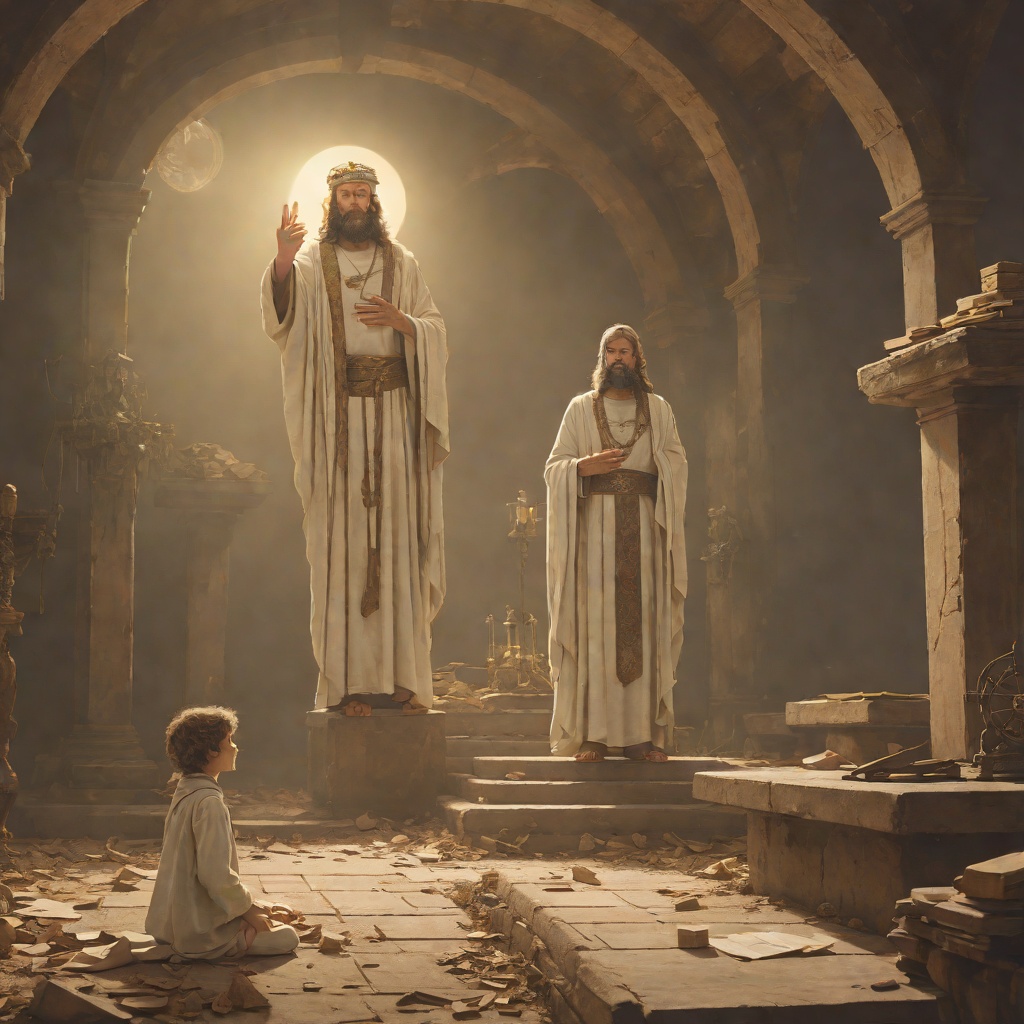
For a short time Mary and her sister went for their lessons to Reb' Lebe's heder, in the bare room off the women's gallery, up one flight of stairs, in a synagogue. The place was as noisy as a reckless expenditure of lung power could make it. The pupils on the bench shouted their way from aleph to tav, cheered and prompted by the growl of the rebbe, while the children in the corridor waiting their turn played puss in the corner and other noisy games. Soon, however, Fetchke and Mary began to have their lessons in private, at their own home, sitting one on each side of the rebbe, reading the Hebrew sentences turn and turn about.
When they left off reading by rote and Reb' Lebe began to reveal the mysteries to them, Mary was so eager to know all that was in her book that the lesson was always too short. She continued reading by the hour, after the rebbe was gone, though she understood about one word in ten. Her favorite Hebrew reading was the Psalms. Verse after verse she chanted to the monotonous tune taught by Reb' Lebe, rocking to the rhythm of the chant, just like the rebbe. She loved the sound of the words, the full, dense, solid sound of them, to the meditative chant of Reb' Lebe. She pronounced Hebrew very well, and caught some mechanical trick of accent and emphasis, which was sufficiently like Reb' Lebe's to make her reading sound intelligent. Drawing on her imagination for details, she was able to read with so much spirit that ignorant listeners were carried away by her performance, and her mother tells her that people used to stop outside her window to hear her read. Of this she has not the slightest recollection, so she supposes she was an unconscious impostor. Certain she is that she thought no ignoble thoughts as she chanted the sacred words.
The Question That Silenced the Rebbe
A pivotal moment in their relationship came when Mary, having absorbed all the mechanical skill Reb' Lebe could impart, began to ask questions that his learning could not answer. One day, as the rebbe was about to leave, the pupil, timidly but determinedly, detained him with a question: "Reb' Lebe, who made God?" The rebbe regarded the pupil in amazement mixed with anxiety. His emotion was beyond speech. He turned and left the room. In his perturbation he even forgot to kiss the mezuzah on the doorpost. The pupil felt reproved and yet somehow in the right. Who did make God? But if the rebbe will not tell, will not tell? Or, perhaps, he does not know? The rebbe? This conflict between her curiosity and his obtuseness marked a turning point, after which Mary remembers no more of him as a teacher.
The question was not merely a child's idle wonder; it was a challenge to the entire edifice of rote learning that Reb' Lebe represented. In a system where girls were taught just enough Hebrew to read their prayers without understanding, Mary's demand to know the origin of God himself was a rupture, a reaching beyond the boundaries of what a girls' teacher was equipped to handle. The rebbe's flight from the question, his forgetting even the mezuzah, revealed the limits of his authority and the poverty of his intellectual resources. It was the moment when the pupil surpassed the teacher, not in knowledge, but in the audacity of her questioning.
The Sausage Incident and the Loss of Respect
It was some time after this conflict between her curiosity and his obtuseness that Mary saw her teacher act a ridiculous part in a trifling comedy, and then she remembers no more of him. Reb' Lebe lingered one day after the lesson. A guest who was about to depart, wishing to fortify himself for his journey, took a roll of hard sausage from his satchel and laid it, with his clasp knife, on the table. He cut himself a slice and ate it standing; and then, noticing the thin, lean rebbe, he invited him, by a gesture, to help himself to the sausage. The rebbe put his hands behind his coat tails, declining the traveller's hospitality. The traveller forgot the other, and walked up and down, ready in his fur coat and cap, till his carriage should arrive. The sausage remained on the table, thick and spicy and brown. No such sausage was known in Polotzk. Reb' Lebe looked at it. Reb' Lebe continued to look. The stranger stopped to cut another slice, and repeated his gesture of invitation. Reb' Lebe moved a step towards the table, but his hands stuck behind his coat tails. The traveller resumed his walk. Reb' Lebe moved another step. The stranger was not looking. The rebbe's courage rose, he advanced towards the table; he stretched out his hand for the knife. At that instant the door opened, the carriage was announced. The eager traveller, without noticing Reb' Lebe, swept up sausage and knife, just at the moment when the timid rebbe was about to cut himself a delicious slice.
Mary saw his discomfiture from her corner, and she is obliged to confess that she enjoyed it. His face always looked foolish to her after that; but, fortunately for them both, they did not study together much longer. The sausage incident is a small, almost comic scene, but it is devastating in its implications. The rebbe's hunger, his timidity, his inability to seize the moment, and his final humiliation all strip away the dignity that his pupils had granted him. Where once his pupils regarded him with entire respect and followed his pointer with earnest eyes, now Mary saw only a foolish, hungry man who could not even reach for what he wanted. The loss of respect was complete, and it coincided with the end of their studies together.
Departure and the Larger Trajectory
Reb' Lebe's departure from Mary's life marks the end of her Old World education and the beginning of her American transformation. The contrast between the two worlds could not be starker. In Polotzk, a girl's education was a brief, shallow affair, conducted by a poorly paid, poorly equipped teacher like Reb' Lebe, who taught by rote and fled from questions. In America, Mary would enter the public schools, where teachers like Miss Nixon and Miss Dillingham would advance her from grade to grade as fast as her knowledge of English allowed, without reference to the usual schedule of promotions. The American teachers, unlike Reb' Lebe, were rewarded for their skill and dedication, and they helped Mary not only to learn English but to love it. She would later declare her love for the English language, glad that the Americans began by being Englishmen, for thus did she come to inherit this beautiful language in which she thinks. It seems to her that in any other language happiness is not so sweet, logic is not so clear.
The trajectory from Reb' Lebe's heder to the American public school is the trajectory of the book itself: from the narrowness of the Pale, where scholarship was confined to Hebrew and even that was unequally divided between men and women, to the openness of America, where ability would be promptly recognized in the public schools. Reb' Lebe, with his rusty coat and his pointed beard, his rote methods and his unanswerable questions, stands as the embodiment of the Old World's limitations. His failure to answer Mary's question about God, and his failure to seize the sausage, are twin failures of nerve and knowledge that define him. Yet he is not a villain; he is a product of his system, a man who knew enough to teach girls Hebrew and nothing more. Mary's parting from him is not bitter but fortunate, for them both. She moves on to a world where her questions will find answers, and he remains behind, a figure of the past, remembered with a mixture of respect for what he taught and amusement at what he could not.
In the larger narrative, Reb' Lebe serves as a foil to the American teachers who follow him. Where he was lean and rusty, they are described with warmth and admiration. Where he taught by rote and fled from questions, they invent mouth exercises to help Mary produce the sound of w, and they halt the lesson to give her a lift over her private difficulties. Where he was a girls' teacher because nobody would pay much for teaching girls, they are professionals who advance their pupils without reference to the usual schedule. The contrast is not merely personal but systemic: it is the contrast between a society that saw female education as a brief, shallow affair and a society that saw it as a right and an opportunity. Reb' Lebe, in his smallness and his timidity, makes the American promise vivid by its opposite. He is the past that Mary leaves behind, the Old World that she is made over from, and his memory lingers in her account as a measure of how far she has come.