Shadchan
The Captain and Ann BarbaraThe Shadchan, or marriage broker, stands as one of the most powerful and revealing institutions in Mary Antin's account of Jewish life in the Pale of Settlement. In the world of Polotzk that Antin describes, the shadchan was not a marginal figure but the central engine of courtship, the commercial intermediary who transformed marriage from a personal choice into a family transaction. The memoir presents the broker as the embodiment of the Old-World system that governed every Jewish girl's destiny, and it measures the distance of Americanization precisely by how far the immigrant generation moved from the broker's reach. Antin's narrative uses the shadchan as a recurring touchstone: the institution appears in her parents' generation as an inescapable force, and its gradual obsolescence in America becomes a quiet index of the new world's promise of freedom, especially for women.
The Shadchan's Role in the Marriage Market
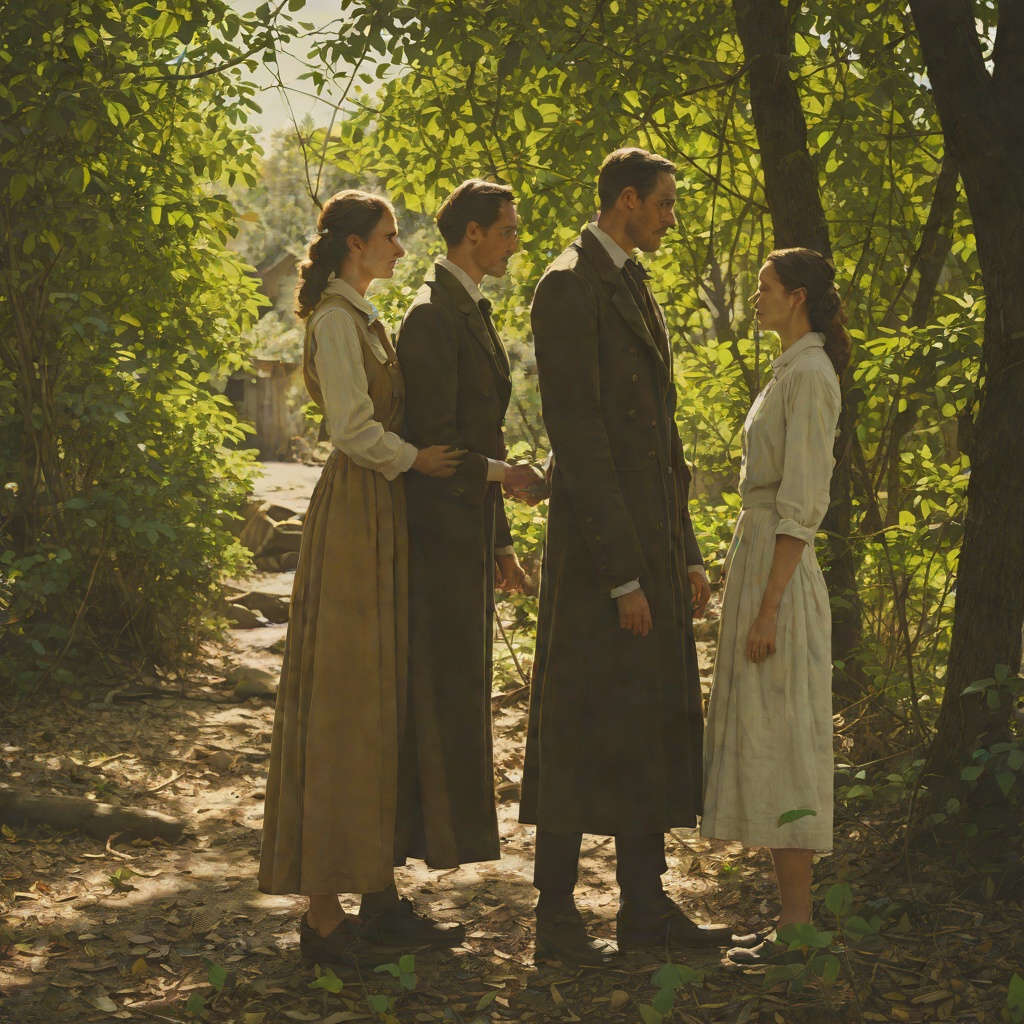
The shadchan's function, as Antin describes it, was thoroughly commercial. For months at a time, the broker advertised a girl's housewifely talents, her piety, her good looks, and her marriage portion among families with marriageable sons. When a match was proposed, the girl herself was brought in at the last moment to be examined and appraised by her prospective parents-in-law, a process that reduced courtship to a transaction of inspection and negotiation. If the negotiations went off smoothly, the marriage contract was written, presents were exchanged between the engaged couple through their respective parents, and all that remained of the girl's maidenhood was a period of busy preparation for the wedding. The system was so pervasive that a girl's education was explicitly oriented toward it: her real schoolroom was her mother's kitchen, where she learned to bake, cook, manage, knit, sew, and embroider, while her mother instructed her in the laws regulating a pious Jewish household and the conduct proper for a Jewish wife. Every girl hoped to be a wife, Antin notes, for a girl was born for no other purpose.
Marriage as Sacrament and the Pressure to Marry
Behind the shadchan's commercial activity lay a religious imperative that gave the broker his power. Marriage was a sacrament among the Jews of the Pale, and to rear a family of children was to serve God. Every Jewish man and woman had a part in the fulfilment of the ancient promise given to Jacob that his seed should be abundantly scattered over the earth, making parenthood the great career. But while men might also busy themselves with the study of the Law, woman's only work was motherhood. To be left an old maid became the greatest misfortune that could threaten a girl, and to ward off that calamity the girl and her family, to the most distant relatives, would strain every nerve—whether by contributing to her dowry, hiding her defects from the marriage broker, or praying and fasting that God might send her a husband. The pressure was compounded by the rule that children must marry in the order of their ages: a younger daughter must on no account marry before an elder, so a houseful of daughters might be held up entirely because the eldest failed to find favor in the eyes of prospective mothers-in-law. Antin records a cousin who was guilty of the disloyalty of wishing to marry before her elder sister, who was rejected by one mother-in-law after another; the uncle, fearing disgrace, hastily concluded an alliance with a family far beneath him, and the girl was married to a boy of whom little was known beyond the fact that he was inclined to consumption.
The Father's Betrothal Through the Broker
The shadchan's reach extended to men as well, as Antin's account of her father's youth makes clear. At the age of sixteen and a half, her father lent a willing ear to the cooing voice of the marriage broker. It was high time for him to marry: his parents had kept him so far, but they had two daughters to marry off and not a groschen laid by for their dowries, while the cost of his schooling had mounted to seventeen rubles a term. The time had come to find him a well-to-do father-in-law who should support him and his wife and children while he continued to study in the seminary. After the usual conferences between parents and marriage brokers, the father was betrothed to an undertaker's daughter in Polotzk. The girl was too old—every day of twenty years—but three hundred rubles in dowry, with board after marriage and handsome presents to the bridegroom, easily offset the bride's age. The boy was happy enough, displaying a watch and chain for the first time in his life and a good coat on week days, and he could have no objection to his fiancée, as he had seen her only at a distance and had never spoken to her. This second match made the father consider himself a man of experience, determined to have a hand in the affair himself.
The Mother's Resistance and Submission
The shadchan's power is most vividly dramatized in the story of Antin's mother, who faced the broker's pressure with open resistance. Her aunt, covetous of her, had adopted a boy from the poorhouse and brought him up with every advantage, hoping the mother would marry him. The aunt dinned the boy's name in the mother's ears day and night, dressing her in flashing diamonds, heavy chains, and tinkling bracelets before the mirror, telling her they would all be hers when she became the bride of Mulke. But the mother would not have Mulke even if all the pearls in the ocean came with him: the boy was stupid and unteachable, of unspeakable origin, picked up from the dirty floor of the poorhouse, his father identified as the lazy porter who sometimes chopped a cord of wood for the grandmother. The mother ran away every time the shadchan came, begged to be left as she was, cried, and invoked her mother's support. But her mother, for the first time in her history, refused to take the daughter's part, joining the enemy—the family and the shadchan—and the girl saw that she was doomed. Of course she submitted, as what else could a dutiful daughter do in Polotzk, submitting to be weighed, measured, and appraised before her face. When the proposed hossen finally came to look her over, she did not recognize him: a beardless young man in top boots that wanted grease and a coat too thin for the weather came in for a package of cigarettes, and she climbed up on the counter to reach them down, never suspecting that this was the man she was to marry.
The Shadchan's Decline in America
The shadchan's fate in America marks the memoir's central argument about freedom. Antin's sister Frieda came to America too late to avail herself of the gifts of an American girlhood; had she been two years younger, she might have dodged her circumstances and evaded her Old-World fate, going to school and imbibing American ideas instead of marrying at seventeen. The father, too recently from the Old World to be entirely free from its social traditions, put Frieda to work out of necessity, and when she had an offer of marriage, he would not stand in the way of what he considered her welfare, letting her escape from the workshop while the roses were still in her cheeks. The act was a sacrifice, for the father was still in the woods financially and would sorely miss Frieda's wages, and there was no one to counsel him to give America more time with his daughter. Antin's own trajectory is the counter-example: she went to college, not to Radcliffe but to Barnard College, taking all the honors she deserved and learning to think in English without an accent. The shadchan, who had governed her parents' generation with absolute authority, simply disappears from her American story, replaced by the free choice and long girlhood that Antin names as the precious rights of an American woman. The institution that had once seemed as inevitable as the seasons becomes, in retrospect, the measure of how far the immigrant child had traveled from the world where a girl was born for no other purpose than to be a wife.