South End
The Captain and Ann BarbaraThe South End of Boston is the slum district where the Antin family lived after their emigration from Polotzk, and it is the setting for Mary Antin's most intense experiences of poverty, Americanization, and self-transformation. More than a mere location, the South End functions in the memoir as a symbolic landscape of both degradation and possibility, where the narrator confronts the harsh realities of immigrant life while also discovering the institutions—schools, clubs, libraries—that enable her rise. It is here that Mary learns to see America not as a promised land already achieved but as a promise to be fulfilled through struggle, and it is here that she plants the seeds of her eventual escape into the wider world of Boston's elite.
The Geography of the Slum
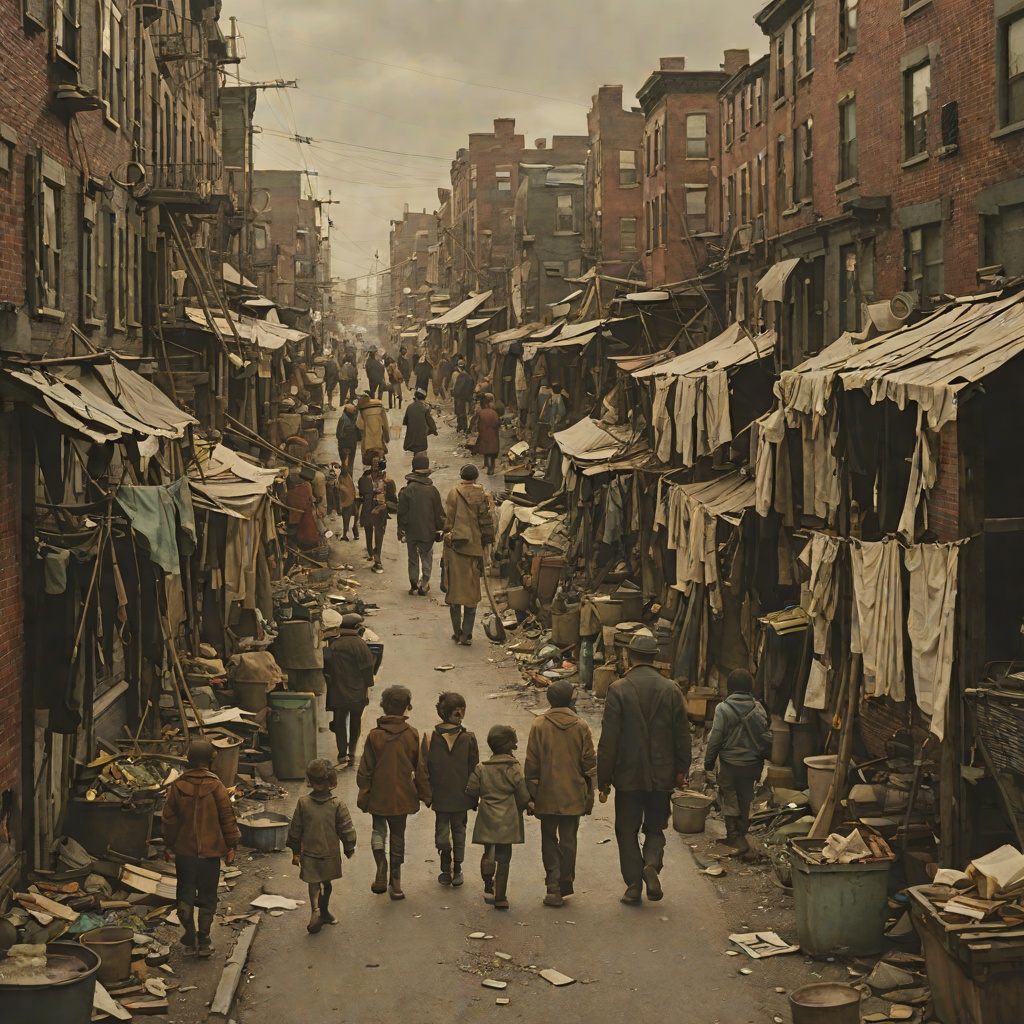
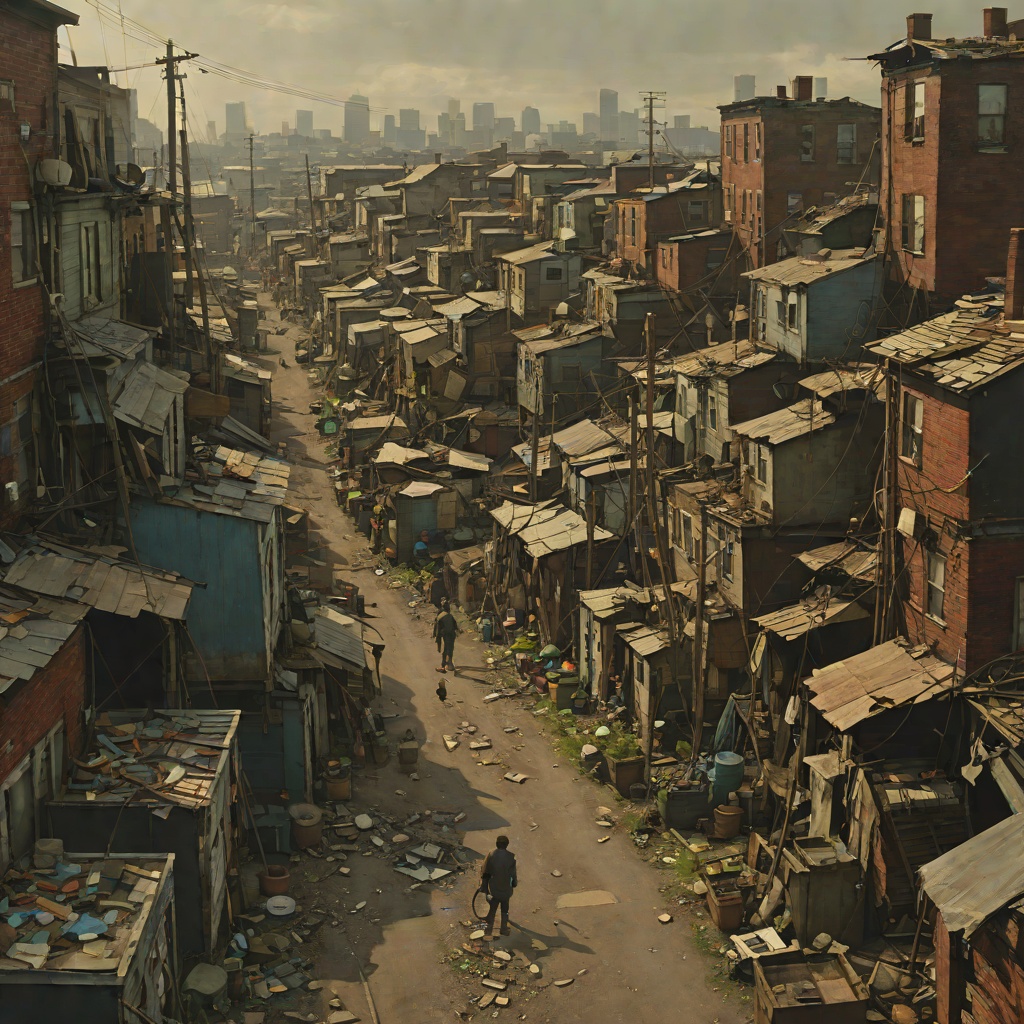
The South End is introduced in the memoir as a counterpart to the West End, where the family first settled upon arriving in Boston. While the West End, with its Wall Street and Union Place, is described as the tenement district or "slums of Boston," the South End is presented as an even more degraded version of the same phenomenon. Mary describes the South End streets as "rubbish heaps of damaged humanity," each one exhibiting "the same fashions of life, death, and endurance." The district is characterized by overcrowded tenements, dirty courts, and a general atmosphere of squalor that contrasts sharply with the clean, open spaces of the American landscape she had dreamed of during her journey from Russia. The narrator is careful to note that the South End is not a unique place but rather a typical example of the urban slum, a "house of detention for poor aliens" where immigrants live "on probation till they can show a certificate of good citizenship."
The heart of the South End ghetto, as Mary describes it, is Harrison Avenue, which intersects Dover Street near its eastern end. This street is to the South End what Salem Street is to the North End, a bustling commercial thoroughfare where "multifarious business bursts through the narrow shop doors, and overruns the basements, the sidewalk, the street itself, in pushcarts and open-air stands." The population, equally multifarious, floods the corridors, doorsteps, gutters, and side streets, pushing in and out among the pushcarts all day long and half the night besides. Harrison Avenue is rarely found clean, and Mary observes that "nothing less than a fire or flood would cleanse this street," noting that even Passover, with its thorough housecleaning, cannot accomplish the feat because the cleansing stops at the curbstone. The filth accumulated over a year is pitched into the street, often through the windows, and what the ashman does not remove is trampled to powder, which then steals back into the houses.
Life on Wheeler Street
The family's first South End home was on Wheeler Street, in the lower part of the district, where they moved after their time in Chelsea. The move was prompted by the father's financial difficulties, as he found "a discrepancy between his assets and liabilities on the wrong side of the ledger" and once more struck tent in search of richer pastures. The new home was another basement grocery with a freshly painted sign over the door, and Mary notes the "charming simplicity" of these proceedings: "Here to-day, apparently rooted; there to-morrow, and just as much at home." The neighborhood had more Negroes than Arlington Street had, which promised more numerous outstanding accounts for the grocery, but they were "a neighborly folk" who took the strangers in, "sometimes very badly." The school three blocks away sang "America" to the same tune as in Chelsea, and geography was made "as dark a mystery."
Wheeler Street itself is described in bleak terms. Mary writes that "there were no real homes" there, only "miserable flats of three or four rooms, or fewer, in which families that did not practise race suicide cooked, washed, and ate; slept from two to four in a bed, in windowless bedrooms; quarrelled in the gray morning, and made up in the smoky evening." There was no common life in any form that means life, no room for it, as beds and cribs took up most of the floor space and disorder packed the interspaces. The centre table in the "parlor" was not loaded with books but held invariably a photograph album and an ornamental lamp with a paper shade, usually out of order. The yard was only big enough for the perennial rubbish heap, and the narrow sidewalk was crowded. Mary is careful to distinguish her own family from this general picture, noting that their parlor was kept "pretty clear," the lamp on their centre table was always in order, and its light fell often on an open book.
The Clubs and the Search for Salvation
The neighborhood went in search of salvation to Morgan Memorial Hall, Barnard Memorial, Morgan Chapel, and other clean places that "lighted a candle in their window." Mary, her brother, and her sister Dora were introduced to some of the clubs by their young neighbors, and they were glad to go, for their home also gave them little besides meals in the kitchen and beds in the dark. With six of them, the store, the baby, and sometimes a "greener" or two from Polotzk whom they lodged as a matter of course till they found a permanent home, they needed to get out almost as much as their neighbors' children. Mary did not care for sewing or cooking, so she joined a dancing-club, where she was a failure. She had been a very good dancer in Russia, but here she found all the steps different, and she did not have the courage to go out in the middle of the slippery floor and mince it and toe it in front of the teacher. When she retired to a corner and tried to play dominoes, she became suddenly shy of her partner, and she never could win a game of checkers, although formerly she used to beat her father at it. She tried to be friends with a little girl she had known in Chelsea, but the girl met her advances coldly, for she lived on Appleton Street, which was too aristocratic to mix with Wheeler Street.
Dover Street: The Fairest Garden and the Prison
The family's final South End home was on Dover Street, which Mary describes in a famous passage of antitheses: "Dover Street was my fairest garden of girlhood, a gate of paradise, a window facing on a broad avenue of life. Dover Street was a prison, a school of discipline, a battlefield of sordid strife." The air was heavy with evil odors of degradation, but a breath from the uppermost heavens rippled through, whispering of infinite things. In Dover Street the dragon poverty gripped her for a last fight, but she overthrew the hideous creature and sat on his neck as on a throne. She was shackled with a hundred chains of disadvantage, but with one free hand she planted little seeds, right there in the mud of shame, that blossomed into the honeyed rose of widest freedom. There was often no loaf on the table, but the hand of some noble friend was ever in hers. The night was rent with the cries of wrong, but the thunders of truth crashed through the pitiful clamor and died out in prophetic silences.
The family had no particular reason for coming to Dover Street; it might just as well have been Applepie Alley. The father had sold, with the goods, fixtures, and good-will of the Wheeler Street store, all his hopes of ever making a living in the grocery trade, and Mary doubts if he got a silver dollar the more for them. They had to live somewhere, even if they were not making a living, so they came to Dover Street, where tenements were cheap, by which she means that rent was low. The ultimate cost of life in those tenements, in terms of human happiness, is high enough. Their new home consisted of five small rooms up two flights of stairs, with the right of way through the dark corridors. In the "parlor" the dingy paper hung in rags and the plaster fell in chunks. One of the bedrooms was absolutely dark and air-tight. The kitchen windows looked out on a dirty court, at the back of which was the rear tenement of the estate. To them belonged, along with the five rooms and the right of way aforesaid, a block of upper space the length of a pulley line across this court, and the width of an arc described by a windy Monday's wash in its remotest wanderings.
The Double Life and the Escape
Mary's life in the South End was a double life. From her bare room overlooking the lumber-yard, she traced her steps to the satin drawing-rooms of the Back Bay, where she drank afternoon tea with gentle ladies whose hands were as delicate as their porcelain cups. Coming straight from the cushioned refinement of Beacon Street, where the maid who brought her hostess her slippers spoke in softer accents than the finest people on Dover Street, she sometimes stumbled over poor Mr. Casey lying asleep in the corridor, and the shock of the contrast was like a searchlight turned suddenly on her life. She pondered over the revelation and wrote touching poems, in which she figured as a heroine of two worlds. The South End, with its poverty and degradation, was the ground from which she launched herself into the wider world, and it is the place she ultimately left behind, though she acknowledges that a long chapter of the romance of Dover Street is left untold. The district thus serves as the crucial testing ground of her Americanization, the place where she proved that even from the mud of shame, the honeyed rose of widest freedom could blossom.