Sunday law
The Captain and Ann BarbaraThe Sunday law, also known as a blue law or Sunday closing law, appears in Mary Antin's memoir as a distinctly American regulation that nonetheless carries a familiar weight of restriction. In the narrative, it functions as a force that curtails commercial activity on the Christian Sabbath, and its enforcement directly shapes the family's fortunes. Unlike the religious laws of the Pale of Settlement, which were imposed on Jews specifically because of their identity, the Sunday law is a general civic regulation, yet its impact on the Antin family is just as decisive, revealing that even the promised land has its own codes of conduct that must be obeyed.
The Sunday Law and the Dissolution of the Crescent Beach Partnership
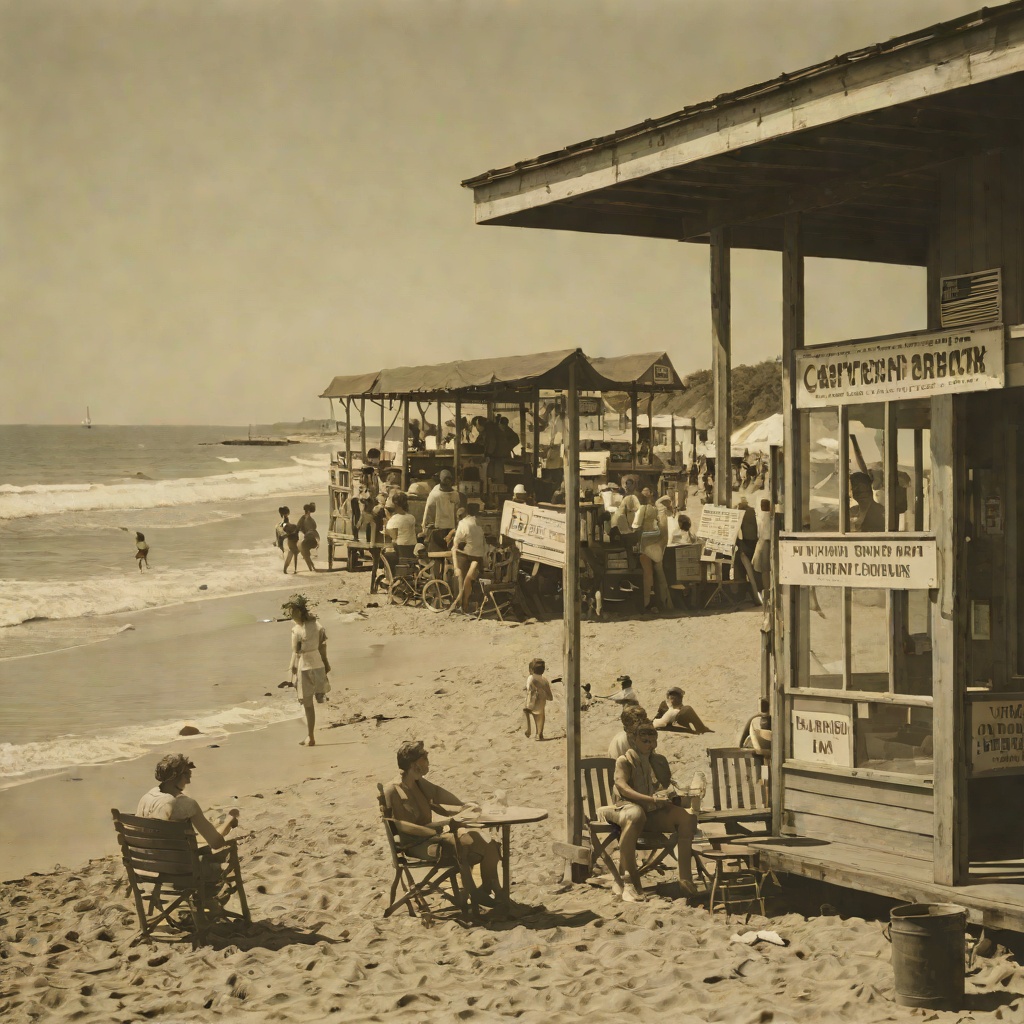
The most dramatic appearance of the Sunday law occurs at Crescent Beach, where the Antin family had entered into a promising partnership with Mr. Wilner. The venture was a source of great pride and joy, particularly for the young Mary Antin, who admired Mr. Wilner's skill at making potato chips that were "thin as tissue paper, crisp as dry snow, and salt as the sea." The business flourished, drawing crowds of holiday visitors, but this "splendor and glory and distinction came to a sudden end." The narrator lists the causes of the collapse: "there was some trouble about a license—some fee or fine—there was a storm in the night that damaged the soda fountain and other fixtures—there was talk and consultation between the houses of Antin and Wilner—and the promising partnership was dissolved." The Sunday law is explicitly named as a conspirator in this downfall, working alongside the "jealous Atlantic" to tear out the family's "feeble stake" in the sand. The law, which likely restricted business operations on Sundays, combined with the natural disaster and the licensing trouble to make the venture untenable, forcing the family to "seek our luck elsewhere."
The Contrast with the Pale of Settlement
The Sunday law's significance is sharpened by its contrast with the restrictions of the Russian Pale of Settlement, which dominate the early chapters of the memoir. In Polotzk, the Czar commanded the Jews to stay within a designated area, and the world was divided into Jews and Gentiles. The restrictions there were arbitrary, identity-based, and enforced with brutal consequences, as seen in the story of the poor locksmith whose household goods were attached because his brother had escaped military service. The taxes were bewildering in their variety, and the people lived in constant dread of police raids. In America, the Sunday law is a different kind of restriction: it is not aimed at a particular group but applies to all businesses. It is a civic rule rather than an instrument of persecution. Yet the memoir does not present it as a purely benign or neutral force. Its effect on the Antin family is to destroy their livelihood, and the narrator's phrasing—"The jealous Atlantic, in conspiracy with the Sunday law, had torn it out"—gives the law an almost malevolent agency, suggesting that even in the land of freedom, economic survival is subject to forces beyond an individual's control.
The Sunday Law and the Meaning of American Freedom
The Sunday law also serves as a counterpoint to the freedoms that the family sought in America. Mary's father, Joseph Antin, had become a citizen at the earliest moment allowed by law, and he saw in America "the freedom to speak his thoughts, to throw off the shackles of superstition, to test his own fate, unhindered by political or religious tyranny." The Sunday law, however, is a reminder that American freedom is not absolute. It is a regulation that restricts activity on a day sacred to the Christian majority, and its enforcement at Crescent Beach demonstrates that the state's power to regulate commerce extends into the new world. This is not the tyranny of the Czar, but it is a constraint nonetheless. The law's presence in the narrative complicates the simple dichotomy between Russian oppression and American liberty, suggesting that the promised land has its own rules, its own fees and fines, and its own ways of disrupting a family's plans. The family's response is not to protest but to adapt, moving to Chelsea and starting anew, a pattern that reflects the resilience required of immigrants navigating the complexities of their new home.