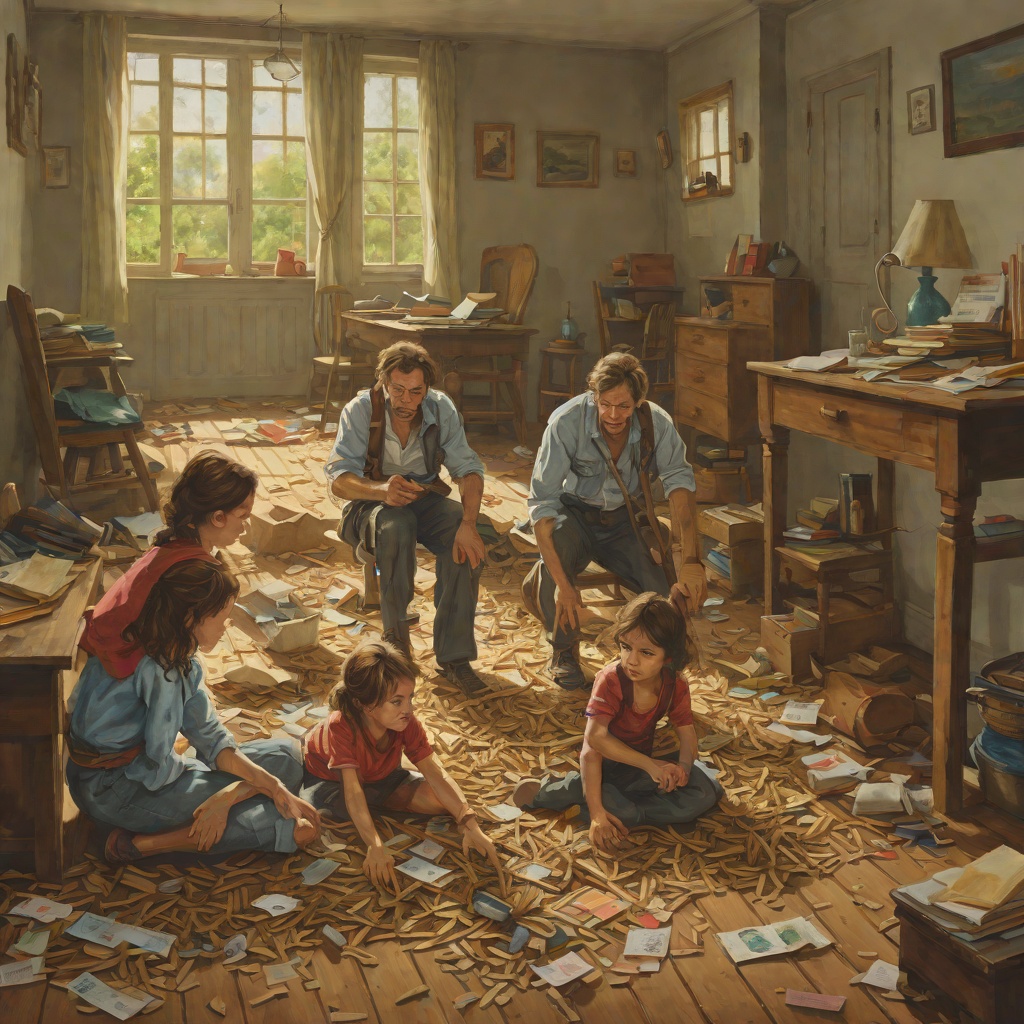
The Attachment of the Family's Household Goods
The Captain and Ann BarbaraThe attachment of the family's household goods stands as one of the most vivid and psychologically revealing episodes in Mary Antin's account of her childhood in Polotzk. It is a scene of state power crashing into domestic life, of a family stripped to its last lame chair and cracked pitcher, and of a young girl who, in the midst of terror, finds a way to laugh. The incident crystallizes the peculiar dread that only Jews in Russia felt when agents of the Government invaded their homes, and it demonstrates the narrator's lifelong habit of reducing catastrophe to its simplest terms. More than a memory of hardship, the episode is a portrait of how the Antin household—and Mary in particular—met the arbitrary violence of authority with a mixture of fear, solidarity, and an almost philosophical lightness of heart.
The Seizure and Its Cause
The trouble began not with a debt of the Antins' own making, but with a claim against a family to whom Mary's mother sublet two of their three rooms, furnished with her own things. The stern creditor who set the law on them was none of theirs; the family had plenty of debts, but this particular claim belonged to their tenant. The police officers swooped down upon the house without warning, as was their habit, and asked no questions, paying no heed to explanations. They affixed a seal to every lame chair and cracked pitcher in the place, and even to every faded petticoat found hanging in the wardrobe. These goods, comprising all the possessions of the Antins and their tenant alike, would presently be removed to be sold at auction for the benefit of the creditor. The arbitrary nature of the seizure—the officers' refusal to distinguish between the property of the family and that of their subtenant—underscored the powerlessness of Jews before the machinery of the Russian state.
The Terror of Government Intrusion
The emotional atmosphere of the scene was one of overwhelming dread. Mary's mother moved about weeping distractedly while the officers were in the house, and the frightened children cried. The neighbors gathered to bemoan the misfortune, and over everything hung the peculiar dread which only Jews in Russia feel when agents of the Government invade their homes. This fear was not merely the fear of losing furniture; it was the accumulated terror of a people who knew that the state could act against them at any moment, without warning and without recourse. The memory of such intrusions was woven into the fabric of Jewish life in the Pale of Settlement, where the Czar commanded Jews to remain within a designated area and where the threat of violence, from pogroms to forced baptism, was ever-present. The attachment of the household goods was a small, domestic instance of a much larger pattern of persecution, and the fear it inspired was the same fear that made Jewish children dread the sight of a priest's procession in the street.
Mary's Philosophical Response
In the midst of the chaos, young Mary retired to a quiet corner to grapple with the fear. She was not given to weeping, but she had to think things out in words. She repeated to herself that the trouble was all about money. Somebody wanted money from their tenant, who had none to give. The furniture was going to be sold to make this money. It was a mistake, but the officers would not believe her mother. Still, it was only about money. Nobody was dead, nobody was ill. There was plenty of money in Polotzk; her own uncle had many times as much as the creditor claimed. He could buy all their things back, or somebody else could. What did it matter? It was only money, and money was got by working, and they were all willing to work. There was nothing gone, nothing lost, as when somebody died. This furniture could be moved from place to place, and so could money be moved, and nothing was lost out of the world by the transfer. This reasoning, repeated to herself in words, was her method of mastering fear—a method that would serve her throughout her life, from her experiments with the Sabbath law to her later confrontations with the challenges of Americanization.
The Bandbox and the Laughter
The episode reaches its climax in a moment of unexpected comedy. As Mary completes her philosophical reduction of the catastrophe, she looks at the window and sees Breine Malke, their next-door neighbor, smuggling something out. If she is caught—! Mary understands at once that she must help. Breine Malke beckons, and Mary moves to stand in the doorway, to obstruct the view of the officers, who are all engaged in the next room. But she cannot resist her curiosity, and she looks over her shoulder a last time to see what it is Breine Malke wants to smuggle out. She can scarcely stifle her laughter. Of all their earthly goods, the neighbor has chosen for salvation a dented bandbox containing a moth-eaten bonnet from Mary's mother's happier days. Mary laughs not only from amusement but also from lightness of heart, for she has succeeded in reducing their catastrophe to its simplest terms, and she finds that it is only a trifle, and no matter of life and death. The absurdity of the rescued object—a relic of better times, now moth-eaten and worthless—becomes the proof of her own philosophy. The laughter is a triumph of perspective over terror, a childish assertion that even the state's power cannot touch the essential things.
The Significance of the Episode
The attachment of the household goods is significant not only as a record of hardship but as a demonstration of Mary Antin's characteristic response to adversity. Throughout her memoir, she returns to moments of fear and danger—the threat of baptism, the Sabbath handkerchief experiment, the terror of the pogrom procession—and in each case she finds a way to reframe the experience, to reduce it to terms she can bear. The episode also reveals the texture of Jewish communal life in Polotzk, where neighbors like Breine Malke acted with solidarity in the face of state intrusion, and where the threat of government action was a constant presence. The moth-eaten bonnet, saved from the auctioneer's hammer, becomes a symbol of the family's resilience and of the small, absurd victories that sustain people in times of crisis. It is a moment of lightness in a narrative otherwise marked by the weight of persecution, and it shows the young Mary already developing the habits of mind that would carry her from the Pale of Settlement to the public schools of America.