The Family Emigration to America
The Captain and Ann BarbaraThe Family Emigration to America is the pivotal action of Mary Antin's memoir, the journey that carries the Antin family from Polotzk in the Russian Pale of Settlement to Boston, Massachusetts. It is the hinge on which the entire narrative turns, transforming the family's material and spiritual condition and setting the stage for Mary's Americanization, her education, and her emergence as a writer. The emigration is not merely a change of location but a rebirth, an Exodus that recapitulates the biblical journey from bondage to the Promised Land, and it is through this journey that the memoir's central themes of freedom, identity, and transformation are established.
The Dream of America and the Father's Departure
The emigration begins not with the family's departure but with the father's, and with the moment when "America" first lodges in Mary's brain as a world entirely unlike Polotzk. She was in bed, sharing the measles with some of the other children, when her mother brought a thick letter from her father, written just before boarding the ship. The letter was full of excitement, describing travel, crowds of people, foreign cities, and a ship ready to put out to sea. Her father was travelling at the expense of a charitable organization, without means of his own, without plans, to a strange world where he had no friends, and yet he wrote with the confidence of a well-equipped soldier going into battle. Mary heard something in the letter that was more than the words seemed to say: an elation, a hint of triumph, such as had never been in her father's letters before. She felt a stirring, a straining in the letter, and understood that her father was inspired by a vision, that he saw something and promised them something, and that this something was "America." And "America" became her dream.
The circumstances of the father's departure were unlike anything the family had experienced before. They had no reliable source of income, no settled home, no immediate prospects. The father had to travel with borrowed money to a German port, whence he was forwarded to Boston at the expense of an emigrant aid society. Mary's mother, as a bread-winner, had nothing like her former success; her health was permanently impaired, her place in the business world had long been filled by others, and there was no capital to start her anew. Her brothers did what they could for her, but they all had large families, with marriageable daughters and sons to be bought out of military service. The allowance they made her was generous compared to their means, but there were four growing children, and the mother was obliged to make do with very little.
The Exodus from Polotzk
The family's own departure is framed as a biblical Exodus, a parallel made explicit in the chapter title. On the day the steamer ticket arrived, the household was thrown into disarray: the mother did not go out with her basket, the brother stayed out of heder, and the sister salted the soup three times. Before sunset the news was all over Polotzk that Hannah Hayye had received a steamer ticket for America, and then the visitors began to come. Friends and foes, distant relatives and new acquaintances, young and old, wise and foolish, debtors and creditors, and mere neighbors poured into the street from every quarter of the city, from both sides of the Dvina, from over the Polota, a steady stream both day and night till the hour of departure. The mother gave audience, her faded kerchief halfway off her head, her black ringlets straying, her apron often at her eyes, receiving her guests in a rainbow of smiles and tears. She was the heroine of Polotzk, and she conducted herself appropriately, giving her heart's thanks for congratulations and blessings, ready tears for condolences, patient answers to monotonous questions, and handshakes and kisses and hugs gratis.
The visitors asked everything: they wanted to handle the ticket, to know how much it cost, whether it was all paid for, whether the family would have a foreign passport or intend to steal across the border, whether they would all have new dresses to travel in, whether they could get koscher food on the ship. With the questions poured in suggestions and solid chunks of advice. The mother ought to make a pilgrimage to a "Good Jew," say the Rebbe of Lubavitch, to get his blessing on the journey. She must be sure to pack her prayer books and Bible, and twenty pounds of zwieback at the least. If they did serve trefah on the ship, she and the four children would have to starve unless she carried provisions from home. She must take all the featherbeds, for featherbeds are scarce in America. The people came oftener and stayed longer as the day of departure approached, rehearsing the mother in long messages for their friends in America, praying that she deliver them promptly on her arrival, and without fail, and might God bless her for her kindness.
Among the visitors was Hayye Dvoshe, the wig-maker, who for the eleventh time repeated herself to the still-patient mother. She begged for a promise, saying she did not sleep nights for thinking of a man who had emigrated to America eighteen months ago, fresh and well and strong, with twenty-five ruble in his pocket, besides his steamer ticket, with new phylacteries, and a silk skull-cap, and a suit as good as new. He had sent one letter describing his arrival at Castle Garden, how well he was received by his uncle's son-in-law, how he was conducted to the baths, how they bought him an American suit, everything good, fine, pleasant, and how his relative promised him a position in his business, a clothing merchant who makes gold. And since then, not a postal card, not a word, just as if he had vanished, as if the earth had swallowed him. Already three letters had been sent, the last one written by Hannah Hayye herself, and no answer. "Lost, as if in the sea!" she lamented.
The last night in Polotzk the family slept at the uncle's house, having disposed of all their belongings, to the last three-legged stool, except such as they were taking with them. Mary did not really sleep; excitement kept her awake, and her aunt snored hideously. In the morning she was going away from Polotzk, forever and ever, on a wonderful journey, to America. The uncle gave out a false bulletin, telling the gossips that the family would not start till the second day, in the hope of smuggling them quietly out and saving them the wear and tear of a public farewell. But his ruse failed of success. Half of Polotzk was at the uncle's gate in the morning to conduct the family to the railway station, and the other half was already there before they arrived. The procession resembled both a funeral and a triumph. The women wept over them, reminding them of the perils of the sea, of the bewilderment of a foreign land, of the torments of homesickness that awaited them. They bewailed the mother's lot, who had to tear herself away from blood relations to go among strangers, who had to face gendarmes, ticket agents, and sailors unprotected by a masculine escort, who had to care for four young children in the confusion of travel, and very likely feed them trefah or see them starve on the way. Or they praised her for a brave pilgrim, and expressed confidence in her ability to cope with gendarmes and ticket agents, and blessed her with every other word, and all but carried her in their arms. At the station the procession disbanded and became a mob. The uncle and the tall cousins did their best to protect the family, but the wanderers were almost torn to pieces. They did get into a car at last, but the riot on the station platform continued unquelled. When the warning bell rang out, it was drowned in a confounding babel of voices, fragments of the oft-repeated messages, admonitions, lamentations, blessings, farewells: "Don't forget!" "Take care of—" "Keep your tickets—" "Möshele—newspapers!" "Garlick is best!" "Happy journey!" "God help you!" "Good-bye! Good-bye!" "Remember—"
The Ordeal of the Journey
On a gray wet morning in early April the family set out for the frontier, the real beginning of the journey. The bags and bundles which composed their travelling outfit were much more bulky than valuable. A trifling sum of money, the steamer ticket, and the foreign passport were the magic agents by means of which they hoped to span the five thousand miles of earth and water between them and the father. The passport was supposed to pass them over the frontier without any trouble, but on account of the prevalence of cholera in some parts of the country, the poorer sort of travellers, such as emigrants, were subjected at this time to more than ordinary supervision and regulation. At Versbolovo, the last station on the Russian side, they met the first of their troubles. A German physician and several gendarmes boarded the train and put them through a searching examination as to their health, destination, and financial resources. As a result of the inquisition they were informed that they would not be allowed to cross the frontier unless they exchanged their third-class steamer ticket for second-class, which would require two hundred rubles more than they possessed. Their passport was taken from them, and they were to be turned back on their journey. They were homeless, houseless, and friendless in a strange place.
The mysterious ride came to an end on the outskirts of the city, where they were once more lined up, cross-questioned, disinfected, labelled, and pigeonholed. This was one of the occasions when they suspected that they were the victims of a conspiracy to extort money from them, for here, as at every repetition of the purifying operations they had undergone, a fee was levied on them, so much per head. The mother, seeing her tiny hoard melting away, had long since sold some articles from their baggage to a fellow passenger richer than she, but even so she did not have enough money to pay the fee demanded of her in Hamburg. Her statement was not accepted, and they all suffered the last indignity of having their persons searched. This last place of detention turned out to be a prison. "Quarantine" they called it, and there was a great deal of it, two weeks of it. Two weeks within high brick walls, several hundred of them herded in half a dozen numbered compartments, sleeping in rows like sick people in a hospital, with roll-call morning and night, and short rations three times a day, with never a sign of the free world beyond their barred windows, with anxiety and longing and homesickness in their hearts, and in their ears the unfamiliar voice of the invisible ocean, which drew and repelled them at the same time. The fortnight in quarantine was not an episode; it was an epoch, divisible into eras, periods, events. The greatest event was the arrival of some ship to take some of the waiting passengers. When the gates were opened and the lucky ones were conducted through, those left behind really rejoiced in each other's fortune, but the regretful envy could not be helped either.
Their turn came at last. They were conducted through the gate of departure, and after some hours of bewildering manoeuvres, described in great detail in the report to the uncle, they found themselves, five frightened pilgrims from Polotzk, on the deck of a great big steamship afloat on the strange big waters of the ocean. For sixteen days the ship was their world. The letter to the uncle dwells solemnly on the details of the life at sea, as if afraid to cheat him of the smallest circumstance. It does not shrink from describing the torments of seasickness; it notes every change in the weather. A rough night is described, when the ship pitched and rolled so that people were thrown from their berths; days and nights when they crawled through dense fogs, their foghorn drawing answering warnings from invisible ships. The perils of the sea were not minimized in the imaginations of the inexperienced voyagers. The captain and his officers ate their dinners, smoked their pipes and slept soundly in their turns, while the frightened emigrants turned their faces to the wall and awaited their watery graves. All this while the seasickness lasted. Then came happy hours on deck, with fugitive sunshine, birds atop the crested waves, band music and dancing and fun. Mary explored the ship, made friends with officers and crew, or pursued her thoughts in quiet nooks. It was her first experience of the ocean, and she was profoundly moved.
Arrival and the Beginning of Americanization
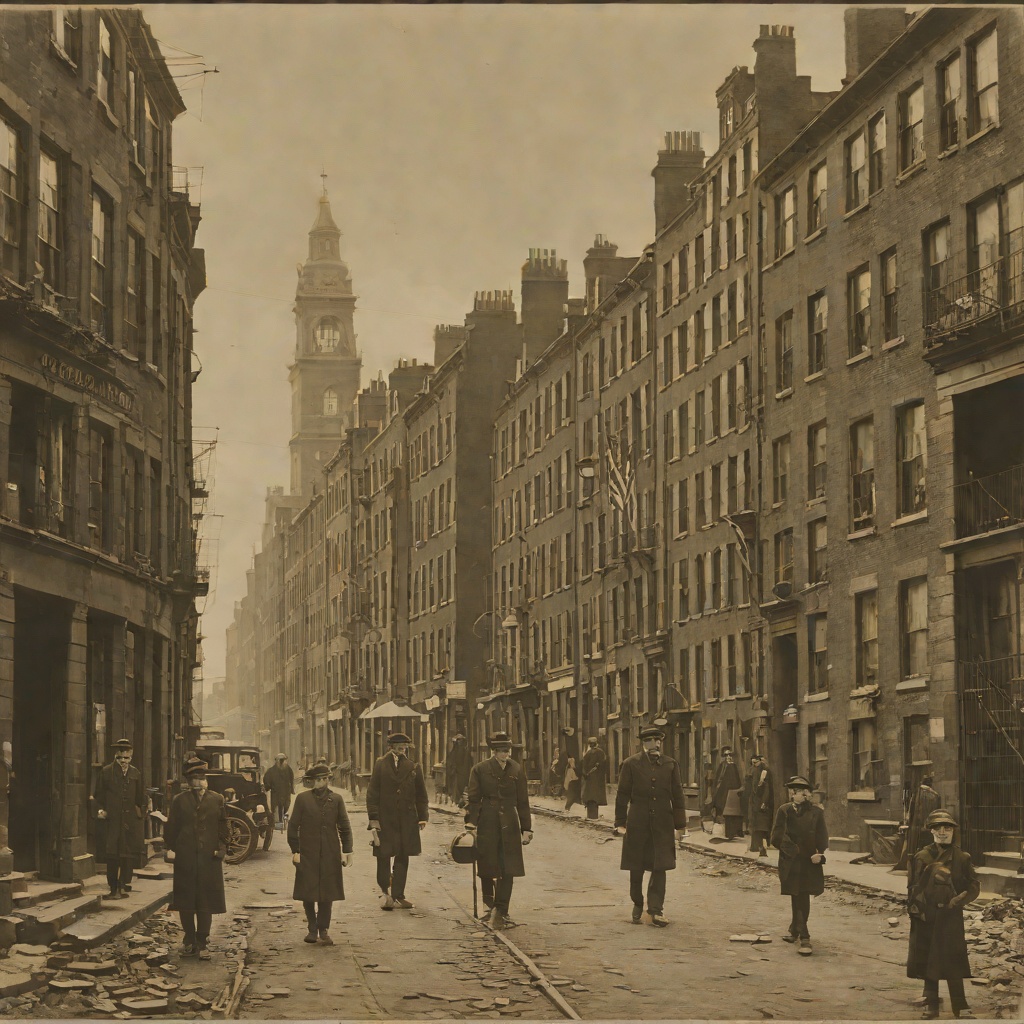
And so suffering, fearing, brooding, rejoicing, they crept nearer and nearer to the coveted shore, until, on a glorious May morning, six weeks after their departure from Polotzk, their eyes beheld the Promised Land, and the father received them in his arms. The initiation into American ways began with the first step on the new soil. The father found occasion to instruct or correct them even on the way from the pier to Wall Street, which journey they made crowded together in a rickety cab. He told them not to lean out of the windows, not to point, and explained the word "greenhorn." They did not want to be "greenhorns," and gave the strictest attention to the father's instructions. The three small rooms into which the father now ushered them, up one flight of stairs, contained only the necessary beds, with lean mattresses; a few wooden chairs; a table or two; a mysterious iron structure, which later turned out to be a stove; a couple of unornamental kerosene lamps; and a scanty array of cooking-utensils and crockery. And yet they were all impressed with their new home and its furniture. It was not only because they had just passed through their seven lean years, cooking in earthen vessels, eating black bread on holidays and wearing cotton; it was chiefly because these wooden chairs and tin pans were American chairs and pans that they shone glorious in their eyes. And if there was anything lacking for comfort or decoration they expected it to be presently supplied, at least the children did. Perhaps the mother alone, of the newcomers, appreciated the shabbiness of the little apartment, and realized that for her there was as yet no laying down of the burden of poverty.
Even the interval on Union Place was crowded with lessons and experiences. They had to visit the stores and be dressed from head to foot in American clothing; they had to learn the mysteries of the iron stove, the washboard, and the speaking-tube; they had to learn to trade with the fruit peddler through the window, and not to be afraid of the policeman; and, above all, they had to learn English. The kind people who assisted them in these important matters form a group by themselves in the gallery of Mary's friends. To the mother, in her perplexity over the cookstove, the woman who showed her how to make the fire was an angel of deliverance. A fairy godmother to the children was she who led them to a wonderful country called "uptown," where, in a dazzlingly beautiful palace called a "department store," they exchanged their hateful homemade European costumes, which pointed them out as "greenhorns" to the children on the street, for real American machine-made garments, and issued forth glorified in each other's eyes. With their despised immigrant clothing they shed also their impossible Hebrew names. A committee of their friends, several years ahead of them in American experience, put their heads together and concocted American names for them all. Those of their real names that had no pleasing American equivalents they ruthlessly discarded, content if they retained the initials. The mother, possessing a name that was not easily translatable, was punished with the undignified nickname of Annie. Fetchke, Joseph, and Deborah issued as Frieda, Joseph, and Dora, respectively. As for Mary, she was simply cheated. The name they gave her was hardly new. Her Hebrew name being Maryashe in full, Mashke for short, Russianized into Marya, her friends said that it would hold good in English as Mary; which was very disappointing, as she longed to possess a strange-sounding American name like the others. She found consolation in the use of her surname, discovering on arrival that her father was "Mr. Antin" on the slightest provocation, and not, as in Polotzk, on state occasions alone. And so she was "Mary Antin," and she felt very important to answer to such a dignified title. It was just like America that even plain people should wear their surnames on week days.
The Transformation of the Family and Its Costs
The emigration set in motion a profound transformation of the family's religious and social life, a process that was both liberating and painful. The father, who had almost his first act on landing on American soil three years before applied for naturalization, and who became a citizen of the United States at the earliest moment allowed by the law, was headlong and strenuous in his methods of making Americans of the family. To the mother, on the eve of departure for the New World, he wrote boldly that progressive Jews in America did not spend their days in praying, and he urged her to leave her wig in Polotzk as a first step of progress. The mother, like the majority of women in the Pale, had all her life taken her religion on authority, so she was only fulfilling her duty to her husband when she took his hint and set out upon her journey in her own hair. Not that it was done without reluctance; the Jewish faith in her was deeply rooted. The law of the Fathers was binding to her, and the outward symbols of obedience inseparable from the spirit. The mother gradually divested herself, at the father's bidding, of the mantle of orthodox observance, but the process cost her many a pang, because the fabric of that venerable garment was interwoven with the fabric of her soul. The father did not attempt to touch the fundamentals of her faith. He allowed her to keep a Jewish kitchen as long as she pleased, but he did not want the children to refuse invitations to the table of their Gentile neighbors. On the holy days he bought the mother a ticket for the synagogue, but the children he sent to school. On Sabbath eve the mother might light the consecrated candles, but he kept the store open until Sunday morning. The mother might believe and worship as she pleased, up to the point where her orthodoxy began to interfere with the American progress of the family. The price that all of them paid for this disorganization of their family life has been levied on every immigrant Jewish household where the first generation clings to the traditions of the Old World, while the second generation leads the life of the New. Nothing more pitiful could be written in the annals of the Jews; nothing more inevitable; nothing more hopeful. The process of the mother's emancipation was not obvious to Mary at the time, but what she observed of her outward conduct has been interpreted by her subsequent experience, so that to-day she understands how it happens that all the year round her mother keeps the same day of rest as her Gentile neighbors, but when the ram's horn blows on the Day of Atonement, calling upon Israel to cleanse its heart from sin and draw nearer to the God of its fathers, her soul is stirred as of old, and she needs must join in the ancient service. It means that she has dropped the husk and retained the kernel of Judaism, but years were required for this process of instinctive selection.
The emigration also established a pattern of ongoing connection between the old world and the new, a transnational field in which Polotzk and Boston remained linked. The family lodged "greeners" from Polotzk as a matter of course till they found a permanent home, and the Wheeler Street tenement, with its six family members, the store, the baby, and sometimes a greener or two, was part of the life of the street. The neighborhood went in search of salvation to Morgan Memorial Hall, Barnard Memorial, and Morgan Chapel, and the children flocked to the clubs, the little girls to sew, cook, dance, and play games, the little boys to hammer and paste, mend chairs, debate, and govern a toy republic. Mary, who did not care for sewing or cooking, joined a dancing-club, and even here she was a failure. She had been a very good dancer in Russia, but here she found all the steps different, and she did not have the courage to go out in the middle of the slippery floor and mince it and toe it in front of the teacher. When she retired to a corner and tried to play dominoes, she became suddenly shy of her partner, and she never could win a game of checkers, although formerly she used to beat her father at it. She tried to be friends with a little girl she had known in Chelsea, but she met her advances coldly, for she lived on Appleton Street, which was too aristocratic to mix with Wheeler Street. Geraldine was studying elocution, and she wore a scarlet cape and hood, and she was going on the stage by and by. Mary acknowledged that her sense of superiority was well-founded, and retired farther into her corner.
The journey itself was also a spiritual awakening that began before the family ever left Russia. On a spring day by the Polota, Mary had watched a peasant push his plow in a market garden, leaving a new black line on the bank for every turn, and suddenly he began to sing, a rude plowman's song. Only the melody reached her, but the meaning sprang up in her heart to fit it, a song of the earth and the hopes of the earth. She sat a long time listening, looking, tense with attention, feeling herself discovering things. Something in her gasped for life, and lay still. She was but a little body, and Life Universal had suddenly burst upon her. For a moment she had her little hand on the Great Pulse, but her fingers slipped, empty. For the space of a wild heartbeat she knew, and then she was again a simple child, looking to her earthly senses for life. But the sky had stretched for her, the earth had expanded; a greater life had dawned in her. This was her first self-birth, and she would plant a rose on the green bank of the Polota in token of eternal life. The emigration, and the long journey across the ocean, continued this process of spiritual birth. At Crescent Beach, where the family moved soon after landing, Mary lay stretched out in the sun, her eyes level with the sea, till she seemed to be absorbed bodily by the very materials of the world around her, till she could not feel her hand as separate from the warm sand in which it was buried. Or she crouched on the beach at full moon, wondering between the two splendors of the sky and the sea. Or she ran out to meet the incoming storm, her face full in the wind, her being a-tingle with an awesome delight to the tips of her fog-matted locks flying behind, and stood clinging to some stake or upturned boat, shaken by the roar and rumble of the waves. It was the growing time, that idle summer by the sea, and she grew all the faster because she had been so cramped before. Her mind, too, had so recently been worked upon by the impressive experience of a change of country that she was more than commonly alive to impressions, which are the seeds of ideas.