The Secret Russian Primer Study
The Captain and Ann BarbaraIn the memoir of Mary Antin, the secret study of the Russian primer stands as one of the earliest and most vivid proofs of the hunger for knowledge that would carry her from the Pale of Settlement to the public schools of America. The episode belongs to the years in Polotzk when she and her sister Fetchke were being taught by Isaiah the Scribe, a teacher who ruled their paper into little squares and made serviceable pens by tying pen points to twigs. Although the sisters began their studies at the same time and progressed together, their parents did not want Mary to take up new subjects as quickly as Fetchke did, believing her health too delicate for much study. So when Fetchke had her Russian lesson, Mary was told to go and play.
The Forbidden Lesson
The prohibition was a direct expression of the family's concern for Mary's frailty, but it collided with a temperament that could not abide being left behind. Mary herself admits that she was disobedient on these occasions, as on many others. She did not go and play; instead she looked on and listened while Fetchke rehearsed her lesson at home. The distinction between the sisters was already a family tradition: Mary was understood to be the quicker, the brighter of the two, the one whose lot could be no common one, while Frieda was relied upon for help. Yet in this small domestic drama, it was the supposedly delicate younger sister who refused the role assigned to her. The episode thus foreshadows the larger pattern of her life, in which she would repeatedly cross the boundaries set for her by circumstance and custom.
The Hidden Storeroom
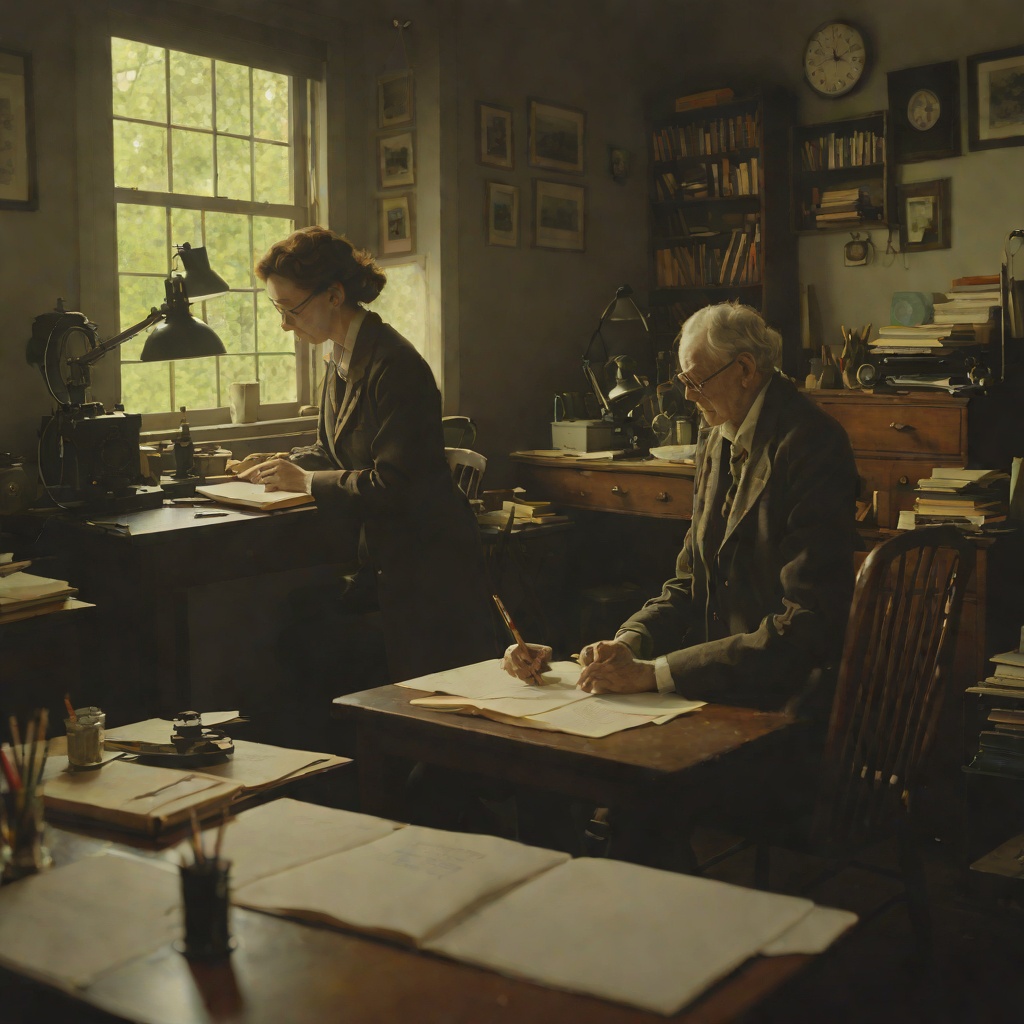
One evening Mary stole the Russian primer and repaired to a secret place she knew of, a storeroom for broken chairs and rusty utensils and dried apples. Nobody would look for her in that dusty hole, and nobody did. While the family searched the house, the yard, the barn, down the street, and at the neighbors', calling her name and telling each other when she was last seen and what she was then doing, she was bending over the stolen book, rehearsing A, B, C by the names her sister had given her. The scene is rendered with the precise sensory detail of a child's memory: the littered place, the high chest that served as her table, the blue glass lamp that lighted her secret efforts. Before anybody hit upon her retreat, she could spell B-O-G, Bog (God) and K-A-Z-A, Kaza (goat). She did not mind in the least being caught, for she had her new accomplishment to show off.
The Discovery and Its Reward
When she was brought from the storeroom into the firelit room where the family was assembled, she confused them all by her recital of the simple words, B-O-G, Bog, and K-A-Z-A, Kaza. The response was remarkable for its gentleness: she was not reproached for going into hiding at bedtime, and the next day she was allowed to take part in the Russian lesson. The stolen knowledge, acquired in secret and against explicit instruction, was quietly legitimized by the family's acceptance. The episode thus reverses the usual moral of disobedience punished; here the transgression is rewarded because it demonstrates precisely the quality the family most valued in her, the quickness and determination that marked her as destined for a different fate than her sister's.
The Meaning of the Stolen Words
The two words she learned carry a weight beyond their syllables. B-O-G, Bog, meaning God, and K-A-Z-A, Kaza, meaning goat, were her first steps into the Russian language, the language of the state that confined her people to the Pale. The choice of words is almost allegorical: the sacred and the humble, the divine name and the common animal, bound together in a child's first spelling lesson. The episode also connects to her earlier love of Hebrew, when she chanted the Psalms to the monotonous tune taught by Reb' Lebe, rocking to the rhythm of the chant, understanding about one word in ten but loving the full, dense, solid sound of the words. In both cases, language is acquired through desire rather than instruction, through a kind of theft that is also a form of devotion.
The secret study of the Russian primer is thus a miniature of Mary Antin's entire trajectory. It shows the double voyage of discovery she describes in her memoir, in which she constantly referred her new world to the old for comparison, and the old to the new for elucidation. The episode also anticipates her later declaration of love for the English language, her sense that in any other language happiness is not so sweet and logic is not so clear. Just as she stole the Russian primer to learn what she was forbidden to learn, she would later seize the English language and make it her own, thinking in it, writing in it, and eventually using it to tell the story of how a girl from the Ghetto was given the freedom of all America. The dusty storeroom with its blue glass lamp is the first classroom of her own making, the place where she proved that her desire to learn could not be contained by the limits others set for her.