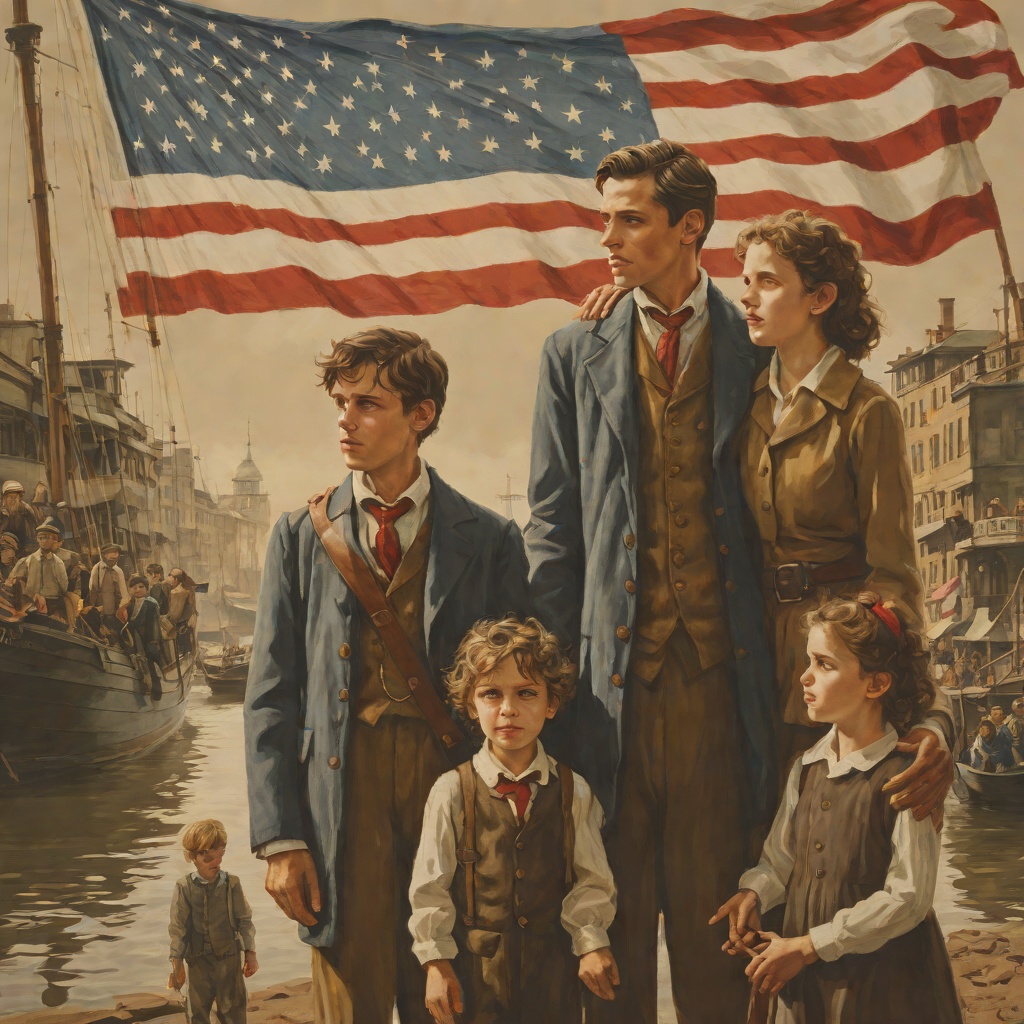
The Star-Spangled Banner
The Captain and Ann BarbaraThe Star-Spangled Banner is the American national anthem that becomes the emotional and symbolic center of Mary Antin's Americanization in her memoir. For the young immigrant from Polotzk, the anthem is not merely a song but a revelation, a sonic baptism into a new national identity. Its first significant appearance occurs in the Chelsea public school as the day approaches for exercises in honor of Washington's Birthday, when the halls resound with patriotic songs. Mary, a model of the attentive pupil, repeatedly loses her place in her lessons as she strains to hear, through closed doors, a neighboring class rehearsing the anthem. This act of listening, of straining toward the music, is a powerful metaphor for her entire immigrant experience—a reaching out toward a new world that is just beyond her current grasp.
The Physical and Spiritual Awakening
The anthem's effect on Mary is both physical and spiritual, a visceral response that borders on the ecstatic. When the doors happen to open and the chorus breaks out unveiled, she describes delicious tremors running up and down her spine, leaving her faint with suppressed enthusiasm. This is not a passive appreciation but an overwhelming, almost painful, surge of feeling. The words she hears, "O! say, does that Star-Spangled Banner yet wave / O'er the land of the free, and the home of the brave?" are not just lyrics but a promise, a declaration of the very ideals she has come to America to find. This moment of intense feeling stands in stark contrast to her previous life, where she knew Polotzk was not her country but goluth—exile. The anthem, with its imagery of a flag waving over a free land, offers a tangible, emotional answer to the prayers for deliverance she had repeated as a child.
From Exile to Patriotism
The anthem's significance is amplified by the contrast with her past. Mary reflects that she had no country before, no flag she loved, no heroes she worshipped; the very names of these things had been unknown to her. In Polotzk, the Passover service closed with the words, "Next year, may we be in Jerusalem," but on childish lips these were no conscious aspiration, merely repeated syllables without hope or longing. Yet even the youngest child knew what it was to be a Jew in exile, feeling the lash of the oppressor from the spiteful treatment of the smallest urchin who crossed himself. The Star-Spangled Banner, therefore, is not just a new song but a new covenant. It replaces the distant, unattainable Jerusalem with a present, tangible America, transforming her from a passive supplicant for deliverance into an active citizen of a free nation. The anthem's promise of freedom is the direct answer to the exile's prayer.
A Performance of American Identity
The anthem's influence culminates in Mary's own performance of American identity. Inspired by the patriotic fervor, she writes a poem in honor of George Washington, a most ambitious undertaking given her few years' acquaintance with English. When she stands before her class to recite it, she is not a heroic figure—thin, pale, and hollow, with a shadow of short black curls and a staring look of prominent eyes, dressed in a red-and-green plaid frock that has a ghastly effect on her complexion. Yet she has the courage of her convictions. Heels clapped together and hands glued to her sides, she lifts up her voice in praise of George Washington, facing twoscore Fellow Citizens. The poem itself is full of impossible metres and grandiose phrases, but to the forty Fellow Citizens it is no laughing matter; even the bad boys sit in attitudes of attention, hypnotized by the solemnity of her demeanor. This public recitation is a performance of her new self, a declaration that she, too, is a part of this nation's story. The anthem, and the patriotic fervor it inspires, gives her the language and the courage to claim her place as an American.
The Anthem as a Marker of Transformation
The Star-Spangled Banner serves as a recurring marker of Mary's transformation, a touchstone for her new life. It is part of the soundtrack of her American education, alongside the other patriotic songs that fill the school halls. The anthem's presence in the school, a public institution, also underscores the separation of church and state that Mary comes to appreciate. Unlike the religious observances of her past, this is a civic religion, a shared national identity that she can embrace without conflict. The anthem, with its focus on the flag and the land, provides a unifying, secular faith for the diverse students of the Chelsea school. For Mary, it is a powerful and joyful alternative to the exile's prayers of her childhood, a song of belonging rather than a plea for deliverance. It is the sound of her own rebirth, the musical embodiment of the promise that America is not Polotzk, and that she has, indeed, been made over.