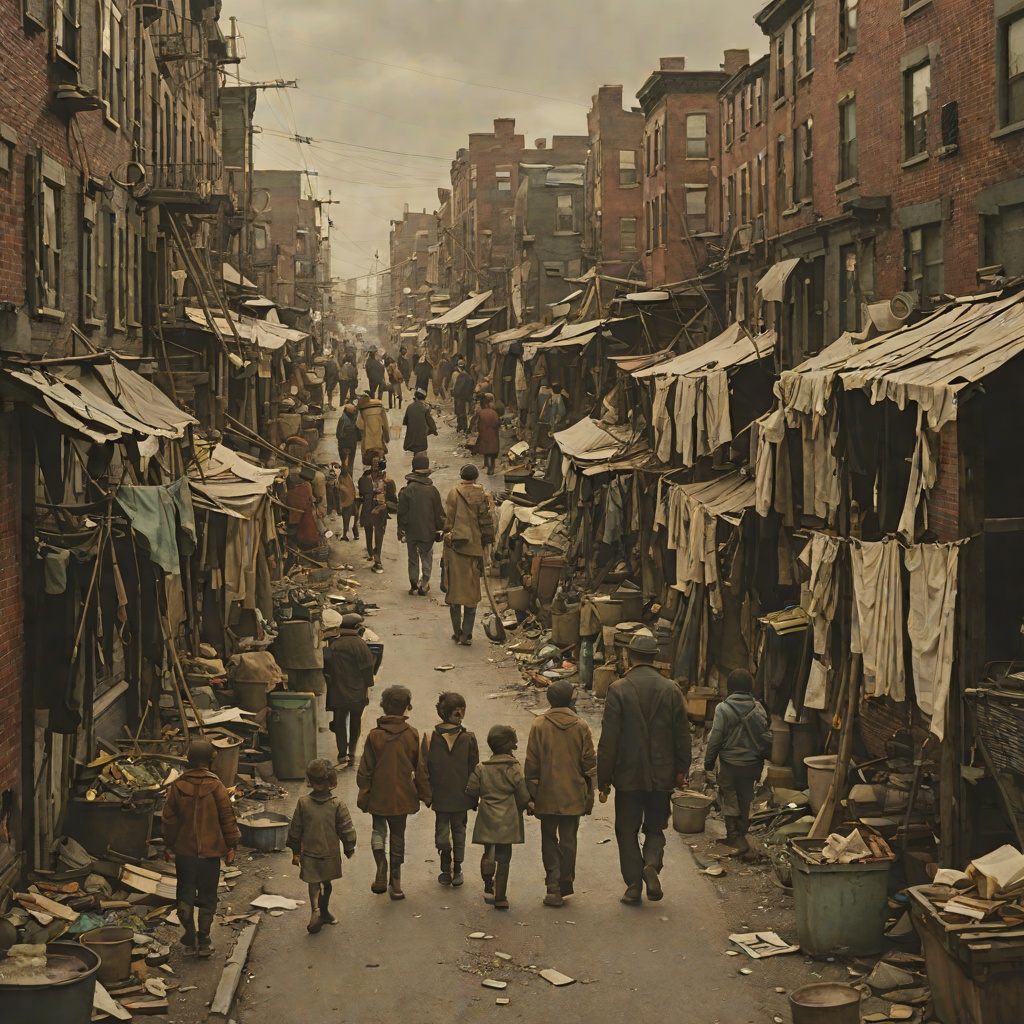
Wall Street (Boston)
The Captain and Ann BarbaraWall Street (Boston) holds a foundational place in Mary Antin's account of her family's immigration to America. It was on this street, in the West End of Boston, that the Antin family first established their home after joining the father, Pinchus, who had emigrated three years earlier. The street is presented not merely as a geographical location but as the threshold of the family's American life, the place where their initiation into American ways began and where the young Mary Antin formed her first, transformative impressions of her new country.
First Impressions and the New Home
The family's introduction to Wall Street came after a journey from the pier in a rickety cab, during which their father instructed them on American behavior, telling them not to lean out of the windows, not to point, and explaining the word "greenhorn." The children, determined not to be "greenhorns," paid strict attention. The street itself, located in the West End, was part of what Antin describes as the tenement district, or the slums of Boston, a quarter where poor immigrants gathered. A sophisticated sight-seer would have seen Union Place, off Wall Street, where the family's new home waited, as "no place at all, but a short box of an alley," with two rows of three-story tenements as its sides, a stingy strip of sky as its lid, a littered pavement as its floor, and a narrow mouth as its exit. But to the newly arrived immigrant, the scene was entirely different. Mary saw two imposing rows of brick buildings, loftier than any dwelling she had ever lived in, with brick underfoot instead of common earth or boards. Friendly windows stood open, filled with the uncovered heads of women and children, whom she believed were interested in the newcomers, a neighborly gesture. Looking up to the topmost row of windows, her eyes were filled with the May blue of an American sky.
The family's new home consisted of three small rooms up one flight of stairs, furnished with only the necessary beds with lean mattresses, a few wooden chairs, a table or two, a mysterious iron structure that later turned out to be a stove, a couple of unornamental kerosene lamps, and a scanty array of cooking-utensils and crockery. This was a stark contrast to their former affluence in Russia, where they had been accustomed to upholstered parlors, embroidered linen, silver spoons and candlesticks, goblets of gold, and kitchen shelves shining with copper and brass. Yet the family was impressed with their new home, not only because they had just passed through seven lean years of poverty, but chiefly because these wooden chairs and tin pans were American chairs and pans, and thus shone glorious in their eyes. The children expected that anything lacking for comfort or decoration would presently be supplied. It was perhaps only the mother, Deborah, who appreciated the shabbiness of the little apartment and realized that for her there was as yet no laying down of the burden of poverty.
A Lesson in American Justice
Wall Street was also the setting for an early lesson in the workings of American justice. A great, hulky colored boy, who was the torment of the neighborhood, treated Mary roughly while she was playing on the street. Her father, determined to teach the rascal a lesson, had him arrested and brought to court. The boy was locked up overnight and emerged from his brief imprisonment with a respect for the rights and persons of his neighbors. For Mary, however, the more interesting aspect was not her revenge on a bully but the way justice was actually administered in the United States. In the little courtroom, bearded Arlington Street stood against wool-headed Arlington Street, with accused and accuser, witnesses, sympathizers, and sight-seers all gathered. Nobody cringed, nobody was bullied, and nobody lied who didn't want to. They were all free and treated equally, just as it said in the Constitution. The evil-doer was actually punished, and not the victim, as might very easily have happened in a similar case in Russia. This experience of "liberty and justice for all" was a powerful confirmation of the ideals of her new country.
The Journey to Crescent Beach and Beyond
The family's time on Wall Street was brief. After about two weeks, they made the journey to Crescent Beach, where the father had prepared to set up a refreshment booth in partnership with an energetic little man. By the time of this move, the family had achieved so much toward their Americanization that the father had very little occasion to admonish them on the way, and he was not ashamed of them. The family's residence on Wall Street thus served as a concentrated period of instruction and adaptation, a necessary prelude to their next venture. The street itself, however, remained a point of reference in the narrative, a symbol of the family's first, hopeful steps in America, before the later moves to the more impoverished and grim neighborhoods of the South End, such as Wheeler Street and Dover Street, where the family's fortunes declined and the realities of immigrant poverty became more starkly apparent. The contrast between the initial optimism of Wall Street and the later struggles of the South End underscores the precariousness of the immigrant experience, even as it highlights the enduring hope that characterized the family's journey.