West End
The Captain and Ann BarbaraThe West End of Boston is the first American neighborhood where the Antin family settles after leaving Polotzk, and it is where Mary Antin experiences her transformative introduction to American urban life. It is presented as the tenement district, or slums, of Boston, yet through the eyes of the young immigrant it appears as a place of wonder, with brick buildings and a May-blue sky. The West End serves as the crucial threshold between the Old World and the New, where the family begins its Americanization and where Mary first encounters the ideals of American justice and equality.
The Slums of Boston
Anybody who knows Boston knows that the West and North Ends are the wrong ends of that city. They form the tenement district, or, in the newer phrase, the slums of Boston. Anybody who is acquainted with the slums of any American metropolis knows that that is the quarter where poor immigrants foregather, to live, for the most part, as unkempt, half-washed, toiling, unaspiring foreigners; pitiful in the eyes of social missionaries, the despair of boards of health, the hope of ward politicians, the touchstone of American democracy. The well-versed metropolitan knows the slums as a sort of house of detention for poor aliens, where they live on probation till they can show a certificate of good citizenship.
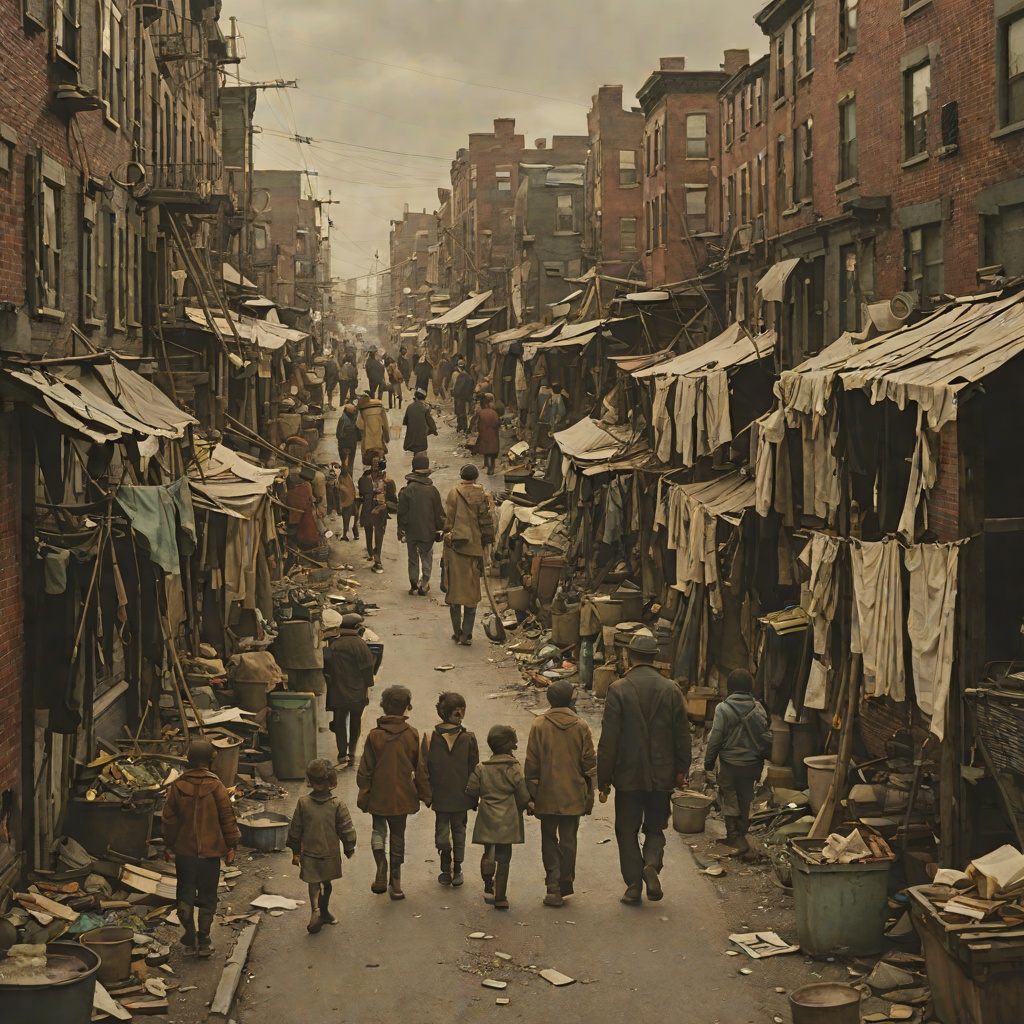
The sophisticated sight-seer would say about Union Place, off Wall Street, where the Antin family's new home waited, that it is no place at all, but a short box of an alley. Two rows of three-story tenements are its sides, a stingy strip of sky is its lid, a littered pavement is the floor, and a narrow mouth its exit. This is the objective, external view of the neighborhood, the view of the outsider who sees only poverty and squalor.
A Child's View of Union Place
But Mary Antin saw a very different picture on her introduction to Union Place. She saw two imposing rows of brick buildings, loftier than any dwelling she had ever lived in. Brick was even on the ground for her to tread on, instead of common earth or boards. Many friendly windows stood open, filled with uncovered heads of women and children. She thought the people were interested in them, which was very neighborly. She looked up to the topmost row of windows, and her eyes were filled with the May blue of an American sky. This contrast between the objective reality of the slum and the subjective perception of the immigrant child is central to the memoir's project: the same place can be a prison to one and a palace to another.
The family's new home in the West End consisted of three small rooms up one flight of stairs, containing only the necessary beds, with lean mattresses; a few wooden chairs; a table or two; a mysterious iron structure, which later turned out to be a stove; a couple of unornamental kerosene lamps; and a scanty array of cooking-utensils and crockery. This was a stark contrast to their days of affluence in Russia, when they had been accustomed to upholstered parlors, embroidered linen, silver spoons and candlesticks, goblets of gold, kitchen shelves shining with copper and brass. Yet they were all impressed with their new home and its furniture, not only because they had just passed through their seven lean years, cooking in earthen vessels, eating black bread on holidays and wearing cotton, but chiefly because of the promise of America itself.
The Beginning of Americanization
It was in the West End that the family's Americanization began in earnest. Mary found on her arrival that her father was "Mr. Antin" on the slightest provocation, and not, as in Polotzk, on state occasions alone. And so she was "Mary Antin," and she felt very important to answer to such a dignified title. It was just like America that even plain people should wear their surnames on week days. This small detail of naming marked a profound shift in social identity: in America, even a poor immigrant could claim the dignity of a full name, a public identity.
As a family they were so diligent under instruction, so adaptable, and so clever in hiding their deficiencies, that when they made the journey to Crescent Beach, in the wake of their small wagon-load of household goods, her father had very little occasion to admonish them on the way, and she was sure he was not ashamed of them. So much they had achieved toward their Americanization during the two weeks since their landing. The West End was thus the first classroom of Americanization, where the family learned to shed its greenhorn ways and begin the process of becoming American.
Justice in the Arlington Street Courtroom
It was also in the West End that Mary first witnessed the workings of American justice. Once a great, hulky colored boy, who was the torment of the neighborhood, treated her roughly while she was playing on the street. Her father, determined to teach the rascal a lesson for once, had him arrested and brought to court. The boy was locked up overnight, and he emerged from his brief imprisonment with a respect for the rights and persons of his neighbors. But the moral of this incident lies not herein. What interested Mary more than her revenge on a bully was what she saw of the way in which justice was actually administered in the United States. Here they were gathered in the little courtroom, bearded Arlington Street against wool-headed Arlington Street; accused and accuser, witnesses, sympathizers, sight-seers, and all. Nobody cringed, nobody was bullied, nobody lied who didn't want to. They were all free, and all treated equally, just as it said in the Constitution! The evil-doer was actually punished, and not the victim, as might very easily happen in a similar case in Russia. "Liberty and justice for all." Three cheers for the Red, White, and Blue! This courtroom scene, set in the heart of the West End slum, became for Mary a living proof of the American Constitution's promises, a stark and thrilling contrast to the arbitrary justice of the Russian Empire.
The Legacy of the West End
The West End was the first of several Boston neighborhoods the family would inhabit, each marking a stage in their American journey. From the West End they moved to Chelsea, then to Wheeler Street in the lower South End, and finally to Dover Street, also in the South End. Each move was driven by the father's business failures, yet each new neighborhood was met with the same resilient optimism. The West End, however, holds a special place as the site of first impressions, the place where the immigrant child first learned to see America not as it was, but as it promised to be. It is the foundational space of the memoir's central argument: that America, even in its slums, offers the immigrant a dignity and a promise that the Old World could never provide. The West End is thus not merely a geographical location but a symbolic threshold, the first step on the path from the Pale of Settlement to the palaces of Boston's public institutions and, ultimately, to the narrator's own transformation into a citizen of the New World.