Castle
The CastleThe Castle is the central, enigmatic authority in Franz Kafka's novel, a vast, inaccessible bureaucratic complex that dominates the village and governs every aspect of life through an impenetrable web of rules, officials, and communications. It represents an ultimate, distant, and often arbitrary power that K. desperately seeks to reach and understand, yet which remains perpetually out of reach, defining the novel's core conflict between the individual and an inscrutable system.
Appearance and First Impressions
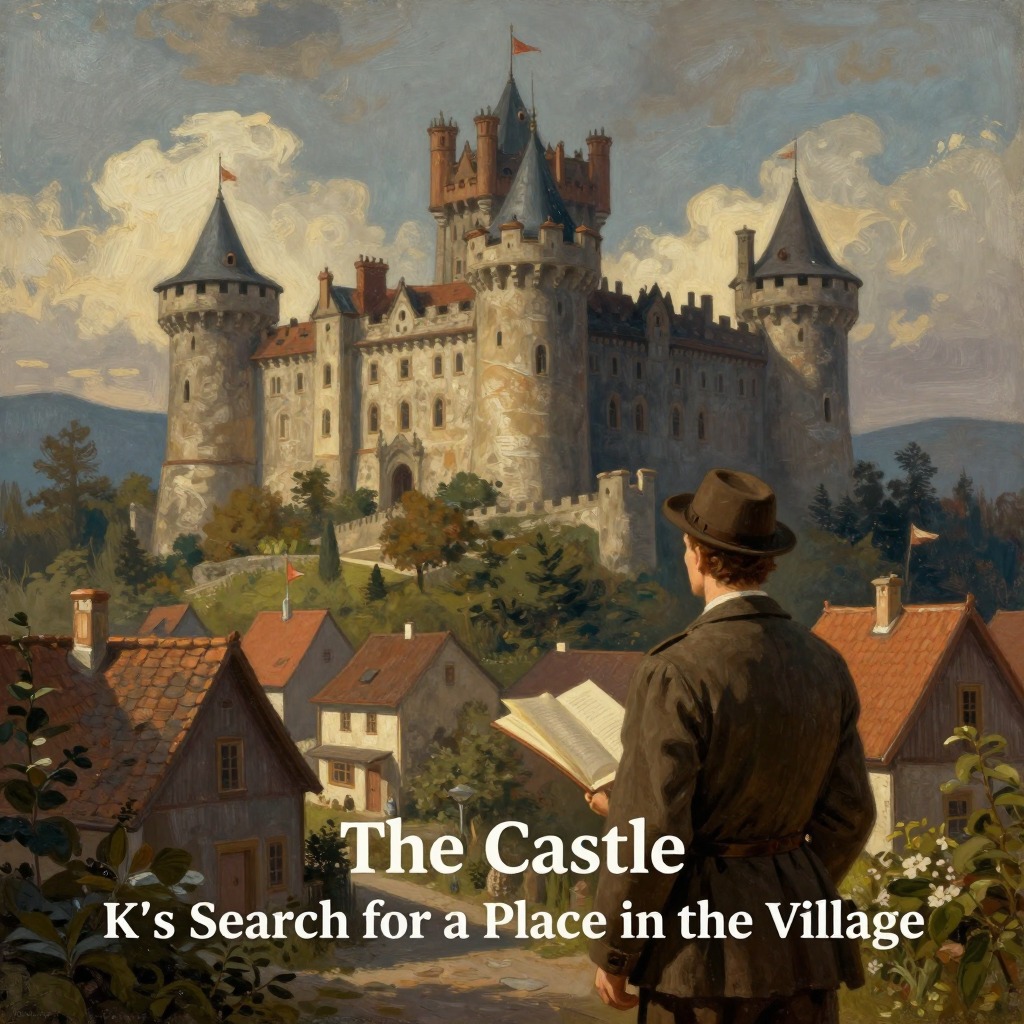
K.'s first view of the Castle is obscured by mist and darkness, leaving him staring at what seems to be a void from the wooden bridge leading into the village. When he sees it clearly the next morning, it is an extensive complex of buildings, neither an old knightly castle nor a showy new structure, but a collection of low, crowded houses that might be mistaken for a small town. A single tower, partly covered with ivy and with small windows shining in the sun, belongs to a dwelling, its battlements crumbling as if drawn by an anxious or careless child. K. finds the Castle disappointing, thinking it a poor collection of cottages with flaking paint and crumbling stone, and he compares it unfavorably to the church tower of his childhood home. The Castle lies still, with no sign of life visible from a distance, and as K. looks at it, he sometimes thinks he sees someone sitting quietly there, looking into space, free and at ease, but the longer he looks, the less he can make out, and everything recedes into the twilight.
The Seat of Authority and Bureaucracy
The Castle is the source of all authority in the village, as Schwarzer, the son of the castle warden, explains on K.'s first night: "This village belongs to the castle, so anyone who stays or spends the night here is, so to speak, staying or spending the night at the castle." It is Count Westwest's castle, and its officials, including the chief executive Klamm, issue letters and decrees that govern the lives of the villagers. The Castle's administrative apparatus is vast and complex, with departments like Department A and Department B, a Central Office that works even at night, and a hierarchy of officials, secretaries, and servants. The village mayor describes the organization as so excellent that mistakes are considered impossible, and there are supervisory authorities that check everything, though their nature is such that even a recognized mistake may not be one in the long run. The Castle's communications are often ambiguous, as seen in Klamm's first letter to K., which the mayor interprets as a private letter rather than an official communication, meaning nothing but that Klamm personally intends to concern himself with K. should he be accepted into the service of the castle.
Inaccessibility and the Quest for Contact
K.'s primary struggle is to gain access to the Castle and its officials, a quest that defines the novel's plot. He is told that no stranger may go up to the castle without a permit, and when he telephones, the answer is a definitive "No" for the next day and any other time. The Castle's inaccessibility is both physical and metaphysical; the main street of the village does not lead to Castle Mount but merely passes close to it before turning aside, and the road never brings K. any closer. The Castle's officials, particularly Klamm, are described as remote and unreachable. The landlady tells K. that Klamm will never speak to him, that he is a gentleman from the castle of high rank, while K. is nothing, a stranger, a superfluous person. Even Barnabas, the messenger who brings letters from Klamm, is plagued by doubts about whether the official he speaks to is really Klamm, and whether the offices he enters are the real castle. The Castle's power is felt everywhere, but its direct presence is always deferred, creating a sense of perpetual waiting and frustrated hope.
The Castle's Relationship with the Village
The Castle and the village are inextricably linked, yet the nature of their connection is a source of constant confusion and anxiety. The teacher tells K. that there is no distinction between the local people and the castle, but the villagers themselves are deeply suspicious of the Castle's authority and its officials. The Castle's servants, when in the village, are a wild, unruly set, ruled by their own insatiable desires, while in the castle itself they are quiet and dignified. The officials, like Klamm, are said to be extremely sensitive, and the entire system of nocturnal hearings is designed to question members of the public whose sight would be intolerable to the gentlemen by day. The Castle's influence is felt in the most intimate aspects of life, from K.'s relationship with Frieda, who was Klamm's lover, to the social ostracism of Barnabas's family after Amalia rejected Sortini's vulgar summons. The Castle's decisions, whether favorable or unfavorable, are made above the heads of the villagers, and K. feels that his status is far too low for him to intervene or get his own voice heard.
The Castle as a Symbol of Transcendent and Arbitrary Power
The Castle functions as a powerful symbol of an ultimate, transcendent authority that is both all-powerful and fundamentally unknowable. The landlady compares Klamm to an eagle, and K. comes to think of Klamm's remote distance, his impregnable residence, his silence, and his piercing glance from on high that would brook no contradiction. The Castle's bureaucracy is described as a vast, self-perpetuating machine that operates according to its own inscrutable logic, where official decisions are as elusive as young girls. The village mayor explains that the authorities do not even consider the possibility of mistakes being made, and that the excellent organization of the whole thing justifies that principle. The Castle's power is not only external but also internalized by the villagers, who live in a state of constant awe and anxiety. K.'s dream of fighting a naked secretary who resembles a Greek god, and his subsequent feeling of having won a great victory, suggests a deep psychological struggle with this authority. Ultimately, the Castle remains an enigma, a place that K. can never reach, and its meaning is never fully resolved, leaving the reader with a profound sense of the absurdity and futility of the individual's quest for meaning and recognition in the face of an incomprehensible system.
The Castle's textual history is as labyrinthine as its fictional counterpart. The first English translation, by Willa and Edwin Muir in 1930, was based on Max Brod's posthumous edition and helped ignite the post-war Kafka craze, especially after a 1941 edition featuring a homage by Thomas Mann. A 1954 'definitive' edition added sections translated by Eithne Wilkins and Ernst Kaiser, and made minor revisions such as changing 'Town Council' to 'Village Council'. The Muirs' translation has been criticized for its 'spiritual' bias, using words like 'soaring unfalteringly' and 'illusory' to describe the castle, which some scholars argue imposes a mystical interpretation absent from the original German. In 1961, Malcolm Pasley secured the manuscript for Oxford's Bodleian Library, leading to a critical edition published by S. Fischer in 1982. Mark Harman used this restored text for his 1998 translation, often called the 'English Critical Edition', which aims to strip away earlier interpretive layers and present a more neutral rendering of Kafka's unfinished work.