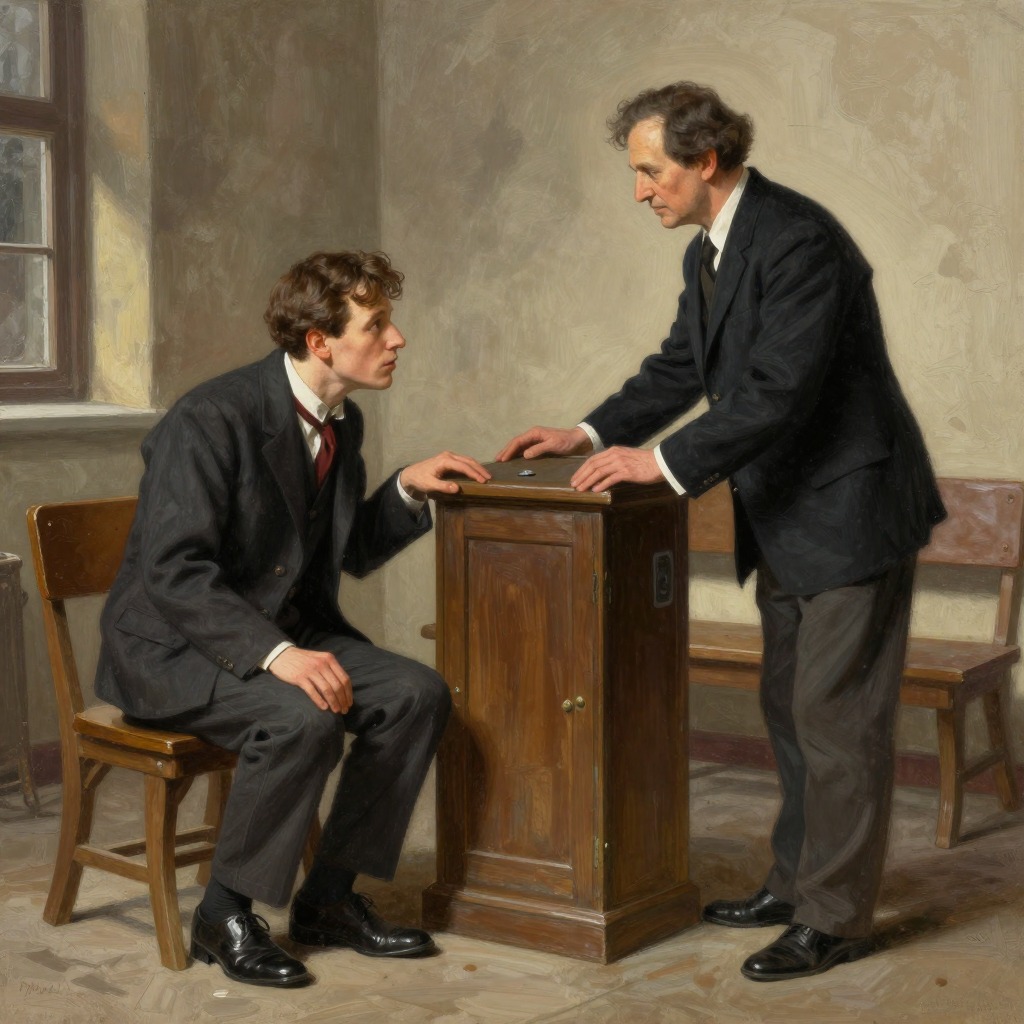
Coffee-pot
The CastleThe coffee-pot is a minor but potent domestic object in Franz Kafka's The Castle, appearing only in the brief, disastrous period when K. and his fiancée Frieda occupy the schoolhouse as janitor and his family. Its two appearances—first as a cherished item of household order, then as a shattered ruin—trace the rapid disintegration of their attempt to build a private life within the village's hostile structures.
Appearance and Domestic Use
The coffee-pot first appears on the morning after K. and Frieda have moved into the school gymnasium, which doubles as their living quarters. Frieda, who has worked hard to make the bleak space habitable, has spread a white crochet-work tablecloth on the teacher's desk and set out a flowered coffee cup, bread, bacon, and a can of sardines. The coffee-pot is part of this improvised domestic tableau, a sign of Frieda's resourcefulness and her determination to create a semblance of home. K., exhausted from his nocturnal wanderings, drinks the coffee she makes over a spirit-burner, leaning against the cooling stove and watching her quick, expert movements. At this moment the coffee-pot is a transparent, functional object, its materiality invisible because it is working properly as part of a caring routine.
Destruction and Materiality
The coffee-pot's second appearance is its last. The next morning, the assistant teacher Miss Gisa arrives to find K., Frieda, and the two assistants still asleep among the gymnastic apparatus, surrounded by the remains of their supper. In a fury, she sweeps everything off the teacher's desk with her ruler. The coffee-pot crashes to the floor and breaks; the oil from the sardines and the remains of the coffee spill across the floor. The coffee-pot, which had been a transparent tool of domestic comfort, suddenly becomes a broken, obtrusive thing, its material fragility exposed. The destruction is not accidental but a deliberate act of official contempt, a physical assertion of the teacher's authority over the janitor's household. The coffee-pot's breaking is the first concrete loss in a cascade of humiliations that will drive Frieda back to the Castle Inn.
Consequences and Significance
Frieda's reaction to the loss of the coffee-pot is disproportionately intense. She is "most upset" by it, and only K.'s promise to go straight to the village mayor and ask for a replacement consoles her enough to emerge from behind the gymnastic apparatus to rescue the tablecloth from further soiling. The coffee-pot's destruction thus becomes a turning point in the narrative of their relationship. It is the moment when the material poverty of their situation becomes undeniable, and when Frieda's capacity to endure humiliation begins to crack. The coffee-pot, a small, ordinary object, carries the weight of their failed hopes for a settled life. Its breaking is a synecdoche for the larger, invisible forces that are systematically dismantling K.'s position in the village. The object's journey from useful tool to broken relic mirrors the trajectory of K. and Frieda's relationship itself: from a brief, intense union of hope to a shattered arrangement that cannot be repaired.