Files
The CastleIn Franz Kafka's The Castle, the Files are far more than paperwork; they are the tangible substance of the castle's authority, the medium through which its power is asserted, withheld, and rendered absurd. They appear throughout the novel as physical objects—bundles tied like firewood, sheets scattered in corridors, documents torn or lost—and as symbols of a bureaucracy that claims infallibility while producing endless confusion. For K., the land surveyor, the files represent both the obstacle to his recognition and the only apparent link to the castle's officials, a paradox that defines his entire struggle.
The Files as Bureaucratic Matter
The files first emerge as a physical presence in the village mayor's house, where they have accumulated to the point of absurdity. The mayor's wife, Mizzi, opens a cupboard stuffed with papers, and two large bundles fall out, "tied up as you might tie up bundles of firewood." The room becomes half full of files, and the mayor explains that he keeps the larger part in the barn, while much has been lost. This material excess—files as firewood, as clutter—underscores the sheer weight of administrative activity that has no apparent purpose. The files are not merely records; they are the detritus of a system that generates paperwork for its own sake, indifferent to the human lives it supposedly organizes.
The files also serve as the medium of official communication, but one that is fundamentally unreliable. The mayor's account of K.'s appointment reveals how a decree about a land surveyor, sent years ago, was lost in transit between departments, leading to a cascade of misunderstandings. The file's cover, bearing a remark about the enclosed document, reached Department B without the document itself, and the conscientious official Sordini spent years pursuing a case that had no substance. The files, meant to ensure order, instead produce chaos, and their loss or misplacement becomes the engine of K.'s predicament.
The Paradox of Infallibility and Error
The files embody the castle's contradictory principles: the authorities claim to make no mistakes, yet the files are full of errors. The village mayor explains that "it is a working principle of the authorities that they do not even consider the possibility of mistakes being made," and yet the entire story of K.'s appointment is a mistake—a land surveyor who was never needed, summoned by a decree that was never properly processed. The files, as the record of this process, are both the evidence of error and the means of denying it. When K. asks about supervisory authorities, the mayor replies that there are only supervising authorities, and they are not intended to detect mistakes "in the vulgar sense of the word, since there are no mistakes." The files, then, are not records of truth but instruments of a system that defines truth as whatever it records.
This paradox is further illustrated by the telephone, which the mayor describes as unreliable: "There is no telephone connection to the castle, there's no switchboard passing on our calls; if we call someone in the castle from here, the telephones ring in all the lower departments." The files, like the telephone, are a medium that promises connection but delivers only illusion. K.'s first letter from Klamm, delivered by Barnabas, is a file of sorts—a written communication that the mayor interprets as a private letter, not an official document, and whose signature is illegible. The letter's meaning is entirely dependent on interpretation, and the files, like the letter, are open to endless reinterpretation.
The Distribution of Files: A Scene of Chaos
In the novel's later chapters, the files become the centerpiece of a remarkable scene of bureaucratic chaos. K., having accidentally entered the corridor of the Castle Inn, witnesses the morning distribution of files. A servant pushes a small trolley laden with files, while another walks beside him with a list, comparing numbers on doors with numbers on files. The distribution is fraught with difficulties: files are returned, negotiations ensue, and some gentlemen refuse to give up files they have received. One gentleman pours a bowl of water over a servant; another throws files down the corridor, scattering sheets of paper. The servant, whom K. admires for his determination, employs cunning tricks to retrieve files, but the scene descends into near-total disorder. This distribution, which should be a routine administrative task, becomes a microcosm of the castle's dysfunction, where the files—the very instruments of order—are the source of conflict and confusion.
K. himself becomes entangled in this chaos. He notices a single sheet of paper left on the trolley and wonders if it might be his file, but the servant tears it up and puts it in his pocket—an irregularity that K. observes but cannot fully understand. The files, which are supposed to be the record of K.'s case, are either lost, torn, or withheld, and K. is left without any tangible evidence of his own existence in the system.
The Files and K.'s Quest
For K., the files represent both hope and frustration. He initially believes that the letter from Klamm, delivered by Barnabas, is a file that will establish his position. But the village mayor dismisses it as a private letter, not an official communication, and the mayor's wife folds it into a paper boat, a gesture that reduces the document to a child's toy. K. later receives a second letter, which he reads by lantern light, but it too is ambiguous, praising work he has not done and promising remuneration that never comes. The files, like the letters, are always just out of reach, always subject to reinterpretation, and never provide the certainty K. seeks.
K.'s relationship to the files is also shaped by his refusal to participate in the system's rituals. When Momus, Klamm's village secretary, asks K. to answer questions for the records, K. refuses, saying he has "a rooted dislike of any kind of questioning." This refusal is a rejection of the files as a medium of power, but it also leaves K. without any official standing. The files, which could have been a path to Klamm, become a dead end, and K. is left to wander the village, seeking other means of access.
The Files as Symbol of Inaccessible Authority
The files ultimately symbolize the castle's inaccessibility. They are the only tangible evidence of the castle's existence, yet they are always incomplete, always lost, always subject to misinterpretation. The castle itself is described as a "poor kind of collection of cottages," and its authority is exercised through documents that no one can fully read or understand. The files are the medium through which the castle communicates, but they are also the barrier that prevents communication. They are, in the words of the village mayor, "official decisions" that are "as elusive as young girls."
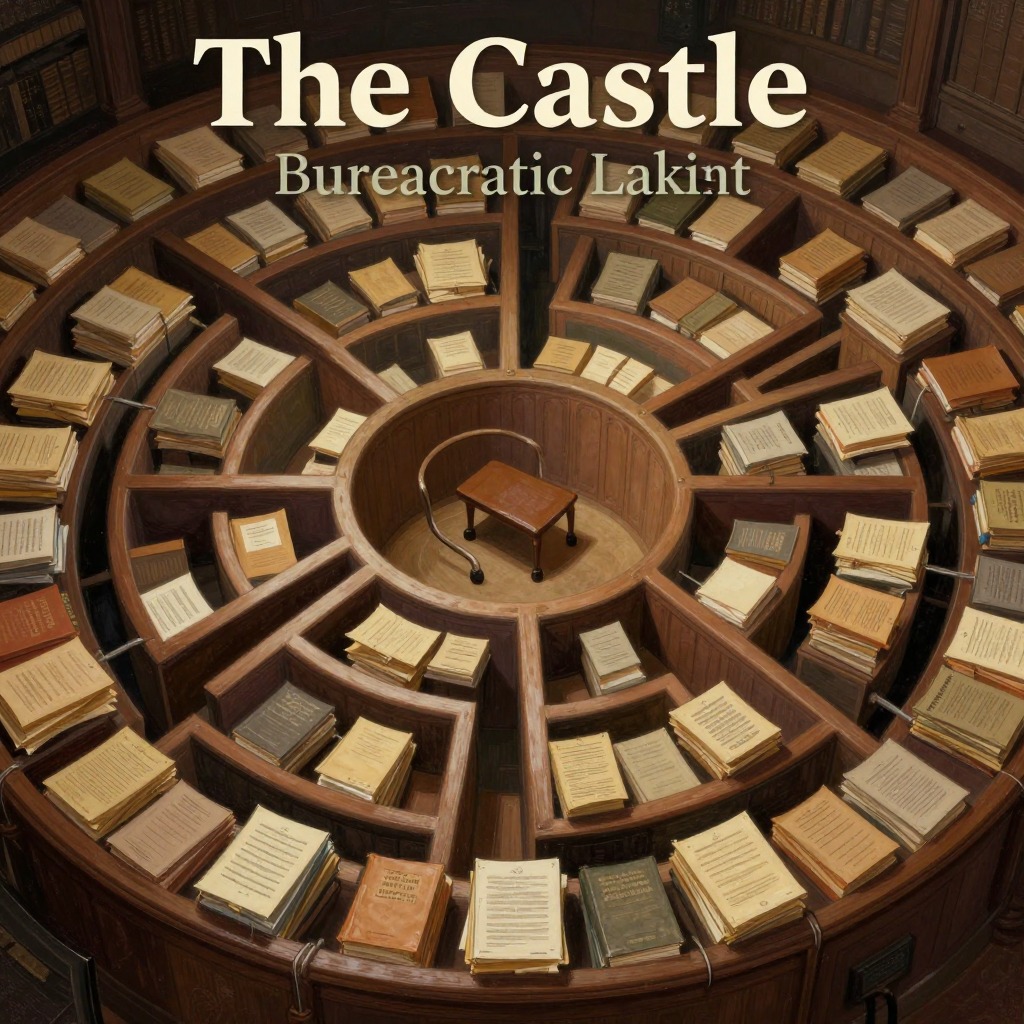
In the end, the files remain an enigma. They are everywhere—in cupboards, in barns, in corridors—but they never yield their meaning. They are the material form of a power that is both omnipresent and absent, and K.'s struggle with them is a struggle with the very nature of authority itself. The files, like the castle, are a labyrinth from which there is no exit, and K.'s quest to find his place within them is a quest that can never be completed.