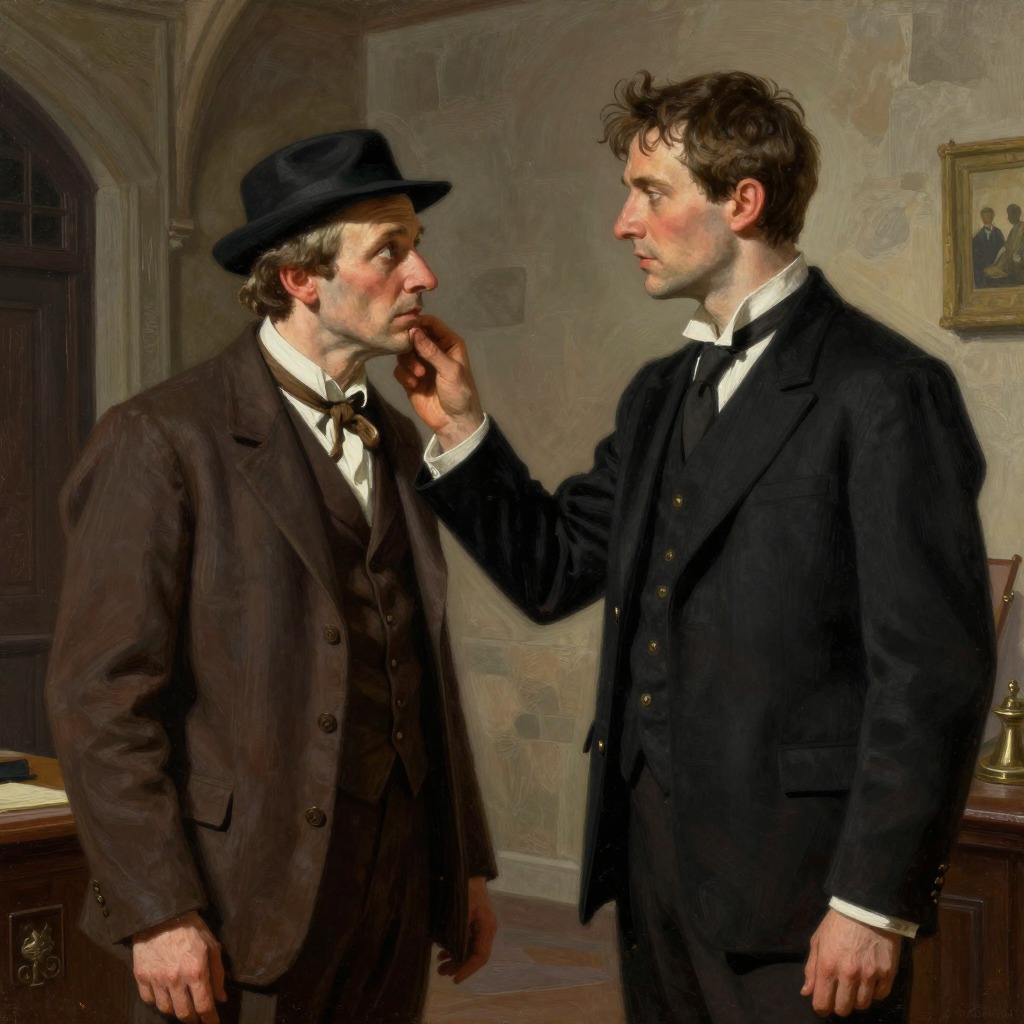
Fritz
The CastleFritz is a deputy warden of the castle, a minor official whose name surfaces at a crucial moment in K.'s first night in the village. When Schwarzer, the son of a castle warden, telephones the castle to check K.'s assertion that he is a land surveyor summoned by the count, it is Fritz who answers. This telephone call, conducted through the inn's newly discovered telephone, becomes the first direct contact between K. and the castle's bureaucracy, and Fritz's response—first denying any record of a land surveyor, then, after a second call, confirming the title—reveals the castle's capacity for both error and correction, and its unsettling awareness of K.'s presence.
Role in K.'s Arrival
Fritz's initial reply to Schwarzer is a flat denial: "There's no record of any land surveyor; this is a common, lying vagabond and probably worse." This verdict, delivered through the telephone, nearly triggers a violent reaction from the assembled villagers, and K. retreats under his blanket. However, a second call, which K. overhears, brings a correction: "A mistake, then? This is very awkward for me. You say the Office manager himself telephoned? Strange, strange." This reversal, attributed to a higher authority, confirms K.'s status as "the land surveyor" and, in K.'s interpretation, shows that the castle "knew all they needed to know about him," had "weighed up the balance of power," and was "cheerfully accepting his challenge." Fritz thus serves as the instrument through which the castle first acknowledges K., an acknowledgment that is both a recognition and a subtle form of control.
A Functionary of the Castle
Fritz's position as a deputy warden places him within the castle's hierarchical structure, yet his function is largely that of a conduit. He is not a decision-maker but a relay point, passing on information from Central Office. The narrative emphasizes the "diplomatic training" of even such "insignificant figures in the castle as Schwarzer," and Fritz's role is similarly subordinate. He is one of "several such deputies," a name without a face, known only through his voice on the telephone. This anonymity underscores the castle's impersonal and labyrinthine nature, where even minor officials are interchangeable and their actions are dictated by unseen superiors. Fritz's brief appearance thus highlights the theme of bureaucratic inaccessibility: the castle operates through a network of functionaries, each with limited authority, and K.'s attempts to engage with it are always mediated by such figures.
Significance in K.'s Quest
Fritz's telephone call has lasting consequences for K. It establishes the precedent that the castle can be contacted, but also that its responses are unreliable and subject to sudden revision. K. later reflects on this when the village mayor explains the illusory nature of telephone communication with the castle, noting that "the rushing, singing sound" on the line is the only real information, while "everything else is just an illusion." Fritz's initial denial and subsequent correction exemplify this unreliability, and K.'s memory of the incident informs his growing skepticism about official channels. Moreover, Fritz's role in confirming K.'s appointment, however ambiguously, gives K. a foothold—a claim to legitimacy that he repeatedly invokes, even as the castle's letters and officials undermine it. In this sense, Fritz is a catalyst: his actions set in motion K.'s long and futile struggle to gain recognition from the castle, a struggle that defines the novel's central conflict.