Gerstäcker's house
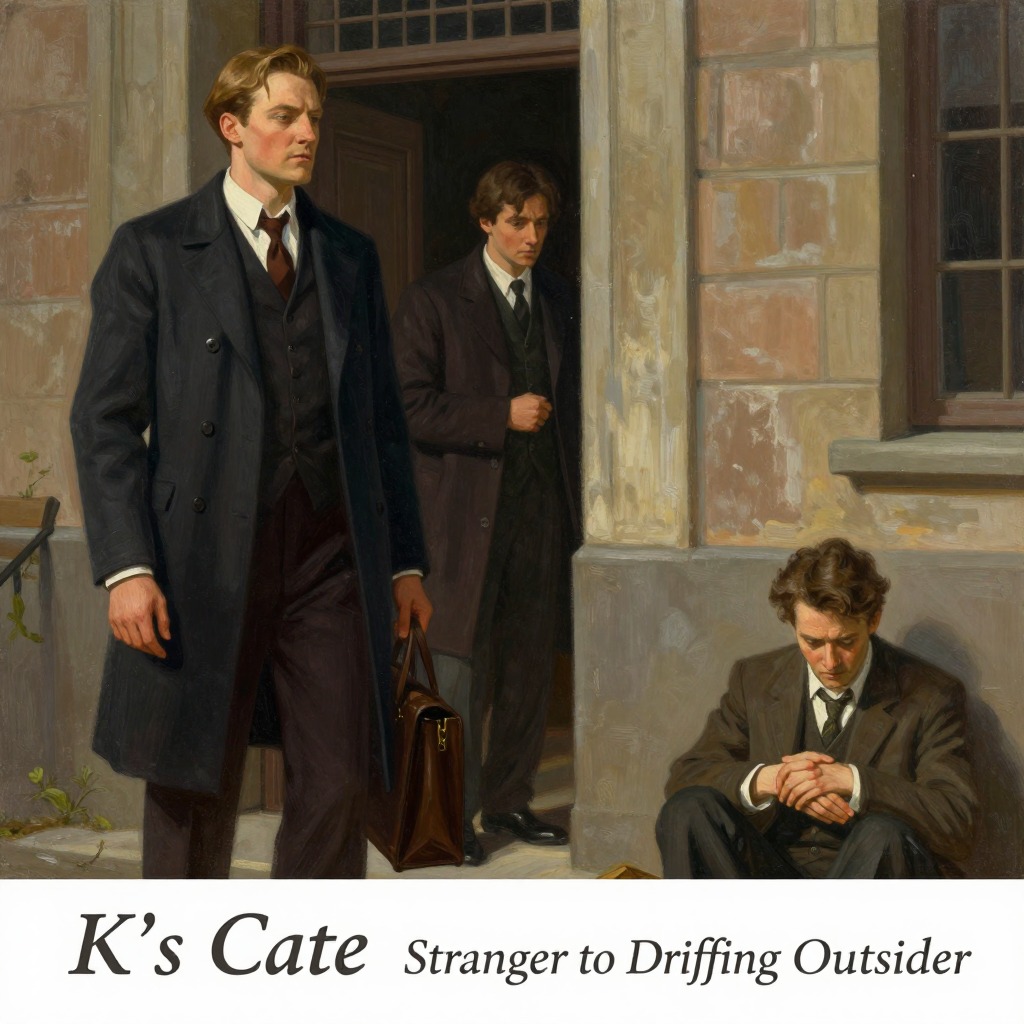
The CastleGerstäcker's house is the home of the carrier Gerstäcker and his mother, a place that emerges only in the final chapter of the novel as a potential refuge for K. after his expulsion from the Castle Inn. It is a dwelling marked by poverty, illness, and a stark functionalism, a world away from the bureaucratic corridors of the castle and the social spaces of the village inns. The house serves as the setting for the novel's concluding scene, where K., having lost Frieda and his position as school janitor, is led there by Gerstäcker with the offer of work and lodging, suggesting a possible, though deeply uncertain, new beginning for the land surveyor.
Setting and Appearance
The house is first described as a living-room only dimly lit by the fire on the hearth and a single candle-end. This sparse illumination reveals a space of poverty and simplicity, a stark contrast to the electric lights and crowded rooms of the Castle Inn. The room is dominated by a niche under the sloping rafters, where Gerstäcker's mother sits stooped, reading a book by the candle's light. The atmosphere is one of quiet, almost oppressive stillness, broken only by the crackling of the fire and the labored breathing of its inhabitants. This is not a place of hospitality or comfort, but a functional shelter for those who are worn down by life, a fitting final destination for K. in his exhausted state.
The Inhabitants
The house is occupied by Gerstäcker and his mother. Gerstäcker, the carrier, is a man defined by his physical ailments and his persistent, almost desperate, pursuit of his own interests. He is first seen as a sickly figure, stooped and limping, with a red face and a woollen scarf wrapped tightly around his neck, a man who seems as feeble as the little horse that pulls his sleigh. His mother is even more frail, speaking with difficulty and extending a trembling hand to K. She is a figure of quiet endurance, reading in her niche, seemingly detached from the world. The house is thus a place of physical decline, mirroring the exhaustion that has overtaken K. by the novel's end.
K.'s Arrival and the Offer of Refuge
K. is brought to the house by Gerstäcker, who has been waiting for him all day. Gerstäcker's motives are not purely charitable; he needs K.'s help with his horses, but more importantly, he hopes K. can use his supposed influence with the castle official Erlanger to help him secure a permit for his work as a carrier. This transactional nature of the offer is made explicit when Gerstäcker admits, 'Why else would I be interested in you?' The house thus becomes the site of a final, pragmatic bargain, where K.'s dwindling status is still seen as a potential asset. K., weary and with nowhere else to go, accepts Gerstäcker's arm and lets himself be led away through the darkness, leaving the reader with a sense of an uncertain future within these dim walls.
Narrative Significance
The house serves as the novel's final setting, a place of anti-climax and quiet resignation. It stands in stark opposition to the castle, which K. has spent the entire novel trying to reach. The castle is a place of power, inaccessibility, and bureaucratic mystery, while Gerstäcker's house is a place of poverty, illness, and simple, immediate needs. K.'s journey from the castle's threshold to this humble dwelling represents a profound descent, a final acceptance of his failure to penetrate the higher authority. The house is not a place of resolution but of suspension, where K.'s story ends not with a triumph or a defeat, but with a weary, uncertain pause, leaving his ultimate fate unresolved.