Letter from Klamm
The CastleThe Letter from Klamm is the first tangible link between K. and the castle, a document that both confirms his appointment as land surveyor and immediately undermines it. Delivered by the messenger Barnabas in the inn's saloon bar, the letter is signed with an illegible signature but printed beside it the words 'Chief Executive, Office X.' It addresses K. as 'Dear Sir,' states that he is 'taken into the count's service,' and names the village mayor as his immediate superior, who will communicate all details of work and remuneration. The letter also promises that Klamm himself will 'keep an eye' on K., and that Barnabas will make enquiries from time to time. This mixture of personal attention and bureaucratic distance sets the tone for K.'s entire struggle with the castle's authority.
Content and Contradictions
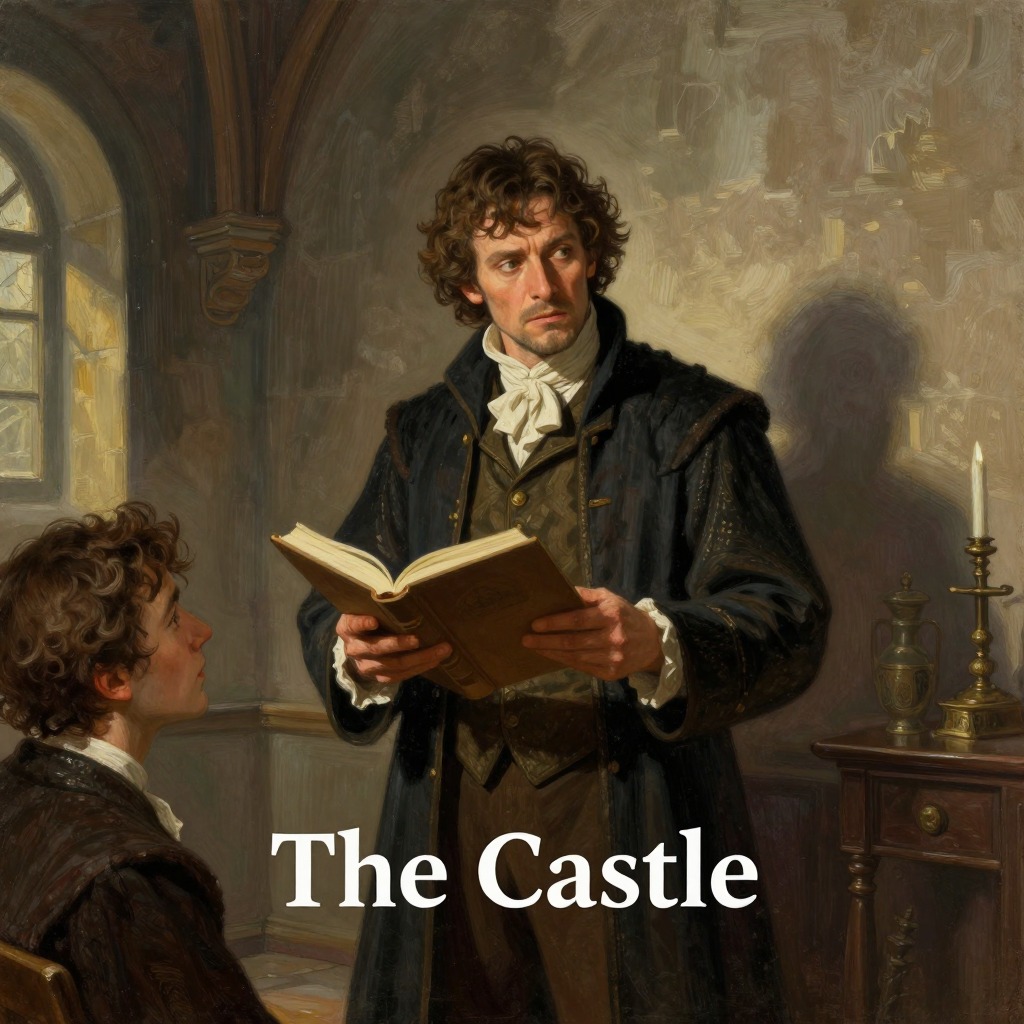
The letter's text is deceptively simple: 'Dear Sir, you are, as you know, taken into the count's service. Your immediate superior is the village mayor as chairman of the parish council, who will communicate to you all further details concerning your work and your remuneration, and to whom you will be answerable. Nonetheless, I will keep an eye on you myself. Barnabas, the messenger who brings this letter, will make enquiries of you from time to time, find out what your requirements are, and impart them to me. I am anxious to have contented workers.' K. immediately perceives the letter's internal contradictions: passages that treat him as a free agent whose autonomy is recognized, and others that address him as a common labourer, hardly worthy of notice. The phrase 'as you know' implies a prior agreement that K. never made, and the letter's reference to 'service,' 'superior,' 'work,' and 'answerable' all point to a status far below what K. had hoped for. K. reads the letter repeatedly by candlelight in his attic room, and decides that the contradictions are intentional, offering him a choice: to be a village worker with only the appearance of a link to the castle, or to accept the letter's terms and work entirely within the village's orbit.
The Mayor's Interpretation
When K. presents the letter to the village mayor, the mayor offers a devastating reinterpretation. He declares that the letter is 'not an official communication at all, but a private letter,' pointing to the salutation 'Dear Sir' as evidence. He notes that it contains no word about K.'s acceptance as a land surveyor, only general terms about service to the castle, and that the burden of proof lies on K. The mayor concludes that the letter 'means nothing but that Klamm personally intends to concern himself with you should you be accepted into the service of the castle.' This interpretation reduces the letter to 'the signature on a blank sheet of paper,' as K. bitterly observes. The mayor's wife Mizzi, who reads the letter with him, clasps her hands and says 'From Klamm,' but the mayor's analysis strips the document of its apparent authority, turning it into a private, non-binding gesture.
K.'s Response and the Second Letter
Despite the mayor's dismissal, K. treats the letter as a real, if ambiguous, foundation for his actions. He hangs it on a nail in his room, replacing a picture, and later takes it with him when he leaves the inn. The letter's promise of Klamm's personal attention fuels K.'s persistent attempts to gain an interview with Klamm, attempts that lead him to the Castle Inn, to the sleigh in the yard, and finally to the secretary Momus's questioning. When K. refuses to answer Momus's questions, he is later handed a second letter from Klamm, which praises his 'surveys' and the work of his assistants, and assures him that 'the matter of your remuneration will be decided very soon.' K. immediately recognizes this second letter as based on a misunderstanding—he has done no surveys at all—and it deepens his sense of being manipulated. The second letter, like the first, is delivered by Barnabas, and K. uses it as an occasion to send a message back to Klamm, requesting a personal interview.
Significance
The Letter from Klamm is a masterstroke of bureaucratic ambiguity. It simultaneously grants K. a foothold in the village and denies him any real standing. Its private, non-official nature, as exposed by the mayor, means that K. can never rely on it as a legal document, yet its very existence keeps his hopes alive. The letter's contradictions—between personal attention and institutional distance, between acceptance and dismissal—mirror the castle's overall strategy of keeping K. in a state of uncertainty. K.'s decision to hang the letter on his wall and to carry it with him shows how much he invests in this fragile token of recognition, even as he suspects it is a trap. The letter thus becomes a symbol of the castle's power to control through ambiguity, and of K.'s stubborn refusal to abandon the hope it represents.