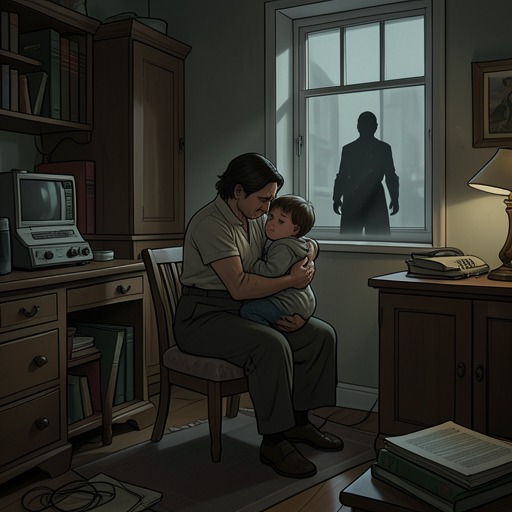
“No one is watching the baby”
The Changeling“No one is watching the baby” is Alice’s concise reading of a moment in Outside Over There, but the phrase acquires force from the gap between the story Apollo Kagwa remembers and the childhood he later learns to describe. It begins as an observation about a fictional baby left exposed to goblins; in the conversation around it, the image points toward Apollo’s own experience of being left alone. The words do not resolve that history. They make its absence of protection newly visible.
The phrase in Apollo’s recollection
Apollo introduces the book while speaking with a group gathered in the aftermath of loss. He says his father used to read to him when he was a baby, then recites the story from its opening, “When Papa was away at sea,” through the point where Ida turns her back on the baby and goblins in purple cloaks sneak through an open window. Apollo identifies the book as Maurice Sendak’s Outside Over There, distinguishing it from the more familiar Where the Wild Things Are. His choice to recall this particular passage gives the conversation a story about a child left unwatched at its center.
Alice responds by asking why Apollo’s father read him a book that sounds frightening, then names what she hears in the scene: “No one is watching the baby.” The sentence is direct and concrete. Its immediate subject is the baby in the book, but the question of who is watching—and what may happen when no one is—reaches beyond the passage Apollo has recited. The story’s goblins are not merely frightening figures; they enter at the moment a caregiver’s attention is turned elsewhere.
A childhood exposed by the story
The phrase resonates with an account Lillian later gives Apollo of leaving him at home when he was four. Faced with a Saturday work demand from Charles Blackwood and unable to find anyone to care for him, she finally went in for a half day. Before leaving, she arranged food and drink in the living room: milk and water in sippy cups, toast with peanut butter, popcorn, and, she thinks, grapes. Apollo was potty-trained, but disliked the overnight diaper she put on him and kept taking it off. Lillian left two plastic buckets by the couch instead.
She also turned on the television. Apollo stopped paying attention to her once she found his shows, and he kissed her before she shut the front door and locked it. Lillian remembers kissing his head repeatedly. The preparations show care being improvised under pressure, but they do not change the central fact: a four-year-old was left by himself in a locked home while his mother went to work. In the context of Alice’s sentence, the food, buckets, and television become measures of how much an adult can arrange around a child’s absence of supervision—and how little those arrangements can substitute for a watcher.
When Lillian came home, Apollo was asleep on the couch. The popcorn, milk, one of the waters, and grapes were gone; the peanut-butter toast lay facedown on the carpet; one bucket contained urine; and the television was showing American Bandstand. He had made it through the half day, and Lillian remembers feeling relieved. The next Saturday, with no one available to care for him again, she repeated the arrangement. When she returned to find things much as they had been before, the improvised solution hardened into a routine: she worked half days on Saturdays, believing that this would satisfy Blackwood and telling herself Apollo was self-sufficient.
Repetition, fear, and belated recognition
That apparent success did not last without consequence. Lillian says Apollo began waking from nightmares, screaming that his father was at the front door and had come to get him, only to leave him behind. Her account connects the image of a child without a dependable watcher to a repeated fear of abandonment. It does not establish that the book passage caused the nightmares; instead, the two scenes illuminate one another. A story about an unattended baby enters Apollo’s memory alongside a childhood in which he was in fact left alone, and alongside his fear that his father would come close enough to be imagined at the door but still depart.
The wording also gains significance through the difference between the two tellings. As a child, Apollo had been told he could watch television until Lillian came back, and he had kissed her goodbye. As an adult, he recalls a book in which a baby’s danger begins when its protector turns away. Lillian’s later account supplies the domestic particulars Apollo could not have understood in the same way at four: the employer’s pressure, the failed search for childcare, the locked door, and the repeated Saturday departures. The phrase condenses the child’s exposure without erasing the adult circumstances that led to it.
The group’s silence and the phrase’s reach
After Alice says, “No one is watching the baby,” the room becomes still. Apollo considers the implication; the others sit with their own sadness, and the gathering settles into silence and prayer. The pause gives Alice’s observation the character of recognition rather than explanation. No one turns it into a diagnosis or resolves the history in that moment. Its effect is to let a sentence about a scene in a children’s book touch the group’s present grief and Apollo’s remembered childhood at once.
The expression therefore works on two scales. Within Outside Over There, it identifies the vulnerability that allows the goblins to approach. In Apollo’s conversation, it becomes a lens through which neglect, parental absence, and the limits of improvised care can be seen together. The phrase does not claim that every unattended child will suffer the same outcome, nor does it make Lillian’s difficult decision simple. Its force lies in the plainness of the question it leaves behind: when a child is alone, practical arrangements may keep the hours moving, but they cannot make someone present.