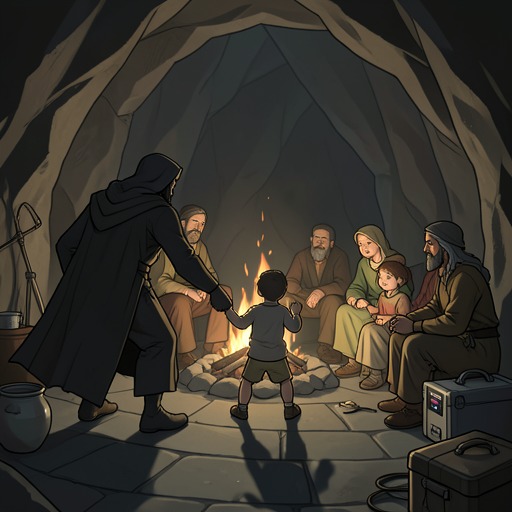
Agnes Knudsdatter is abandoned in the cave
The ChangelingAgnes Knudsdatter is abandoned in a cave by her father, Nils Knudsen, to satisfy a bargain with a troll. Recounted by Jorgen Knudsen to Apollo Kagwa, the event turns an inherited family pact into a specific act of parental betrayal, while the landscape around Queens borough supplies the hiding places that let the bargain endure.
Causes and Setting
Jorgen places the sacrifice within Nils’s migration from Norway. Nils wanted to bring his wife, Anna Sofie, with him, but doubted that the small sloop planned by the Quaker migrants would safely carry his family. He brought the troll as what Jorgen calls insurance, at a price: Nils would serve as its caretaker and appease it. The arrangement followed the family across the ocean rather than ending with the journey.
Nils, Anna Sofie, and Petra Mikkelsdatter remained in Queens borough while the other Sloopers traveled farther upstate. At first the area was farmland, with thousands of acres of forest and green space. Jorgen explains that such terrain resembled the troll’s natural habitat, and that the later park’s hills and pockets still held caves where something large could hide. He also frames the land on a much longer timescale: the Laurentide ice sheet once covered the region beneath ice a thousand feet thick. The city’s apparently settled ground thus carries traces of geological change as well as the older, wooded landscape in which the family’s bargain took root.
The Abandonment
The pact demanded a child. When Nils could no longer delay fulfilling it, he took his daughter Agnes into the woods and delivered her to the creature’s cave. Jorgen’s account makes the act deliberate: Nils was not separated from Agnes by accident or by the journey from Norway, but acted as the troll’s caretaker by handing over his own child.
The story is told retrospectively, as Jorgen explains the family’s past to Apollo. Its immediate force comes from the collision between an abstract account of migration and the concrete consequence of the bargain: a father carries his daughter into the woods and leaves her in a cave. Apollo’s attention shifts from Jorgen’s explanation to a sketch of the abandoned baby, and he looks away, overwhelmed by what the account entails.
Consequences and Uncertainty
The sacrifice also helps explain the family’s recurring history of children given to the troll. In Jorgen’s den, a sequence of portraits runs along the wall like a timeline: sketches and charcoal drawings give way to daguerreotypes, black-and-white photographs, and early color images. Every subject is an infant, and none is older than a year. The images turn the story of Agnes from an isolated atrocity into part of a pattern preserved across generations.
Jorgen says the bargain was difficult because asking a mother to surrender her child proved unbearable for Anna Sofie. She broke down, went into the woods to look for Agnes, and never came out. Apollo suggests that she might have found her daughter and fled, but Jorgen refuses to confirm that hopeful possibility. The account leaves both women’s fates unresolved: Agnes is known to have been abandoned, while Anna Sofie disappears searching for her.
Narrative Significance
The episode reveals that the Knudsen family’s apparent connection to the troll rests on an inherited arrangement maintained through the sacrifice of children. Jorgen presents the bargain as practical insurance against a dangerous crossing, but its cost exposes the violence concealed inside that language of protection. The cave is both a real hiding place in a landscape of forests and hills and the point at which family history becomes an act of abandonment. By placing Agnes’s story beside the succession of infant portraits, the narrative makes the past not a single tale told once, but a repetition whose consequences remain visible to Apollo.