Apollo Kagwa
The ChangelingApollo Kagwa’s life is shaped by a father who vanished, a name his family deliberately changed, and the family he later struggles to protect. A rare-book dealer by vocation, he becomes a husband and father whose search for Emma Valentine leads him back through grief and inherited violence. His eventual vision of raising his son does not promise an easy future; it makes the ordinary difficulties of parenthood feel precious precisely because they remain possible.
Identity and Background
Apollo is the son of Lillian Kagwa and Brian West. When Brian West disappeared, Apollo was four. Years later, Lillian told her son that she had once dreamed of his father leaving, and that they had named the child Brian after his missing grandfather. The family’s naming thus preserves a connection to the very absence that shaped Apollo’s childhood.
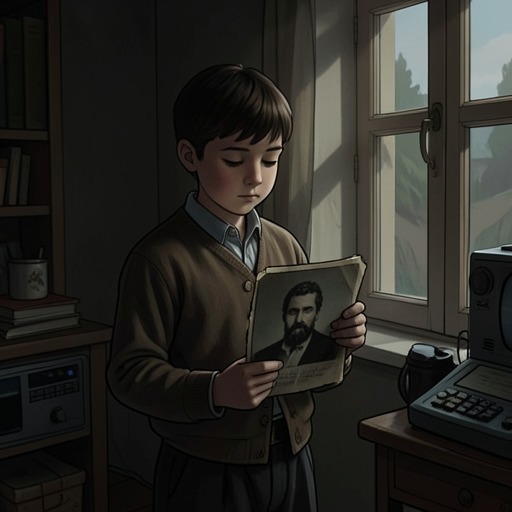
In the fall of 1989, when Apollo was twelve and attending IS 237 in Flushing, Lillian had reverted to her maiden name. Apollo became a Kagwa by legal decree as well. The change was an act of erasure: mother and son removed West from their names and lives. After eight years, neither spoke of Brian West or expected to make him a subject of conversation again. Then Apollo received a message from him, accompanied by a gift. Apollo carried a box inside and opened it, an unexpected return of the past to a household that had tried to leave it behind.
Books and the Shape of His Working Life
Apollo’s interest in books takes precedence over conventional academic achievement. As a senior at John Bowne High School, he earned mostly Bs and Cs; although teachers recognized his intelligence and capacity for study, his real enthusiasm was already his business. He might have gone to college, but his attention had settled elsewhere.
At nineteen, he moved out of Lillian’s apartment and into a studio in Jackson Heights. Books crowded the small space so thoroughly that there was hardly room for a twin bed. He crossed the country on book hunts, examining frontispieces and margins; he sometimes paused to see the sights or date a woman, but those diversions did not displace his work for long. His first great discovery in the field came at thirty-four. The details provided about his early career emphasize not a planned professional ladder but a sustained appetite: he had found his calling early, and built his adult life around it.
His work also gives his story a recurring practice of looking closely. Apollo makes a living attending to what books contain and what their traces can reveal. That habit of searching takes on a more personal meaning when the people he loves become absent or unreachable: he must learn to pursue human truths that cannot be settled by examining an object.
Family, Fatherhood, and Fear
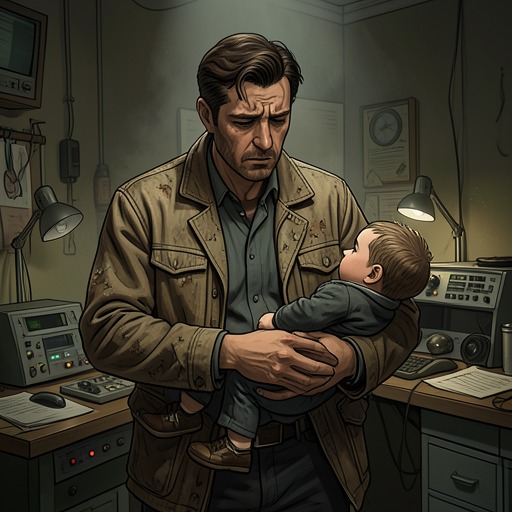
Apollo’s relationship with Emma begins in the basement book-sale nook of a library. After he asked her to dinner and she declined, he returned on successive Fridays to the sales. In time, she gave him her name: Emma Valentine. Their son, Brian Kagwa, was born during a stalled train ride. When Emma’s water broke, the baby arrived quickly, and Apollo caught him before he touched the floor. The scene places Apollo in the immediate role of protector and father, an experience sharply different from his own early history of paternal absence.
That responsibility later becomes entangled with fear. After months of distance from Emma, Apollo wakes restrained in his own kitchen. His first urgent concern is not himself but Emma and Brian: Emma has gone out, and he fears for the boy who remains. The episode reveals the depth of his attachment even when his marriage has become strained. He also recognizes that he has locked Emma out, a fact that complicates any simple picture of himself as the family’s protector.
In time, Apollo’s fear becomes a crisis that carries him beyond his home. Released from Rikers Island after two months, he does not go home. He instead goes to the Fort Washington branch of the New York Public Library with a shotgun and takes three of Emma’s co-workers hostage, demanding to know where she has gone and refusing to accept that they do not know. The standoff lasts six and a half hours. The co-workers decline to press charges and testify on his behalf, but Apollo has nevertheless crossed into an act that endangers others. On his release, he has not told Lillian he is coming and has not spoken to Patrice Green since his imprisonment. His sense that only four human beings remain in his inner circle gives his freedom a desolate cast.
The Search for Emma and the Past
The discovery that Emma is alive changes the direction of Apollo’s search. William Wheeler offers to help him find her, while warning that the women around him will protect their own rather than assist. Apollo does not simply accept William’s account as a solution. After four months without identifying himself with Emma, he calls himself her husband and says he belongs to her; the declaration surprises him and leaves him trembling. It marks a change in how he speaks of their bond, not proof that their estrangement has been repaired.
Apollo’s search also brings him to the grave he has avoided confronting. At Nassau Knolls Cemetery in Port Washington, he finally feels ready to learn who is buried there. At dawn, he opens the gravesite and sees his child for the first time in four months. The act is at once an encounter with loss and a refusal to let uncertainty stand in for knowledge.
In another confrontation, Apollo turns toward Jorgen Knudsen with a utility knife in hand, aware of his impulse to use it. He stops to look again at pictures of the children who were victims. Their varied faces interrupt the immediate pull of revenge and widen his attention from a personal struggle to the lives of those harmed. Later, among bones at the cave, he decides that one skull belonged to Agnes Knudsdatter, the first abandoned child in Queens. Apollo’s naming of her gives an individual identity to remains that might otherwise stay anonymous, while connecting his search for his own child to a longer history of children lost or abandoned.
Recognition, Reunion, and Ending
Apollo finds Emma and tells her he has been searching for her. Their reunion does not erase the intervening months; it makes the distance between them part of what they must face. As they descend through the levels of the amphitheater, Apollo feels her attention and wants to tell her about Brian West. He understands his father’s attempt to kill him as a memory, and sets it beside the violence of Kinder Garten, who believed that horrific acts could be expressions of love. Apollo asks himself how Brian West could have held onto the belief that he was a good father, and how Apollo himself had justified becoming impatient and cruel toward Emma. The parallel forces him to examine not only what was done to him, but what he might repeat.
When Apollo and Emma reach their son inside a sack, they dig with their hands rather than risk injuring him with a knife. The shared rescue makes their care immediate and practical: both parents work to reach Brian. Apollo then imagines the years ahead in deliberately unideal terms. He sees toilet training, interrupted nights, hidden vegetables, kindergarten, difficult homework, fights, stolen money, and the day Brian may call his father a failure. He welcomes even these anticipated trials. His hope is not that fatherhood will prove him flawless, but that he and Emma will be there to meet the ordinary demands of raising their child.
Apollo’s arc therefore turns on the difficult difference between wanting to protect a family and being able to care for one without repeating harm. His own father’s disappearance and remembered violence remain active in his understanding of himself; they do not automatically dictate his future. The novel’s closing possibility is modest and hard-won: Apollo can imagine a life in which he and Emma raise Brian together, with all its fatigue and conflict still ahead. His gratitude rests not on a fantasy of safety, but on the chance that the family’s story can continue.