Apollo Kagwa and Emma Valentine
The ChangelingApollo Kagwa and Emma Valentine’s relationship is a marriage and a shared practice of parenthood, strained by exhaustion, financial limits, and a devastating breach of trust. Its late reconciliation does not erase what they have done to one another or what they have lost: it begins with mutual recognition, becomes physical closeness, and finds its clearest promise in the ordinary years they hope to share with Brian Kagwa.
Marriage Under the Pressures of New Parenthood
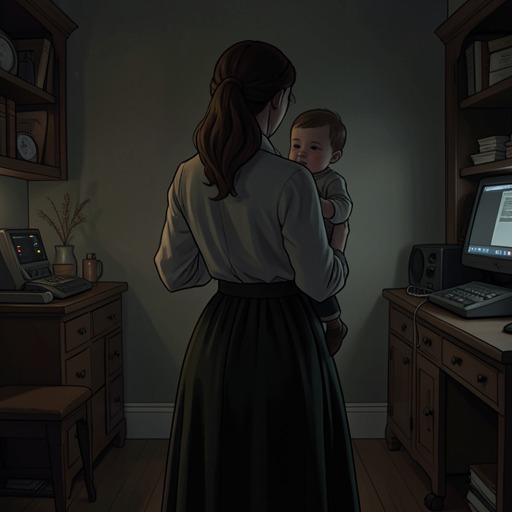
After Brian’s birth, the couple’s household has to be reorganized around a newborn and limited means. Apollo surveys the former lounge, now intended as Brian’s room, and imagines the crib, dresser, toys, and supplies they still need. Emma has made a list, but her job has been reduced to half-time, with the possibility of losing it altogether; they have postponed purchases while deciding what is essential. Apollo’s wish to give his son more sits beside the practical uncertainty they face together.
The immediate work of caring for Brian is exhausting and emotionally exposed. When Apollo returns home, Emma is crying as she tries to get the baby to latch. Kim Valentine takes Brian so that he can be checked, while Lillian Kagwa comforts Emma and tells her she had faced the same difficulty with Apollo. The scene places care within a network of family support, but it also shows the parents’ vulnerability: the arrival of their child brings love and purpose without making the labor or anxiety disappear.
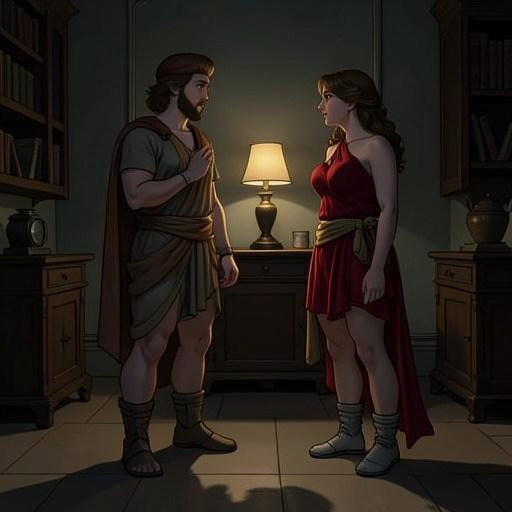
Their family life is later shadowed by a sharper injury. In the cave, Emma recalls Apollo’s last words to her before their separation: “You’re what’s wrong with our family,” followed by the instruction to take another pill. She says that this was the first time he took her light from her. Her account ties the rupture not simply to disagreement but to the pain of being treated as the problem when she was struggling. Apollo does not answer with a counterclaim; he lowers his head as she speaks.
Reunion and the Work of Acknowledgment
When they meet again in the cave, Emma has stayed awake through the night to protect Brian. She explains that she never sleeps and keeps watch so he will be safe. Apollo wants to comfort her, but the scene makes clear that tenderness cannot substitute for hearing what she says. Her exhaustion and vigilance are part of the cost she has borne while caring for their child.
The apology that follows is brief and direct. After caring for Emma, Apollo tells her, “I should’ve believed you.” Emma answers, “I wouldn’t have believed you either,” acknowledging that the failure of trust could have run in either direction. The exchange does not make their earlier hurt disappear; instead, it gives each of them room to recognize how difficult belief might have been from the other’s position. Apollo then tells her, “We’re together now.” Emma nods and meets his gaze, turning the statement into a shared, if tentative, present rather than a claim that everything has already been repaired.
Their reconciliation is also expressed through touch. Emma lets Apollo see her, and they make love after a long period without even kissing. Their renewed intimacy is playful as well as passionate: Emma wrestles him for position, bumps her forehead against his chin, and laughs with him. The return of laughter matters alongside desire. For a short while, they can be together without the cave’s danger or their estrangement defining every movement between them.
Brian and the Future They Choose to Imagine
That intimacy remains a reprieve, not an escape from the immediate danger. Apollo and Emma find Brian inside the troll after it has swallowed him whole; they tear open the creature’s belly sack with their hands because Apollo fears a knife might strike their son. Brian is still alive and wriggling when they pull him out. The rescue makes their common purpose concrete: the child whose care has tested their marriage is also the person they have joined forces to save.
Afterward, Apollo imagines the difficult future of raising Brian: potty training, nights without diapers, coaxing him to eat vegetables and go to kindergarten, helping with homework, cleaning him up after a fight, and facing the day he judges his father a failure. The vision includes fatigue, conflict, and the possibility of disappointment, not just milestones to celebrate. Apollo is grateful for all of it because those ordinary troubles mean that Brian has a future and that he and Emma may share in it. The scene makes family less an ideal of perfect harmony than an ongoing commitment to care for a child through the mundane, frustrating years as well as the extraordinary crisis.
At the bus stop, Emma leans into Apollo while they watch Brian. Apollo whispers, “And they lived happily ever after.” Emma revises the fairy-tale ending: “Today,” she says, and “And they lived happily today.” The qualification is central to their renewed understanding. Their happiness is real, but the story does not present it as a permanent cure for grief, conflict, or uncertainty. When Apollo asks whether today is enough, Emma answers, “That’s everything, my love.” The ending locates their bond in the present they have recovered together, rather than in a guarantee that no further hardship will come.
Care, Trust, and the Meaning of Family
The relationship’s course links intimate partnership to the practical work of parenting. Before the cave, limited income and the demands of infant care shape the couple’s daily life; later, Emma’s sleepless watch and Apollo’s care for her reveal how much strain they have carried apart. Their reunion depends on acknowledging that strain instead of assuming that love or marriage alone has resolved it. Apollo’s apology and Emma’s reciprocal admission make reconciliation an act of listening as well as affection.
Brian’s rescue and the future Apollo imagines also bind the couple through shared responsibility. Their family is not defined only by biological ties or by the fairy-tale promise of a happy ending: it is made visible in feeding a newborn, keeping watch, risking themselves to save him, and anticipating the long labor of raising him. By ending with Emma’s insistence on happiness today, the novel grants their renewed closeness emotional weight without converting it into certainty. They are together, their son is alive, and the future is open to them one day at a time.