Apollo leaves college to pursue rare-book dealing
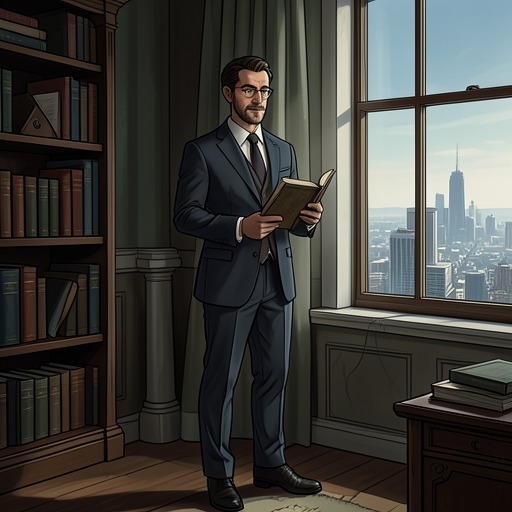
The ChangelingApollo Kagwa’s decision not to attend Queens College in 1995 turned an adolescent bookselling enterprise into his chosen vocation. A mentor’s gift, Confessions of a Literary Archaeologist, gave him a model for imagining rare-book collecting as a life’s work; Apollo recognized himself in that possibility and chose the uncertain trade over the college place he had earned.
The Business Before the Decision
Apollo’s commitment to books preceded the choice. At John Bowne High School, where he was a senior, his grades were consistently ordinary: Bs and Cs, much as they had been since ninth grade. Teachers could see that he had intelligence and could study, but his strongest enthusiasm was elsewhere. By seventeen, he had made Improbabilia a thriving concern, known to rare- and used-book dealers in Queens, Manhattan, and the Bronx.
His approach brought him into shops as a young Black teenager carrying a heavy pack and introducing himself as Apollo. He would call dealers in advance, presenting his visit as a courteous call from a fellow bookseller. He tried to sell weathered magazines, including The Connoisseur and Highlights. His mixture of entrepreneurial confidence and inexperience could disarm established dealers, some of whom became mentors rather than simply prospective buyers. They taught him how to value books, navigate estate sales, and choose places to sell at antique shows. The trade was already giving him an education, though not one awarded through a school.
Carlton Lake’s Example
Apollo had been accepted to Queens College in 1995. In the summer before classes were due to begin, one of the dealers who had mentored him gave him a graduation present: Carlton Lake’s Confessions of a Literary Archaeologist. Lake’s account traced his development as a collector of rare books, manuscripts, music scores, and letters from the Napoleonic era. His collection became famous, but the book also described the earlier formation of his taste: reading widely, browsing secondhand bookstores, and beginning to collect with financial help from an indulgent grandmother.
Lake’s account offered Apollo more than a success story. It showed a collecting life taking shape through close attention to books and the discovery of something hidden in one. Lake recounts buying a copy of Baudelaire’s Les Fleurs du Mal at a New York auction and finding the poet’s own corrections in its margins. He called the discovery an illumination; it marked the moment he understood himself as a literary archaeologist and a book man. For Apollo, the anecdote made the trade legible as a calling rather than merely a way to make money.
The contrast between Lake’s circumstances and Apollo’s sharpened the identification. Lake had a grandmother to bankroll his purchases; Apollo did not. He also knew that his knowledge was incomplete: at that point, he did not yet know the difference between Baudelaire and Beatrix Potter. But neither the lack of family financing nor the limits of his expertise persuaded him that the vocation was closed to him. Reading Lake, he concluded that he would not be attending Queens College in the fall. The decision was an act of commitment made before he possessed either Lake’s resources or his accomplishments.
A Vocation Tested Over Time
The choice did not produce an immediate equivalent of Lake’s celebrated discovery. Apollo had found his direction early, but his first major find in the field came when he was thirty-four. At nineteen he had moved out of Lillian Kagwa’s apartment and settled in a Jackson Heights studio so crowded with books that a twin bed barely fit. He traveled across the country on book hunts. Other parts of life could interrupt the work—he sometimes took in the sights or dated—but, after those diversions, he returned to books.
His breakthrough came at a basement estate sale in a Bronx apartment building. The books were packed into forty-two containers, ranging from sneaker boxes to an orange milk crate. The collection belonged to the D’Agostinos, a couple who had died within months of each other. Their four children and eleven grandchildren found the books unsettling, while Apollo recognized a remarkable collection of works on magic and the occult. A snapshot of the couple tucked into a grimoire made the domestic evidence of their lives sit strangely beside the books they had accumulated.
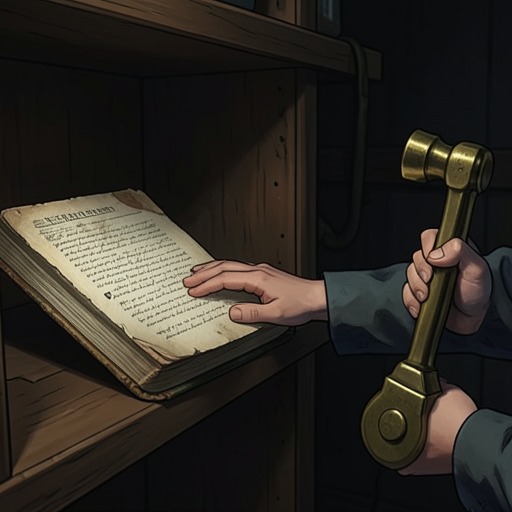
Apollo made a low offer and won the sale after being the first dealer willing to travel to the South Bronx. He rented a van that afternoon and brought the books home. Cataloguing them took a week. As he examined the collection, he noticed marginal notes in two different hands. In a third-edition folio of Witch Hunter Manual of the Blood Council, he found a 1945 postcard addressed to the D’Agostinos and signed by Aleister Crowley. The postcard transformed the cataloguing work into a discovery: the collection held a personal trace connecting its former owners to a famous occultist. The find did not occur when Apollo first chose the trade, but it gave that early choice a concrete, hard-won counterpart to Lake’s auction revelation.
Books as Work and as Evidence
Apollo’s later dealings show the different kinds of value his vocation taught him to recognize. When he showed Emma Valentine a true first edition of To Kill a Mockingbird, he pointed out its original cover and fine condition, estimating that it was worth five thousand dollars and might be worth at least twice as much after Harper Lee’s death. He also opened it to the title page, where Lee had signed the book to Pip, her childhood best friend, who had become a writer. The copy’s edition, condition, signature, and dedication made it at once a collectible and a record of a relationship.
Books also recur outside the marketplace, bearing traces that matter for reasons other than price. In another scene, Gretta says that a book has been ruined because someone wrote one thing across every page. Earlier, a collection of objects left at Apollo’s door included a children’s book among movie stubs, a photograph, a rental agreement, a hotel bill, food receipts, and a marriage certificate for Brian West and Lillian Kagwa. These objects are not evidence that every book in Apollo’s life is a collectible; rather, they show how a book can sit among records that expose personal histories. The distinction gives his profession a wider narrative resonance: he learned to inspect the physical evidence books contain, while the story repeatedly places books alongside the evidence of people’s lives.
Apollo’s refusal of college is therefore neither a rejection of learning nor an instant triumph. His training came through dealers, shop visits, estate sales, and the slow accumulation of judgment. Lake’s book supplied the example that helped him name what he was already doing; the years before his first great find show the delay between choosing a vocation and receiving its defining reward. Apollo’s path makes the decision consequential precisely because it begins with conviction, continues through practical labor, and is tested over time.