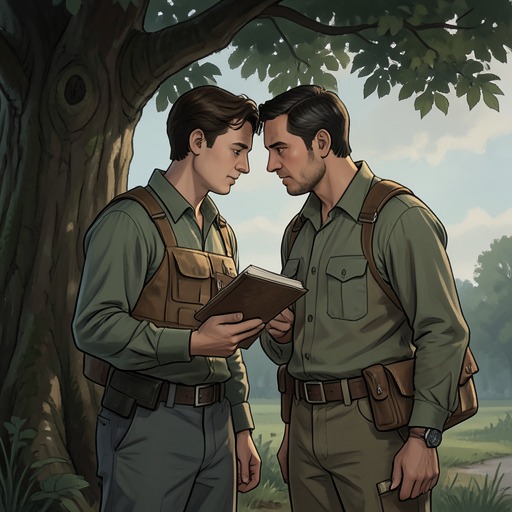
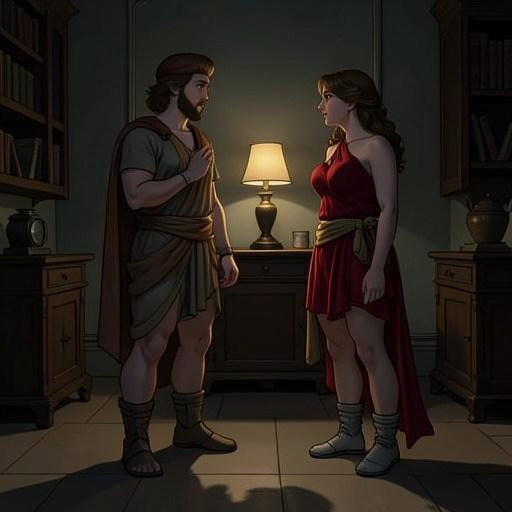
Apollo meets Emma Valentine
The ChangelingApollo meets Emma Valentine at the Fort Washington branch of the New York Public Library, where her composure in a small public confrontation becomes the first impression that draws him back. What begins as a stop at a basement book sale turns into a patient courtship: Apollo asks Emma to dinner, she declines, and he returns week after week until she gives him her name and, five months after their first meeting, agrees to a date.
Background and Setting
Apollo had come to Washington Heights for an estate sale that yielded nothing, then stopped at the Fort Washington branch. He was familiar with library sales as a modest but useful part of his rare-book business. Such sales offered worn books the branch meant to sell rather than recycle, alongside donations from local residents. They were not likely to produce a collection like the D’Agostino books, but a fifty-cent purchase might be resold for five dollars. Apollo valued the margin as practical business, even if he found little romance in it.
The books he sought there were often large-print crime novels, which he shipped to retirees who had found his website. The work recalled his earliest business model: selling People magazine to Mrs. Ortiz in apartment C23. This was a routine commercial stop, not an appointment arranged to meet anyone. The basement sale occupied a nook beside the reading room, and one librarian had to cover both the sale and the main desk. When Apollo arrived, she was helping a mother and two children choose picture books. The younger child repeatedly pulled books from the shelves and onto the floor, leaving the librarian to manage cleanup as well as the sale and desk.
The Visitor and Emma’s Response
A man called out from the reading room, his voice so loud in the quiet space that it seemed amplified: “Hello! Hello! I am in distress!” He was enormous, wore a bulky old backpack, and carried shopping bags crammed full in both hands. He announced that he urgently needed a toilet. Rather than yield to the volume of his appeal, the librarian asked why he was shouting; she pointed out that she could hear him without it.
The practical obstacle was that the bathroom key was kept behind the desk, and the librarian required identification before handing it over. The man had none. She opened a drawer and brought out a two-foot wooden ruler with a key attached to its end by a string. Using the ruler to indicate what she wanted, she told him to leave his bags with her and assured him he would come back for them. He resisted, clutching the bags close and saying, “These contain secrets.”
Emma did not escalate the exchange. She put the ruler away, closed the drawer, folded her arms, lifted her face to look directly at him, and waited. Apollo watched until the man set down the bags; the backpack followed only after he asked whether that too had to be left. Emma’s answer was simple: “All the bags.” She then gave him the key. His thanks, delivered softly, contrasted with his earlier shouting, and Emma answered warmly. The room listened as he fumbled with the key and opened the wooden bathroom door. When it shut, the people in the reading room seemed to emerge from the spell of the encounter. Emma had already moved on, returning to the mother and children, who bought four books for a dollar.
Apollo’s First Impression and Courtship
Apollo had been standing dumbstruck. He told Emma he had been about to help her with the man, then acknowledged that she had handled the situation herself. Her answer, “That’s my job,” made the division between them plain: Apollo had watched himself prepare to intervene, but Emma had already taken charge of the problem in front of her. The scene introduces her through action rather than explanation. She protects the order of the room, secures the visitor’s bags, and gets him the bathroom key without surrendering control of the encounter.
Apollo asked Emma to dinner as she rang up his three books. She politely declined. The refusal did not end his interest, and the regular schedule of the sale gave him a reason to return: it was held in the basement nook every Friday. He came back the following week, and then the week after that. Only eventually did Emma tell him her name. The progression is measured in repeated visits rather than an immediate change of heart; Apollo’s interest is clear, while Emma decides when to share even this first piece of personal information.
The First Date
Five months after they met, Emma finally agreed to go out with Apollo. Trying to impress her, he chose a small sushi restaurant on Thompson Street. They had to wait outside in late fall, in weather cold enough to make standing on the sidewalk feel like being inside a refrigerator. By the time they were seated, they were shivering, and they drank a bottle of hot sake before any food arrived.
The date also brought the first limited account of Emma’s family background. She said she had grown up in Boones Mill, Virginia, and had a sister, Kim Valentine, who was eleven years older. Her parents had died when Emma was five, but she would not say more about their deaths. The disclosure establishes both a loss in her childhood and a boundary around it: Apollo learns the fact, not the story behind it. In retrospect, the meeting’s defining pattern is already visible. Apollo returns and waits; Emma offers what she chooses, first her name and later a brief account of her past. Their relationship begins not with a grand declaration but with a practical encounter, a declined invitation, and the persistence of Friday visits.