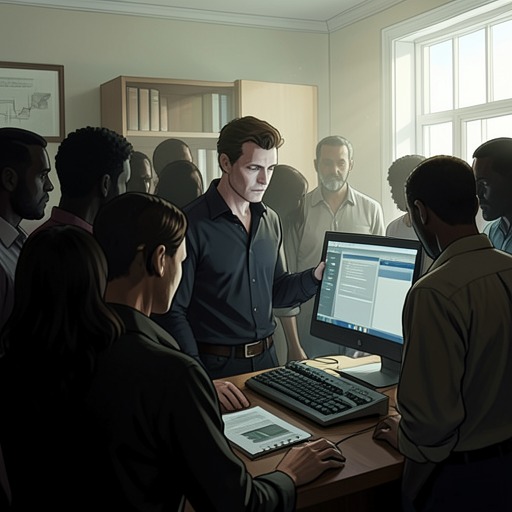
Apollo's incarceration at Rikers Island
The ChangelingApollo Kagwa’s incarceration on Rikers Island lasts only two months, but it becomes a period of suspension between the death of his son and a release he does not want. It follows his attempt to force information about Emma Valentine from her co-workers and ends with him returning to Washington Heights without a home he can yet face. The contrast between the prison’s tightly controlled routines and the obligations waiting outside shows how his punishment continues beyond the island.
Imprisonment and the hostage-taking
Apollo Kagwa is sent to Rikers Island after arriving at the Fort Washington branch of the New York Public Library with a semiautomatic shotgun and taking three of Emma Valentine’s co-workers hostage. He wants them to tell him where Emma has gone and refuses to accept that they do not know. The standoff lasts six and a half hours. The co-workers do not press charges and later testify on his behalf in court, but Apollo is nevertheless sentenced to two months on Rikers Island.
The arrest comes after a sequence of losses and displacements. Apollo has not been home since the morning Brian Kagwa died. A building superintendent finds him and calls paramedics; Apollo is taken to New York Presbyterian Hospital, where he remains through surgery to repair his eye. After leaving the hospital, he recovers at Lillian Kagwa’s home and meets with detectives and federal agents. By the time he returns to Washington Heights, Brian has been dead for three weeks. Rather than go back to his apartment, Apollo goes to the library with the weapon, turning his search for Emma into the act that leads to his imprisonment.
The discipline of prison life
Apollo later describes his time on Rikers Island as comparatively calm. He is held in Taylor, a unit populated mostly by short-term prisoners, and considers himself fortunate beside men with more difficult circumstances. Prison organizes his days through small rules and repeated procedures: he follows orders, wears his identification, keeps his shirt tucked into his pants, eats on schedule, and showers once a day. He never makes a phone call. By trying not to attract notice, he makes an impression on no one and prefers it that way.
This self-effacement is more than a practical way to avoid trouble. Apollo recalls that he felt no fear in prison because he had come to believe his heart had failed or been removed during his eye surgery. In his own understanding, he had died when Brian died; the person moving through the institution was little more than a body compelled to eat, shower, and obey. His emotional numbness makes the prison’s routine feel like a form of suspended animation, not a return to life.
Release and the continuing aftermath
Apollo’s release begins in a crowded holding area called a bullpen. He waits there for eleven hours with 149 other men while guards complete the procedures for release. The prisoners are packed so tightly that two faint where they stand. Apollo is processed and given his clothes and belongings in a brown paper bag. Four blue-and-white buses then carry the released men away; the other passengers greet the journey with the excitement of children going to camp, while Apollo is the only one who does not want to be released.
Before dawn, the bus drops its passengers at Queensboro Plaza. Each man receives an envelope with just enough money for a subway ride and a cup of coffee. The talk around Apollo turns to where newly released men might find sex workers, and one passenger recalls that they once waited at Twin Donut before moving to a spot on Twenty-seventh Street. Another remarks that things change and cannot be fought. The conversation and the passengers’ joking underline the return to ordinary social appetites that Apollo cannot share: as the bus crosses into Queens borough, his heart begins to beat louder, and the sensation of feeling alive seems unwelcome.
The familiar route makes the distance between release and home especially sharp. Apollo knows Queensboro Plaza and can estimate how long it will take to reach Washington Heights, but he has not told Lillian Kagwa he is coming and has not spoken to Patrice Green since going to jail. The story of Emma Valentine and Brian Kagwa has appeared in the news, where Brian is known as Baby Brian and Emma is described as having killed him and disappeared. Apollo thinks of his family as having become part of a horror story. He feels poisoned by grief and cannot yet return to the apartment. His release therefore restores his freedom of movement without restoring a place where he feels able to live.
Parole and the first day outside
At five-thirty in the morning, Apollo reaches Bennett Park without consciously deciding to go there. His body has fallen into the habit of visiting the park with Brian at that hour, and that routine carries him back to Washington Heights after months away. The gesture brings the lost relationship into the first hours of freedom: prison has interrupted the routine, but it has not erased the bodily habit formed around his son.
Apollo also has an appointment downtown at eleven. Later that day he reaches the Yorkville Branch of the New York Public Library, an elegant townhouse and city landmark, where a court-mandated meeting is being held in a basement room arranged with chairs in a circle. The meeting is presented as a vital aspect of his parole. Twelve people are present; Alice is the first to notice him and waves him toward the group. Apollo explains that he was released before sunrise, met his parole officer that afternoon after waiting two hours, and has come to the meeting on his first day out.
His parole officer had encouraged him to go home, shower, and rest. Apollo instead asks for help finding a meeting because he will do anything to avoid entering the apartment. The court’s requirement thus brings him into a room intended to support or supervise his return, while his immediate need is to remain away from the place associated with Brian’s death. When Alice asks why he took the hostages, the account records the question but not Apollo’s answer. The unresolved exchange leaves the reasons for his action under examination rather than converting incarceration into a completed passage back to ordinary life.