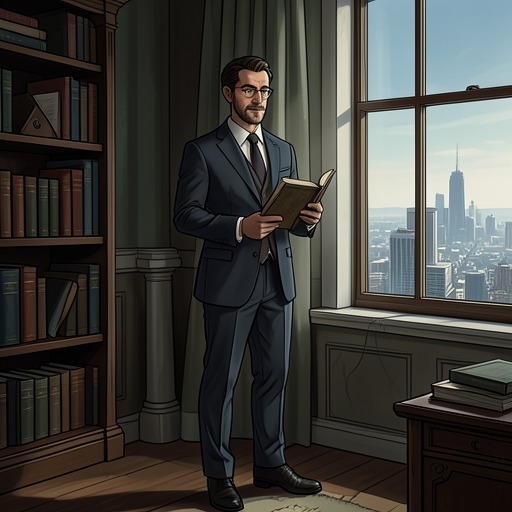
Apollo’s D’Agostino collection discovery
The ChangelingApollo Kagwa’s discovery of the D’Agostino collection began as a rare-book dealer’s windfall and became a reckoning with the life he wanted. In a Bronx basement, among forty-two containers of books, Apollo found a cache of occult volumes whose value was exceeded, for him, by what their traces revealed about the couple who had owned them. The collection’s most startling item—a postcard signed by Aleister Crowley—made the find potentially legendary. Its deeper significance emerged later, when Apollo recognized two distinct hands in the books’ margins and understood the collection as evidence of two people studying together over many years.
The estate sale and the collection
Estate sales offered Apollo both risk and surprise: a trip might yield water-damaged books in a garbage bag or, as at a townhouse in Sugar Hill, shelves of preserved first editions. He had pursued book dealing since early adulthood, living among books in a crowded Jackson Heights studio and traveling across the country on book hunts. Yet his first great discovery in the business did not come until he was thirty-four.
That discovery was at an estate sale in the basement of a Bronx apartment building. The books filled forty-two containers, ranging from sneaker boxes to an old orange milk crate salvaged from a supermarket. Among them were some of the rarest books on magic and the occult Apollo had encountered. Their former owners, Domenico and Eliana D’Agostino, had died within months of each other. The collection had unsettled their four children and eleven grandchildren, who were left with books that seemed far removed from the ordinary image suggested by the couple’s family snapshot.
Apollo found that photograph tucked into a grimoire. It showed an old couple whose homely appearance seemed incongruous with the volumes of sorcery surrounding it. That contrast almost made him laugh in front of the family. The collection’s unusual contents were not merely an amusing mismatch, however: they would become part of the evidence that the books had belonged to a shared intellectual life.
The sale and the postcard
Apollo made a low offer at the sale. Because he was the first dealer willing to travel to the South Bronx, he secured the collection. He rented a van that afternoon and brought the books home. Cataloging them and uploading information about the relevant volumes took a week, a practical stretch of work between the excitement of acquisition and the moment the collection’s most surprising item emerged.
While examining a third-edition folio of Witch Hunter Manual of the Blood Council, Apollo found a postcard addressed to the D’Agostinos. It had been stamped in 1945 and had not yellowed as much as he expected. Its sender’s name and signature were unmistakable: Aleister Crowley. A quick online search confirmed that Crowley had been a celebrated occultist in the early twentieth century, notorious for his reputation and controversial pursuits. The postcard’s brief, bawdy note, followed by a personal expression of remembrance, connected the couple’s private collection to a figure whose name alone could make the find extraordinary.
The card changed Apollo’s estimate of the haul. The books had already made it his best find; if the postcard could be authenticated, the collection might become legendary. Apollo thought of the contrast between Carlton Lake’s discovery of Baudelaire’s corrected texts and his own prize: an irreverent postcard from Crowley. He read it again, laughed, and lifted it as if to share the joke. Only then did he register that he was alone in his living room.
A discovery that changes meaning
The postcard was a potentially valuable object, but the collection’s significance shifted when Apollo looked again at the books themselves. He scanned the card and considered the couple’s apparent adventures in occultism. In the margins, he had found notes in two different kinds of handwriting. Those marks suggested that both spouses had read and studied the books, leaving comments that answered or accompanied one another. The volumes could thus be understood not only as merchandise or as a startling collection, but as the surviving record of an ongoing conversation between two people.
That recognition sharpened the contrast at the heart of the discovery. Apollo had acquired a rare and perhaps exceptionally valuable collection, but its evidence of companionship also made his own isolation newly visible. No one was there when he found the postcard; no one shared the joke or the excitement of the possible authentication. His feeling moved from surprise at the find to a strong sense of loneliness.
At three in the morning, in his one-bedroom apartment and surrounded by a small library of occult texts, thirty-four-year-old Apollo realized that his biological clock had started. The D’Agostinos’ books had first appeared to him as an excellent payday, then as the record of a couple’s shared life. In bringing that shared life into focus, the collection also made Apollo confront his own desire for a life beyond solitary work. The discovery’s decisive consequence was therefore not just a new prize in his business: it changed what he saw when he looked at the books, and what he understood about himself.