Brian Kagwa
The ChangelingBrian Kagwa’s story turns on a terrible distinction between the child his parents believe they have lost and the son they eventually find alive. Born to Apollo Kagwa and Emma Valentine on a train, he is named for Apollo’s vanished father. In infancy he becomes the focus of ordinary parental care and imagined futures; later, his disappearance and rescue make him the center of a supernatural deception that leaves his family grieving before they can be reunited.
Birth and Name
Emma Valentine gives birth on a train after her water breaks. Apollo Kagwa catches the baby before he reaches the floor. In the brief interval before Emma can hold him, Apollo unbuttons his shirt and holds his son against his skin, watching him take his first breaths. The scene establishes Brian first through a father’s attention: he is a small, newly arrived person whom Apollo watches closely, even as the birth leaves him momentarily alone with the child.
Apollo asks whether they can call the boy Brian. The name belongs to Brian West, Apollo’s own father, who disappeared when Apollo was four. Apollo later tells his son that he had nightmares about that departure and that he heard nothing from Brian West until he was twelve, when a box appeared at the family’s door. The name therefore connects the newborn to a history of absence before he can know anything about it. Emma agrees to the name, and Apollo greets the baby with happiness. He considers a middle name after they return home, but Emma rejects his suggestion of Cowboy; the evidence does not establish what middle name they ultimately choose.
The baby arrives on a Friday night. Emergency medical technicians reach the family twenty-two minutes after Apollo and Emma first meet him, and Emma and Brian spend two days under observation at Harlem Hospital. Apollo remains in a chair beside Emma for both nights, then helps bring mother and child home by taxi on Monday. These first days place the new family’s intimacy alongside the practical vulnerability of caring for a newborn.
Infancy and Family Life
At home, Brian sleeps in a Moses basket in his parents’ bedroom. The room that had served as the couple’s lounge is expected to become his room, though money constrains what they can buy: Emma’s work has been reduced to half time, and she may lose the job. Their first supplies are limited to essentials, including the basket, newborn diapers, sleepers, washcloths, and baby wash. Apollo looks at the room and wants to give his son more than they can yet afford, a desire that makes Brian’s arrival both a source of joy and a new measure of the family’s economic insecurity.
The early weeks also require help. Emma struggles to get Brian to latch and tries to conceal her frustration when Kim Valentine and Lillian Kagwa arrive with groceries and prepared meals. Kim takes Brian so a midwife can check him and his aunt can hold him; Lillian comforts Emma and recalls having the same difficulty when Apollo was a baby, without her own mother beside her. Brian’s care thus draws three generations of women into the immediate work of supporting the exhausted new parents.
When Emma’s leave from work is nearly over, Apollo takes Brian with him to an estate sale in Riverdale. Patrice Green has alerted him to the sale, and Apollo cannot postpone the trip because the family needs his income. Emma cries as she leaves for work, not because she distrusts Apollo but because leaving her baby so soon feels unbearable, while losing her salary is not an option. Apollo rents a Honda Odyssey, surrounds Brian’s rear-facing car seat with pillows, and drives so slowly that a journey expected to take twenty minutes takes nearly an hour. At the house, he straps Brian into a carrier and talks of hunting for books. The episode gives Brian no independent action beyond his infant attention to the bright sky and moving tree branches, but it shows how fully Apollo has adapted his working life around keeping his son close and safe.
Apollo also speaks to Brian about the family history attached to his name. While the baby lies on a blanket during tummy time, Apollo tells him about Brian West’s disappearance and the box left at the door years later. He describes the box as a time capsule containing objects tied to his father and grandmother’s past. Brian cannot yet understand the account, but Apollo’s decision to tell it makes the baby a listener to a story of paternal absence that Apollo himself is still trying to interpret.
Loss and the False Child
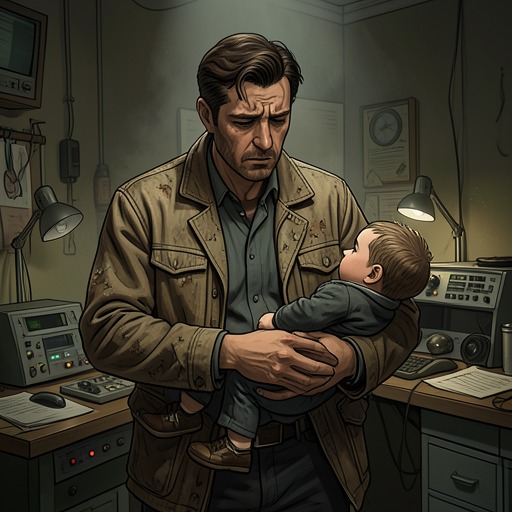
The first six months of Brian’s life become the measure by which Apollo understands what has been taken from him. After Emma says that the child in their home is not a baby, Apollo’s immediate fear turns toward his family: he remembers Emma and Brian together and worries about the boy’s safety. The infant’s cries from the back room sound to him like the cries of a newborn, although Brian is six months old. Apollo’s alarm is not simply for himself; the scene makes his attachment to his son the force that survives his terror and pain.
Apollo later describes recovery as the question of whether he can regain what he has lost: a son, a wife he thought he knew, and a marriage. He spends two months at Rikers Island and leaves reluctantly, still confronting the loss of his family. His grief enters ordinary possibilities he had expected to share with Brian. Seeing a schoolhouse that also serves as a library, he imagines watching his child in class, attending parent-teacher conferences, and helping with homework. These routine acts, once easy to take for granted, have become luxuries he fears he will never experience.
The public remembrance of Brian magnifies Apollo’s private loss. Patrice shows him a Facebook page dedicated to the baby, with sixteen thousand fans and a photograph used in news reports. Apollo recognizes it as a picture he had posted from the basement of the family’s Riverdale home and wonders how it spread from his personal page to the press and then to the tribute page. Brian’s image circulates widely, but that public attention cannot tell Apollo whether his son is truly dead. Cal urges him to see the grave for himself before he tries to help Emma, who has maintained that Brian is alive and believes she has narrowed down where he is: the forest.
At the grave, Apollo opens the small white casket after breaking through its sectional liner. For the first time in four months, he sees what he believes to be his child. But the bundle he lifts is not Brian: it is a mass of tangled hair or fur, roughly the size of a six-month-old. The discovery overturns the apparent certainty of the burial. The body in the grave has given Apollo a concrete object to mourn, yet its exposure reveals that the child he named and raised was not there. The search shifts from accepting Brian’s death to finding the living child Emma insists is somewhere in the forest.
Captivity and Rescue
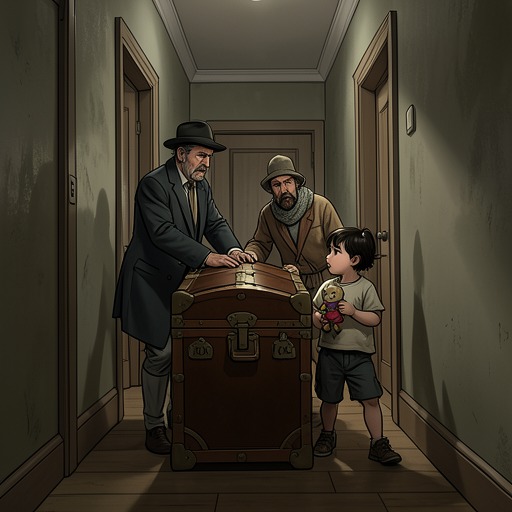
Apollo’s uncertainty persists when he and Emma reach the cave. He asks whether Brian is still inside, unable to ask aloud whether the boy is alive. Emma answers with the certainty of a mother. Before entering the cave, Apollo also calls Lillian: he fears that he and Emma may not return and does not want to disappear without saying goodbye to his mother. His decision places the search for Brian within the same family history of missing fathers that shaped the child’s name, but this time Apollo goes toward the danger rather than leaving his son behind.
In the cave, Apollo and Emma find a small body lying on its side inside a storage box. They hear regular breathing. Emma lifts the child from a makeshift bed of dead leaves and dirt, and Brian wakes. Though he appears to be six months old, he is ten months old: he has survived months of captivity while his parents believed him lost. The gap between his apparent age and his actual age makes the lost months legible in his body without giving him a voice to account for them.
The Troll swallows Brian, but Apollo and Emma find him alive inside it and pull him free. The rescue establishes the literal force of the description that Brian is the only child ever born twice: first on the train, then brought back into the world from the Troll. Daylight reaches the creature and turns it to stone, ending the immediate threat. Apollo lingers by the stones, connecting the end of the monster to his own childhood haunting by fatherlessness.
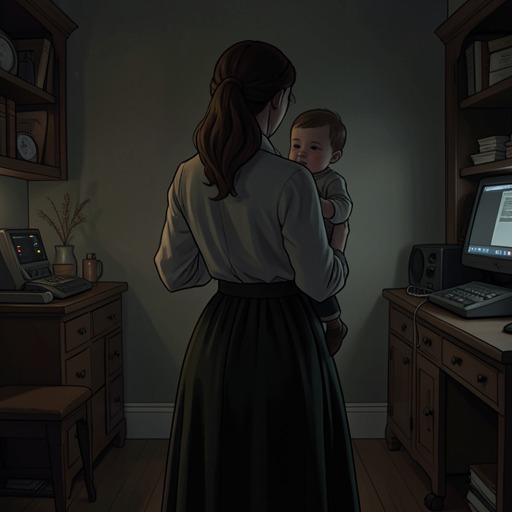
When Apollo finds Emma again, she carries Brian inside a large coat taken from Jorgen’s house. At ten months old, Brian looks up at the bare tree canopy without appearing frightened or wounded. His eyes follow the branches, and he seems to respond to birds. His parents do not speak to him or to each other as they leave the woods; the reunion is conveyed through their careful movement with him and his return to the daylight. At a park bathroom, Apollo and Emma wash the mud from Brian’s hair and face. The story ends this part of his life not with an explanation from the child, but with his parents tending to him again.
Narrative Significance
Brian’s importance lies in the way his birth and recovery transform Apollo’s inherited story of absence. Apollo names his son after a father who disappeared, then finds himself forced to confront the possibility that Brian has vanished too. His early care for the baby—holding him close, carrying him on a bookselling trip, and speaking to him about the family past—makes the later loss intimate rather than abstract. The mundane future Apollo imagines at the schoolhouse shows what the separation threatens: not only Brian’s life, but the ordinary years of parenthood that Apollo hoped to share with him.
The distinction between the false child and the real Brian also makes appearances unreliable. A child seems to be present in Apollo and Emma’s home, and a child seems to lie in the grave; neither fact proves that their son is there. Brian’s survival depends on Emma’s refusal to accept the death as final and on Apollo’s willingness to test what he has been told by going to the grave and then into the forest. His rescue restores the family’s physical closeness, but the evidence ends with Brian as an infant newly returned from captivity, not with an account of what he will later remember. His significance rests in that reunion and in the future it makes possible, rather than in any knowledge he can yet express.