Digital surveillance and privacy
The ChangelingDigital surveillance and privacy are joined in the novel through a troubling reversal: the devices and practices meant to record family life, communicate, and find people can also make private homes accessible to strangers. A photograph of Apollo Kagwa and Brian Kagwa prompts Emma Valentine to wonder who is watching them; later, Kinder Garten makes clear that networked devices can turn ordinary domestic routines into material for remote observation and commercial sale.
Everyday sharing and the exposed family
The danger first appears through photographs. While Emma is at work, Apollo sends her an image of himself and Brian Kagwa in the driveway of a large house. Apollo is loading or unloading bags from a rented minivan while the baby lies on a blanket, looking up at the trees. Emma is too busy at the library to examine the image closely. Only later, walking home, does she remember it and wonder who took the photograph. When she searches her phone, the image has disappeared from her texts, downloads, and gallery, as if its sender had retrieved it. The unexplained disappearance makes the photograph feel less like a family snapshot than a trace of an observer whose presence cannot be confirmed.
A later text sharpens the threat. Emma has received a photograph of Apollo and Brian in a Zipcar, with Brian secured in a car seat while the vehicle appears to be stopped at a red light. The picture was taken through the passenger-side window, close enough to suggest that someone had approached the baby. Apollo discovers Emma’s phone in the garbage and demands to know why it is there. She explains what she received; he responds by insisting that the child be called by his name, Brian. The exchange links digital intrusion to a domestic conflict, while Apollo’s insistence on Brian’s name underscores the personal reality obscured by the camera’s impersonal view.
The device as a threshold
Jorgen Knudsen gives the surveillance threat a folkloric image. He compares a computer or phone to a home, arguing that people inhabit their devices and that the devices therefore become homes of their own. In folktales, a vampire cannot cross a threshold without an invitation; physical doors and latched windows can be shut, but technology, Jorgen argues, has no equivalent locked entrance. His analogy makes digital access seem like a breach of domestic boundaries, not merely the collection of information at a distance.
Jorgen points to the details people willingly share: the playgrounds they visit with their children and when they go there, the fact that they have hired a babysitter, and photographs of their children’s schools. The problem is not only that information exists online, but that its audience is uncertain. Parents may share out of pride and affection without knowing who can see what they disclose or what those disclosures could enable. Jorgen turns that vulnerability against Apollo, portraying the new father’s habit of documenting a child’s life as a trail that a predator might follow. His accusation is cruel and self-serving, but the story later reveals a concrete basis for its warning: a watcher can exploit household technologies without the occupants understanding that they have admitted him.
From household computer to remote camera
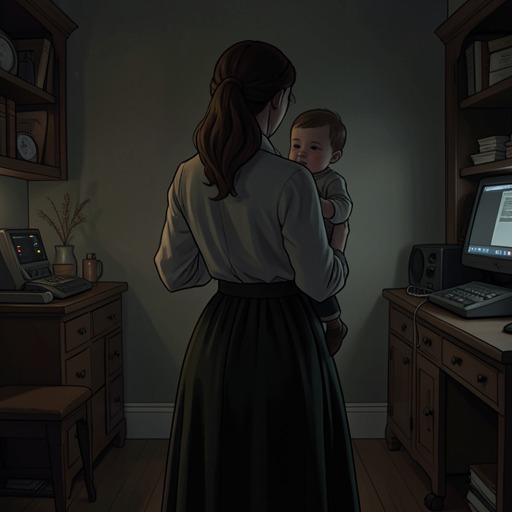
In the basement where Apollo and Emma find Kinder Garten, the domestic and technological dimensions of the threat converge. The room contains an office chair, computer desk, and computer system exactly like the setup Patrice Green built in his basement apartment. Beside the monitors, an iPad displays a photograph of an infant cradled in a man’s hands. Kinder Garten, seated at the rig with headphones on, is watching a family in Charleston, South Carolina: a father, two grandparents, and two teenage girls moving through a kitchen as they prepare breakfast.
The camera’s perspective is close to counter height, yet the family appears unaware of it. The grandfather approaches the lens and looks into it without apparent concern, then types slowly while occasionally glancing up. Apollo recognizes the explanation: Kinder Garten has turned the family’s own laptop into the camera. The scene makes surveillance frightening precisely because it does not require a conspicuous hidden device. The apparent observer is embedded in an object the family uses itself, and the family’s unawareness persists even when one member looks directly at the lens.
Apollo then realizes Kinder Garten may have used the same method to observe him, Dana, and Patrice Green in Patrice’s basement. While they watched footage of Emma’s escape, Kinder Garten may have been watching them through the computer system. The possibility alters the meaning of their earlier access to the video: their attempt to see Emma could have placed them within someone else’s field of view. Kinder Garten’s headphones further isolate him from the people entering the basement. His station functions as a private viewing environment in which he can observe without hearing or acknowledging those who are physically nearby.
Surveillance as a collective business
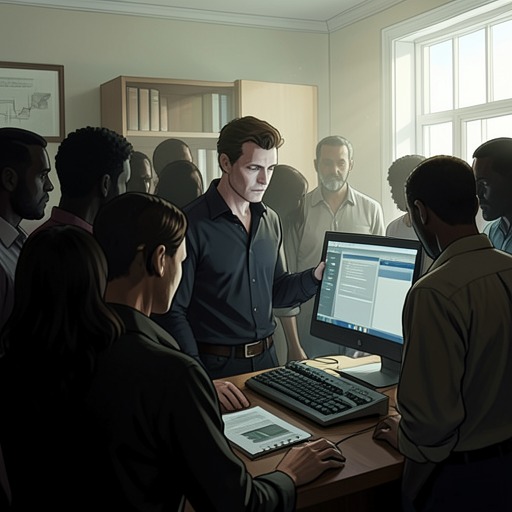
The monitors reveal that Kinder Garten’s operation extends beyond one watcher. Other screens display groups of smaller windows, each showing a man seated at a computer with headphones and a microphone. Together, the men watch the Charleston family’s kitchen. Their arrangement resembles a group gathered for online entertainment, but the activity is the invasion of a real household. The contrast between the casual appearance of remote companionship and the people being watched exposes how easily intimate life can be reframed as spectacle.
Kinder Garten explains that he has monetized what his father did without payment. The Knudsen men’s pact promised prosperity in exchange for sacrifice, but Kinder Garten claims that his father received no blessing because he failed to make the proper sacrifice. Kinder Garten presents charging viewers as a way to turn the inherited arrangement into a source of income. He advertises access through specialized online forums, offers monthly subscriptions to view the camera, and hopes eventually to take payment in bitcoin because it would be harder to trace. He says that the people watching see everything and know no act within the monitored space. The secret surveillance is thus organized as a paid service rather than a single private obsession.
His account also exposes the commercial logic of the operation. Kinder Garten calls the watched subject a beta test and says he hopes word will spread. He has only one camera in the space he is discussing because he could not risk staying there long enough to install more; he imagines upgrading to a 35-millimeter full-frame CMOS sensor for full-HD video. The technical specifications and subscription plans give the intrusion a businesslike surface, while his reference to viewers waiting for a finale makes the family’s exposure part of an anticipated entertainment product. Privacy is not merely violated; the violation is packaged and sold.
The double use of networks
The novel does not present networked communication as harmful in every circumstance. When Apollo cannot find Emma, William Wheeler explains that a hundred people using a hundred computers across the country can search as much ground as a group and keep working day and night. He has asked trusted friends to help. The same broad capacity for connection that lets strangers watch a family can therefore be directed toward finding someone who is missing. The contrast is not between technology and its absence, but between purposes, access, and control: one network helps Apollo search, while Kinder Garten’s network converts unseen access into surveillance and profit.
Across these episodes, privacy depends on more than whether a device is physically inside a home. A phone carries images beyond the moment and place in which they were made; a laptop can be repurposed as a camera; shared family details can make children and routines legible to an unknown audience. The threat remains difficult to grasp because the watcher may be absent from the room, hidden within familiar equipment, or concealed among an online crowd. By turning domestic technology into both a means of connection and an instrument of intrusion, the novel makes the home’s digital threshold as consequential as its physical doors and windows.