Doctor’s Cottage
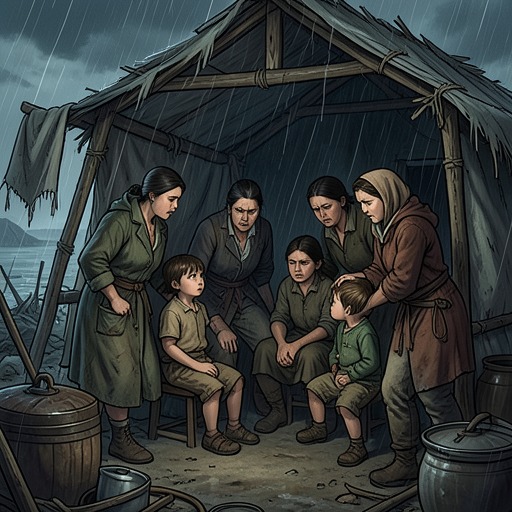
The ChangelingDoctor’s Cottage is a communal building on North Brother Island, associated with the settlement’s food-growing work and daily care of children. It is presented both as a practical interior—with coolers, tables, and a makeshift supply of utensils—and as part of a fragile community whose ordinary routines are abruptly broken by an attack. Apollo’s visit to the cottage brings those aspects together: as he struggles to absorb a revelation about Agnes, he tries to feed Gayl, and later the building is destroyed in the explosions that strike the island.
Place in the Island Community
Doctor’s Cottage is connected to the island’s collective way of life. During recess in the courtyard, Apollo sees children playing while a small group of women emerge from the cottage carrying work tools and gardening equipment, with burlap sacks over their shoulders. Cal explains that a benefit of establishing the community on the island is being able to grow its own food, comparing the arrangement to a kibbutz in the middle of the East River waters. The movement between cottage and courtyard suggests a shared working environment: the building is not only shelter but also part of the settlement’s practical support for communal life.
The presence of children gives the place a particular emotional charge for Apollo. After listening to the noisy, varied activity in the courtyard, he is overcome by the sight and sound of the children. Cal, who says that becoming a mother made proximity to children enough to give her husband hives, steadies Apollo with an arm at his back. The cottage’s nearby role in the island’s daily activity therefore sits beside a deeper contrast: the community tends children as part of ordinary life, while the surrounding story is marked by threats to children and by histories of parental loss and abandonment.
The Dining Room and Apollo’s Care for Gayl
Apollo reaches the Doctor’s Cottage with Gayl after Gretta Wheeler tells him that her daughter’s name, Agnes, appears on every page of the book. The discovery reframes his recent success: he had celebrated selling the book for seventy thousand dollars, but now believes he had been complicit in a crime against Gretta. He also confronts the possibility that the man who wrote Agnes’s name had killed her. The revelation leaves him so disoriented that he compares his state to dying, and he stumbles toward the cottage with Gayl without initially realizing where he is taking her.
Inside the dining room, Apollo turns to a simple act of care. The floor is covered with dirt and debris, and a row of coolers lines one wall. He searches them until he finds leftover macaroni and cheese in a Tupperware container. A cardboard box serves as the community’s utensil drawer, holding plastic forks, spoons, and knives alongside paper plates and cups. Apollo takes food and utensils to a table, sits down, and settles Gayl on his lap. Though still dazed by what he has learned, he can manage the familiar routine of offering a child food.
Gayl refuses the macaroni and cheese and slaps Apollo’s hand, spilling it onto the floor. The small interruption is significant because it keeps the scene grounded in a child’s immediate response rather than Apollo’s attempt to make sense of the revelation. The cottage offers no answer to the history attached to Agnes, and Apollo’s distress remains unresolved; nevertheless, for a moment, its dining room allows him to attempt a concrete responsibility toward a child in his care.
Destruction and Narrative Significance
The cottage’s communal function makes its destruction a direct blow to the island settlement. After Kinder Garten announces that Apollo will bear responsibility for what follows, explosions tear the Doctor’s Cottage apart. The Nurses’ Residence is hit soon afterward, and the blasts are heard as far away as Rikers Island, where prisoners later report hearing what sounded like bombs on the East River. Apollo runs back toward the courtyard, struggling to reconcile the destruction with the apparent impossibility of artillery fire. The damaged buildings and trembling ground make the attack undeniable even as its source remains difficult for him to comprehend.
Doctor’s Cottage thus moves in the narrative from a place associated with cultivation and care to one of the first structures visibly shattered by the assault. The sequence places the settlement’s ordinary labor—women carrying gardening tools and sacks, children playing in the courtyard, Apollo trying to feed Gayl—against the sudden violence that destroys its buildings. The contrast gives the cottage significance beyond its physical use: its destruction shows how quickly the island’s work of sustaining a community can be interrupted, and how the spaces where people care for children are exposed to the same danger as the rest of the settlement.