Emma Valentine
The ChangelingEmma Valentine is Apollo Kagwa’s wife and Brian Kagwa’s mother, but her story is not confined to those relationships: she is an orphan who leaves a small Virginia town to see the wider world, a librarian who carries books into an isolated community, and a mother who survives a crisis by acting without help. Her decisive change comes not when she becomes powerful enough to endure alone, but when she tells Apollo that survival has required her to do so and asks whether they can face what remains together.
Identity and Early Life
Emma grew up in Boones Mill, Virginia, and was five when both her parents died. Her sister, Kim, was eleven years older. Emma disclosed these facts to Apollo early in their relationship but said little more about the deaths, leaving the loss present in her history without making it a story she was ready to tell him in full. Later, Kim connected Emma’s experience as a bereaved child to her fear of losing the person she loved most.
Books and films helped Emma imagine a life beyond Boones Mill. She watched a Brazilian film in Portuguese with English subtitles and was drawn to the sound of the language. She persuaded Ms. Rook to order more Brazilian movies, including Bye Bye Brasil, Subway to the Stars, and Os Trapalhões e o Rei do Futebol. Ms. Rook eventually stopped buying tapes because one girl’s enthusiasm could not justify the expense, but the films had already enlarged Emma’s sense of possibility: she came to understand that the world extended far beyond her hometown and wanted to see it herself.
Emma and Apollo first met at the Friday book sales in a library basement nook. He asked her to dinner while she rang up three books; she politely declined. Apollo returned the next Friday, and then the Friday after that. Only after these repeated visits did Emma give him her name. Their courtship began through persistence and conversation rather than an immediate acceptance of his invitation.
When Apollo tried to impress her, he took her to a small sushi restaurant on Thompson Street. It was late fall, and they waited outside in the cold before being seated; they drank a bottle of hot sake before the food arrived. Emma told him about her upbringing and her older sister, while keeping the deaths of her parents at a distance. Her interest in Brazil soon became a concrete decision. She told Apollo she had bought a ticket to Salvador, in northern Brazil, and was leaving. Four weeks later, she departed.
Marriage and Motherhood
Emma eventually became Apollo’s wife. Their son, Brian, was born on a stalled A train: when Emma’s water broke, she responded with relief, and Apollo caught the baby before he touched the floor. The circumstances of Brian’s arrival placed Apollo directly in the act of receiving and protecting their child, a beginning that later stands in sharp contrast to the couple’s separation and their uncertainty about whether Brian is safe.
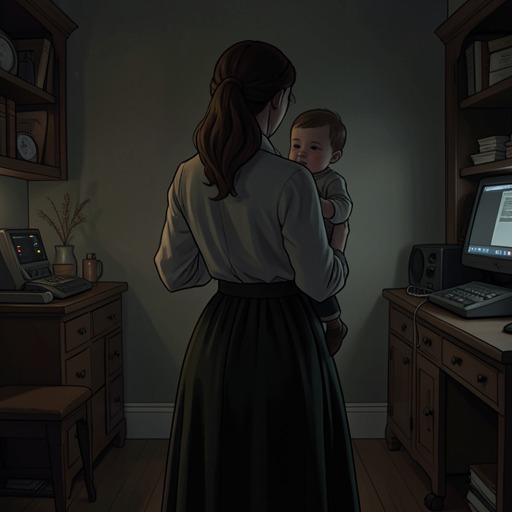
The early demands of motherhood strained Emma. In a conversation with Kim, Emma said that sometimes she looked at Brian and did not think he was her son. Kim answered by describing her as exhausted and having returned to work too soon. She also connected Emma’s fear to the loss of her own parents in childhood: having once been deprived of the people she loved, Emma could fear losing the person who mattered most to her. Kim’s response offers context for Emma’s distress without reducing it to a single cause or turning her fear into a settled judgment about her child.
The marriage reached a rupture when Emma struck Apollo with a claw hammer, seriously injuring him. She had been his wife for five years. The attack was followed by her insistence that Brian was not a baby, a statement that makes plain how radically her perception of their child had shifted. These actions frighten and injure Apollo, but the later account of Emma’s isolation changes how the crisis can be understood: her conduct belongs to a period of severe distress and danger, not to a simple story of a mother who has stopped caring for her child.
After the family crisis, Emma disappeared. When Fabian entered the bedroom, he found a broken window leading to the fire escape and an open security gate. The glass was on the sill and fire escape rather than inside the room, and a board was later installed to replace the broken window. Emma had escaped that way, although no one could explain how she had entered the locked apartment that morning without keys. The unexplained entry and escape leave her departure threaded with the book’s supernatural uncertainty as well as its practical consequences.
Separation and Life with the Wise Ones
For a time, Emma appears in Apollo’s experience as a ghost moving through lower Manhattan near Wall Street. People seem not to see her; they turn away or look at their phones as they pass. This image makes her separation visible as social erasure: she moves among crowds without being acknowledged. The description is Apollo’s encounter with her apparent haunting, not a complete account of where she has been or what has happened to her.
Emma is alive and has spent time with the Wise Ones on North Brother Island. She told one of them that Apollo would come, though that prediction was not believed. Her account also reveals a part of her life during the separation: she returned to New York at least once a week to stock the community’s library. She was shocked by how few books the women had and believed that a life without books was not fully lived. The children valued the books, though some of the women felt judged by Emma’s efforts. Her work as a librarian persists beyond her former life in the city, becoming a form of care in a community far from it.
On the island, Emma’s connection to Apollo is neither erased nor secure. She had spoken about him to the woman who later met him, but she had also survived without him. When Apollo arrives with another person, the woman gives him a second chance after taking the night to consider the situation, warning that another betrayal will not be forgiven. Emma’s account therefore reaches Apollo through the community she has joined: he must be admitted on terms set by people who have reason to protect their secluded life.
Reunion and the Rescue of Brian
Apollo’s return to Emma is preceded by a demand that he go to Brian’s grave and see it for himself before trying to help her. Cal insists that he needs certainty about his son and that he will be no use to Emma otherwise. This instruction makes the grave a necessary passage in Apollo’s search, but it also marks the stakes of Emma’s continued struggle: finding her requires him to confront what he believes has happened to Brian.
When Apollo finally sees Emma in the woods, she appears at the center of a violent, blue-lit storm. The weather and distance make the reunion feel nearly unreachable; Emma seems to wear the storm around her. Apollo whispers that he should have believed her. The scene presents recognition as more than simply finding his wife: he has to acknowledge that her account and the danger she faced were real, even when he could not understand them.
Emma guards the cave where Brian is being held. She says she never sleeps and keeps watch through the night to keep him safe. Her warning to Apollo that she will take him with her to hell if he is deceiving her shows how little trust the reunion has restored at first. Protection has become a continuous vigil, and even Apollo’s return does not immediately dissolve Emma’s suspicion or the burden she has carried.
At the final confrontation, Emma climbs onto the troll after discovering that it has swallowed Brian. She realizes that the danger has been hidden inside the creature rather than where she had been trying to find it. Apollo and Emma pull their son out, and Brian is still alive. Emma’s decisive action in that moment belongs to the same protective effort as her vigil at the cave: she responds to the new knowledge by moving toward the danger, not away from it.
Change and Narrative Significance
After Brian is rescued, Emma explains that she had been keeping him alive, keeping herself alive, and working against Jorgen Knudsen day and night. She rejects the idea that she succeeded because she possessed extraordinary power; she says, in effect, that she acted because there was no other choice and she had to do it alone. Her account restores the circumstances that had been obscured by Apollo’s distance and fear. What could look like invulnerability was instead the cost of having no one to share the work.
Emma does not treat reunion as an automatic return to the marriage as it was. She says that working alone was killing her and that she hopes she no longer has to do so. She offers the possibility that the two of them may be stronger together, but makes that future conditional on Apollo helping her. The request is both intimate and practical: she needs partnership in the ongoing work of keeping their family safe, not merely a declaration that the separation is over.
Her arc holds care and harm in the same frame. Emma’s actions toward Apollo have consequences, and her fear and isolation do not cancel them; equally, those actions do not erase her persistent efforts to protect Brian. The movement from the locked apartment and unexplained escape to the cave-side vigil, and then to the recovery of Brian, makes her a figure through whom the story tests what protection demands under extreme pressure. Her ending is not a claim that the damage has vanished. It is a cautious opening toward shared responsibility, built on Emma’s insistence that endurance should no longer be mistaken for a life she can or should carry alone.