Emma seeks chains to secure Brian’s room
The ChangelingEmma Valentine’s search for chains to reinforce Brian Kagwa’s room turns a private fear into a visible, shared task. The errand first looks strange to Kim Valentine: Emma carries a heavy bag through the neighborhood and around a playground, unwilling to explain herself. Only after Kim stays beside her does Emma disclose what she hopes the chains will do. The scene’s movement is from alarm and isolation toward practical sisterly support, without suggesting that the chains resolve the fear behind the request.
The contact and the bag
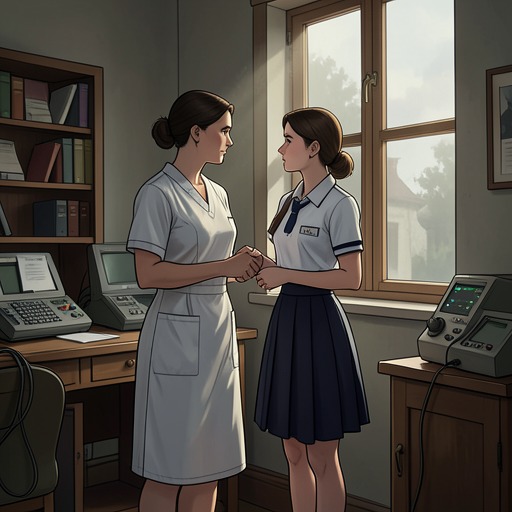
Emma has heard about a woman through a message board and says the woman was told she would come. When asked who sent her, Emma answers that Cal did. The woman opens the door shortly afterward. She appears much younger than Emma and Kim, but shares the exhaustion they associate with new mothers; her skin is sallow and her eyes are red. She passes a large tote through the doorway. Metal shifts and clinks inside. After a brief hope that the contents will be useful, the woman looks quickly at Kim and shuts the door.
Emma heads for the elevator, with Kim close behind. Kim suggests going up to Fort Tryon Park, but Emma refuses. Kim watches her clutch the bag in both hands and struggle with its weight. When Kim reaches for it and asks what is inside, she pulls it away and discovers chains. Emma does not answer the question. She takes the tote back, lifts it with a huff, and, tired of waiting for the elevator, goes for the stairs. The exchange gives Kim a concrete object to worry about, but no explanation yet: the chains are heavy, conspicuous, and plainly important to Emma.
The route through the playground
Kim follows her sister farther north, reasoning that a thirty-three-year-old woman hauling a bag of chains is not hard to spot. Emma goes into Jacob Javits Playground. Kim considers calling Apollo Kagwa, but cannot see how to describe Emma’s behavior without making it sound like an accusation. She loves her brother-in-law, yet she does not want to place herself between him and Emma. Since their parents died, Kim reflects, nobody has truly come between the sisters, and she is reluctant to break that pattern. She briefly tries to explain the chains away as something for new bicycles, remembering that there was also a U-lock in the bag, but cannot quite persuade herself.
The playground’s ordinary activity sharpens the contrast. Mothers push daughters on swings; a couple helps their son climb a jungle gym. An older girl spins herself in a tire swing while her grandmother watches from a nearby bench with a distracted, deeply tired air. Against this background, Emma walks the perimeter as if on sentry duty, carrying the bag. At times it strikes the ground and the chains rattle, an unsettling sound among the children. Kim reaches her, and they walk quietly together. Emma’s tension is so palpable that Kim’s back stiffens and her shoulders lock into a posture like her sister’s. Kim decides not to ask directly about the chains, the woman at the door, or the message board. Instead, she begins telling Emma a story about April 14, 1988, drawing on their shared past to approach what Emma has not yet said.
What the chains are meant to protect
The explanation arrives when Emma sits upright against Kim’s shoulder and points to the bag. Brian’s room is the one with the fire escape. It already has a security gate, but Emma says that it does not feel like enough. She wants to wrap the chains around it as well. The extra barrier, she admits, would simply make her feel better, and she is afraid Apollo will argue with her rather than agree to install it. The chains are therefore not presented as a measured solution to a demonstrated breach: their immediate purpose is to give Emma some sense of protection when the existing gate cannot reassure her.
Kim meets this admission with closeness rather than challenge. She squeezes Emma and proposes telling Apollo that the chains were ordered by a doctor; she will help put them on. Emma grins and calls her a good sister. Soon the two women rise, each taking one handle, and carry the heavy bag home together. Their shared grip makes the change in the scene tangible: what Emma had hauled alone becomes a burden the sisters carry side by side. Kim’s response does not require her to understand every part of Emma’s fear before offering help.
Fear, exhaustion, and support
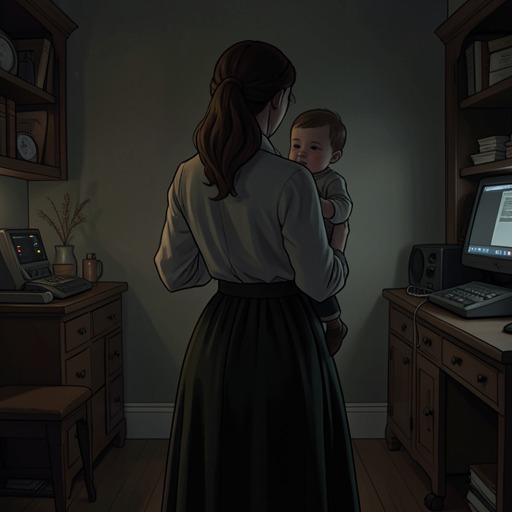
The scene places Emma’s vigilance beside evidence of her exhaustion and distress. Kim understands her sister as worn down: Emma returned to work too soon, and as a baby she lost both parents. Kim connects those circumstances to the possibility that Emma fears losing the person she loves most. Emma has also described a disturbing difference she senses in Brian, though he looks like the child she gave birth to; when she holds him with her eyes closed, she can almost feel that he is someone else. Her fear about the gate belongs to this larger uncertainty, but the scene does not establish that the chains can settle it.
Kim’s loyalty continues beyond the walk home. She suggests that Emma try Zoloft, an antidepressant, and supports her as Emma stops eating and loses six pounds in two weeks. Those later details show how little the act of carrying chains can contain: Emma’s need for protection is entangled with a serious strain that persists after the practical errand. The episode nonetheless marks a real, limited change. Kim does not call Apollo or force Emma to explain herself in the playground; she listens, accepts the stated need, and helps make the proposed safeguard possible. The chains remain a sign of alarm, but they also become the means by which the sisters express care without requiring fear to be argued away.